

Pioneer Investments -

Agency Mortgage-Backed Securities (MBS) Market

IAUM Article - 2026-03-17T090714.330

Market Commentary and Outlook | February 28, 2026

Agency MBS Maintained Stability in Volatile February
Agency MBS weathered broader risk-off sentiment better than most alternatives in February. Despite signs of economic resilience, investor anxiety over AI-driven disruption and shifting trade policies sparked a flight to quality, driving Treasury yields lower throughout the month. Domestic economic data was strong, with manufacturing surveys returning to expansionary territory for the first time since 2022, while nonfarm payrolls expanded by 130,000 and the unemployment rate declined to 4.3%, underscoring growth-supportive labor market stability. Inflationary signals, however, continued to complicate the Federal Reserve’s policy path. The headline Consumer Price Index showed signs of deceleration, but the Core Personal Consumption Expenditures Index, the Fed’s preferred inflation measure, firmed to a 3.0% rise on a year-over-year basis. Meanwhile, the Trump administration re-imposed tariffs using different mechanisms immediately after the Supreme Court invalidated those previously implemented. As a result of these upward price pressures, the expected Fed Funds rate at the end of 2026 rose despite Treasury rates falling in longer tenors. The broader macroeconomic outlook and investor focus was ultimately redefined on February 28 when the failure of bilateral nuclear negotiations culminated in joint US-Israeli military action against Iran, driving energy prices higher and ensuring that geopolitical instability will be the primary driver of financial market volatility for at least the near-term.

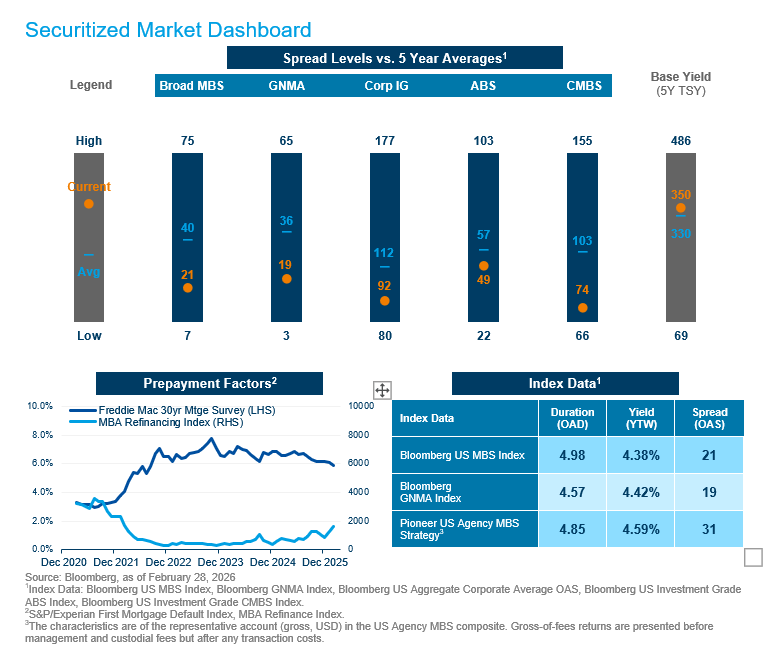
Through another month of broader market tumult, agency MBS performance remained relatively stable and range-bound, consistent with the market view we have espoused in prior months and we update in this issue. The Bloomberg US MBS Index gained 1.67% on the month, reflecting a -0.08% excess return to Treasuries. Sector option-adjusted spread (OAS) widened by 5bp to +21bp, though about 6bp of widening was caused by a Bloomberg prepayment model update during the month. Negative excess returns were instead driven by a rise in interest rate volatility, as evidenced by the widening in nominal spreads of 12bp on the month. This choppy performance far outpaced corporate debt, as the Bloomberg US Corporate Index widened 11bp, and the Bloomberg US High Yield Index widened 26bp in OAS.

What’s the Next Step to Lower Mortgage Rates?
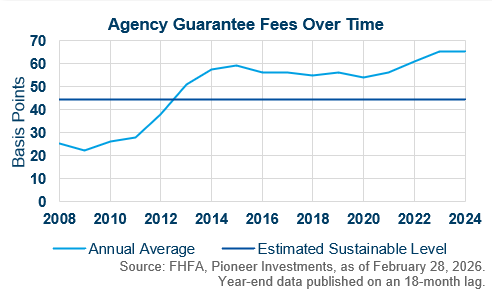
The White House’s January announcement of $200 billion in buying from Fannie Mae and Freddie Mac drove mortgage rates tighter. Combined with falling Treasury rates, the primary mortgage rate hit its lowest level since 2022. However, mortgage spreads have given up some of that tightening in the weeks since, and geopolitical events and inflation concerns could push Treasury rates higher. With housing affordability still in focus ahead of the US midterm elections, what can the White House do next? We believe a likely option could be a cut in the guarantee fee that Fannie Mae and Freddie Mac charge to borrowers to insure against defaults. Based on recent public filings, the agencies have about 21bp of profitability built into the guarantee fee, constituting about 80% of their revenue. Last year, we considered a cut in the guarantee fee to be in conflict with the desire to reprivatize Fannie Mae and Freddie Mac. That process has already been endangered by the instruction to increase their portfolio sizes, threatening their autonomy and ability to prioritize profits as a publicly-traded company. If reprivatization is truly off the table due to the administration’s push to use the agencies for affordability-related goals, cutting these fees by up to 21bp is possible.

Positively, we project that most of a potential cut would pass through to the borrowers’ rate, minus a modest concession investors will demand for the increased option cost at lower rates and increased refinanceability. Alternatively, it could be targeted just to purchase loans or first-time homebuyers to reduce the impact to the agencies’ revenues.

However, as we have mentioned previously, MBS spreads vs Treasuries or primary-secondary spreads are second-order effects on mortgage rates. The primary driver is 7-to-10-year Treasury rates, which are more dependent on the market’s expectations for economic growth, inflation, term premium, and debt sustainability, and are much harder for the White House to attempt to control. Meanwhile, the housing supply shortage can be attributed to zoning laws that are broadly managed at the local (rather than federal) level, and building costs have recently been exacerbated by increased materials costs from tariffs and a decline in the homebuilding labor force from reduced immigration. In short, the White House may find it difficult to effect meaningfully lower housing costs in the near term.

Image
Screenshot 2026-03-17 091129

Outlook: A Range-Bound 2026, Until the Next Headline 
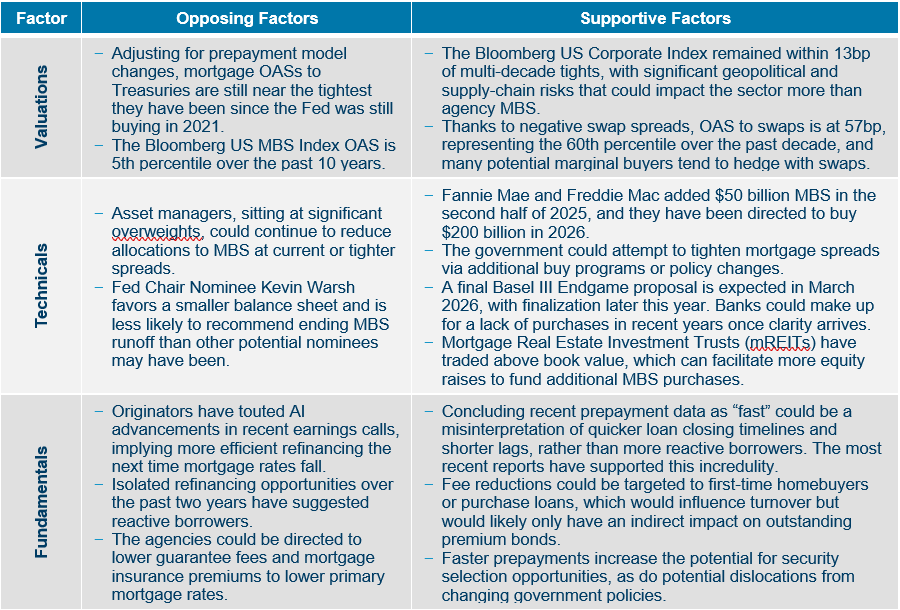
For the past few months, we have remained motivated to maintain a benchmark weight relative to Treasuries or a mild overweight versus interest rate swaps. Recent stability amid broader market volatility reaffirms this view. The arguments against MBS are emphatic and first-order, but offsetting positive factors provide support to the asset class at these levels.

Image
Screenshot 2026-03-17 091339

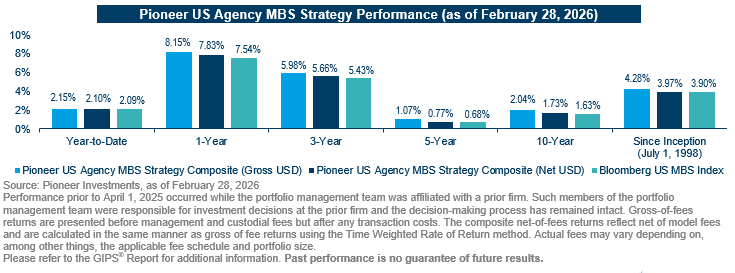
The balanced table above suggests a neutral allocation to most benchmarks is prudent at this time. Broadly, the willingness of asset managers to sell at tighter spreads, with banks, overseas investors, mREITs, and Fannie and Freddie willing to buy at wider spreads, can provide both the resistance and support to maintain stable spreads. We are more bullish on agency MBS as a positive contributor to an aggregate, multi-sector, or multi-asset portfolio, and we are more constructive on MBS relative to swaps than to Treasuries. Our strongest conviction lies in specified pools with characteristics we find underappreciated by the market, particularly for higher coupons with the most model risk premium, as well as in lower coupon interest-only strips. Spread compression reduces relative value overall, but we are optimistic that prepayment uncertainty and headline-induced dislocations can provide dynamic allocation and security selection opportunities.

Image
Screenshot 2026-03-17 092517
Image
Screenshot 2026-03-17 092644


READ MORE FROM PIONEER INVESTMENTS


The views expressed in this presentation are those of Pioneer Investments, a Victory Capital Investment Franchise, and are subject to change at any time. These views should not be relied upon as investment advice, as securities recommendations, or as an indication of trading intent on behalf of any strategy. Future results may differ significantly than those stated.
The services and any securities described in this document may not be registered for sale with the relevant authority in your jurisdiction and may not be regulated or supervised by any governmental or similar authority in your jurisdiction. Where unregistered, they may not be sold or offered except in the circumstances permitted by law. Pioneer Investments is not making any representation nor does this document constitute a representation with respect to (i) the eligibility of any recipients of this document to acquire any securities or any services described herein in any jurisdiction or (ii) the eligibility of any recipients of this document to receive this document in any jurisdiction. If you are in doubt about the content of this document or your eligibility, you should obtain independent professional advice.
Each portfolio is actively managed. Sector allocations will vary over other periods and do not reflect a commitment to an investment policy or sector. Holdings are subject to change due to active management. This should not be construed as a recommendation to buy or sell the securities listed.
Performance shown is past performance, which is no guarantee of future results. Current performance may be lower or higher than the performance data quoted.
Advisory Services offered by Victory Capital Management Inc.
©2026 Victory Capital Management Inc.

Image
Screenshot 2026-03-17 092934


20260311-5296288

Share this post

Sign Up Now for Full Access to Articles and Podcasts!

Unlock full access to our vast content library by registering as an institutional investor

Register

Contacts


Pioneer Investments

Pioneer Investments manages $132 billion in assets and has a long-standing history of innovation with deep expertise managing fixed income portfolios and creating customized solutions within the more opportunistic areas of the securitized market.

Pioneer Investments’ culture of innovation, in the securitized market, originated at Smith Breeden, where its founders developed early option-adjusted spread modeling techniques for MBS valuation. The innovative approach continues under Victory Capital, which manages over $9.1 billion for insurance companies. We are focused on delivering competitive risk-adjusted returns, while considering the accounting, regulatory, and capital management needs of our insurance clients to create long-term partnerships.  We understand the unique needs of insurers, and we provide customized and efficient risk-based capital solutions that align with insurers' risk tolerances and investment objectives.

Source: Pioneer Investments, a Victory Capital Investment Franchise, as of December 31, 2025
 

Jay Alexander, CFA, CAIA
Managing Director, Institutional Markets
jalexander@vcm.com
+1 (612) 965-5426
 
Emma White
Director, Institutional Markets
ewhite@vcm.com
+1 (617) 422-4569

Marko Komarynsky
Director, Institutional Markets
mkomarynsky@vcm.com
+1 (210) 697-3613

View the contributor page

Sign Up Now for Full Access to Articles and Podcasts!

Unlock full access to our vast content library by registering as an institutional investor .

Create an account

Already have an account ? Sign in

Ѐ Ё Ђ Ѓ Є Ѕ І Ї Ј Љ Њ Ћ Ќ Ѝ Ў Џ А Б В Г Д Е Ж З И Й К Л М Н О П Р С ΄ ΅ Ά · Έ Ή Ί Ό Ύ Ώ ΐ Α Β Γ Δ Ε Ζ Η Θ Ι Κ Λ Μ Ν Ξ Ο Π Ρ Ё Ђ Ѓ Є Ѕ І Ї Ј Љ Њ Ћ Ќ Ў Џ А Б В Г Д Е Ж З И Й К Л М Н О П Р С Т У Ф Х Ц Ч Ш Ā ā Ă ă Ą ą Ć ć Ĉ ĉ Ċ ċ Č č Ď ď Đ đ Ē ē Ĕ ĕ Ė fi fl œ æ ß