




Brookfield Asset Management-

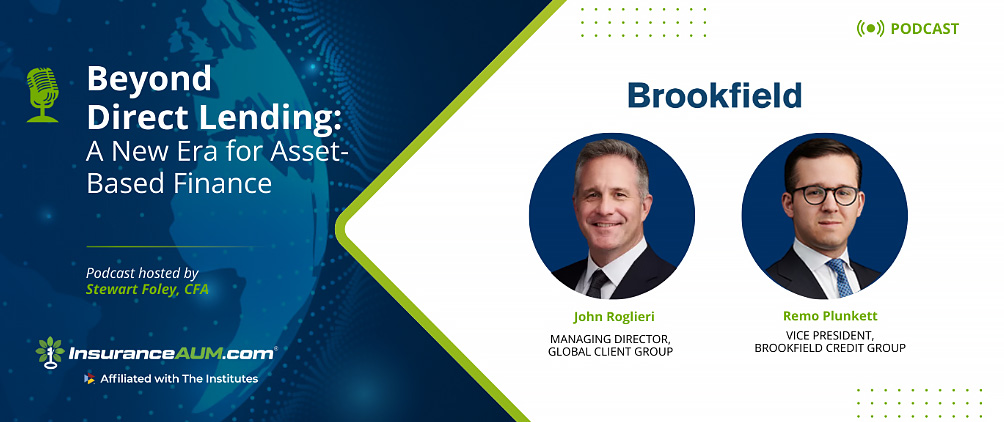
Beyond Direct Lending: A New Era for Asset-Based Finance

Image
BrookfieldFeatured


Stewart: Hey, welcome back to the Home of the World’s Smartest Money. This is the InsuranceAUM.com podcast proudly affiliated with The Institutes. I'm your host, Stewart Foley, and the today's title is Beyond Direct Lending: A New Era for Asset-Based Finance. And today we're digging into a part of the market that has evolved faster than almost any other private asset-based finance. And it sits at the intersection of private credit, securitization, real assets and insurance portfolio construction. And it's becoming a critical tool for insurers looking to diversify away from crowded direct lending markets. So to help us make sense out of this opportunity and where it's going, we have two leaders from Brookfield Asset Management. We have John Roglieri, Managing Director in Brookfield's Strategic Credit Initiatives, and Remo Plunkett, Vice President in Brookfield's Credit Group. Gentlemen, thanks for being on. Thanks for taking the time today. We're thrilled to have you.

Remo: Thanks for having us.

Stewart: We'll start this the way we always do, which is where did you grow up? New icebreaker. Newsflash, we'll start with you, John. Where did you grow up and what job would you like to have, if not this one?

John: Excellent question. I think an easy answer where I grew up should be self-explanatory. I grew up in Tenafly, New Jersey. I actually still live in town, Tenafly New Jersey, so I haven't ventured far from home. I actually returned back there about 25 years ago. So I've been there for a long period of time. And if I weren't sitting here today, very easy answer. I would love to be coaching college football. Not sure that I have either the credibility or capability to do that, but you asked me what I'd like to be doing and that's exactly what I'd like to be doing on Saturdays.

Stewart: Hey, based on Lane Kiffin’s deal, it's a pretty good gig, I got to say.

John: It can clearly be quite lucrative.

Stewart: It can be quite lucrative. Yeah, absolutely. Remo, how about you? Where'd you grow up and if you weren't doing this job, which one would you like?

Remo: So I grew up in Burlington, Vermont. So New Englander, I've spent most of my time in the Northeast. And if I could have any job other than this one, I think I'd want to own a winery, maybe Napa Valley. Enjoy some good food, good wine.

Stewart: Okay, so I'm going to give you a little Texas lore here, right? So I live in Fredericksburg, Texas, which is on the Texas Wine Trail, and Texas is a massive wine producing state. In fact, between Fredericksburg in Johnson City, there's something on the order of 80 wineries. So it is significant. So I just want to throw Texas name in the hat and just in case you end up making a purchase, you can buy a winery here in Texas for a number that is significantly less than the Napa Valley. So I know that as fixed income people, we're value buyers, right? So that's what we do. But let's start with the big picture. You focus on private credit and securitizations across multiple verticals. John, when you look ahead, where do you see the next wave of growth in asset-based finance, otherwise known as ABF?

John: That's a great question. I think that we talk about historically where we've been, where we are today and where we're going historically, where we've been. I think there's a misconception that asset structured credit, if you will, asset-based finances is called today is new, it's in fact not new. So I came up through the asset backed commercial paper era in the early two thousands where a lot of what constitutes private asset backed credit today was occurring back then. And so from an evolutionary standpoint, you have a few different modules, if you will. You have large types of transactions, large volumes in mortgages, in autos, in some of your commons. ABF is often defined as the backbone of consumer finance, which I think is certainly true and real world economy. And what you're seeing today, and as you talk in the next iteration is people going back to things like rail car transactions, cell tower deals, solar transactions. The reality is for asset-based finance, anything that has a recurring contractual cashflow can be securitized, can be tranched and arranged in an effective manner to meet investor profiles and investor demand. So as part of this podcast, we talk about insurance. And so you take a little bit of a longer perspective there from a duration standpoint, there are many assets that I think can continuously evolve to meet the needs of different constituents coming into this space. And that's the beauty of ABF recurring contractual cash flows can provide investment opportunities by design.

Stewart: Yeah, it's super helpful. It's great stage setting and the space is so much broader and more dynamic I think, than most people realize. Remo, let's talk about from an insurer perspective, why is private ABF so compelling? And I love that John said it's not new because I was like, we've done this before, but what makes it compelling and how would you compare it to the public ABS market that our listeners are probably very familiar with?

Remo: So we see the opportunity set in private ABF is being attractive for insurance clients really tied to three key areas, structured and downside protection, size and deployment certainty and risk adjusted return potential. At the end of the day when evaluating an allocation to private ABF, we're giving up some liquidity. We think insurers are well placed to do this, but we really need to be focused on the compensation or value that we're picking up in return, particularly as we've observed compression of spreads between public and private ABS markets. So to begin with the structural point, we see meaningful potential for more tailored and downside protected structures as a result of bilaterally negotiated private ABF transactions. We're talking about similar collateral being financed between the two markets, but it's important to recognize that private ABF is not just public ABS with a bit more spread.

The differentiation comes from proactive collateral selection and bespoke structures that are not possible in the public markets. So we really think structure matters and that the private format facilitates this in a more productive way given the ability to tailor collateral pools, create structural protections and work really closely with your counterparty, be that an originator or another borrower type. And that's really facilitated well by the private markets. In terms of size and deployment, we think that there's a potential to secure better allocations. You see a lot of oversubscription in public ABS. This is a frustration likely of many members of the audience who traffic in those markets. But as a manager of insurance capital investing in this space, we are really focused on providing size and certainty of execution to our issuers. We get paid for it in terms of spread, but we get paid for it in terms of certainty of allocation, which we think is really attractive and a natural synergy between insurers and originators of asset-based credit because in the end of the day, both of these counterparties are looking to continue their core businesses of writing insurance and originating credit.

And we see an opportunity to create partnerships, forward flow programs, what have you, between our insurance capital partners and a diverse set of originators. And last but certainly not least, is in addition to better structure, better allocation potential, we see spread enhancement versus the public opportunity set opportunity. Excess risk adjusted return is the fundamental reason to invest in private credit and it's available in private ABF, assuming you can come to the table with an appetite for illiquidity and the ability to participate in more customized formats and structures than what is supported by the public markets.

John: I just want to add on to that. I think I agree with everything Remo said. I think one of the things that's important is that you used the word partnership, and I think that the differentiating feature of public versus private is that private lens itself to being a true partner with folks that are looking for what I refer to as balance sheet velocity. Take for example, if you're in the auto business and every month you're producing a certain number of leases and you have that balance sheet velocity need, the difference in private credit is that you have the opportunity. We at Brookfield or others have the opportunity to work with originators of those assets to truly understand the fundamentals of their business, to be a committed long-term partner, and at the same time to be able to go deep around the underlying assets and collateral and to write protective structures that really meet the tailored needs of insurance clients or other investors that are coming into this space.

Stewart: I don't want to put words in your mouth, but it seems to me that if you are working with the same issuer over time, the familiarity with the collateral types and what they're doing helps you, right? I would think that that helps you get comfortable with the collateral that you're underwriting and with the partners that you have. It's interesting too, because a lot of times people on the investment side say, is this a good time to do whatever it is? Well, insurance companies don't market time writing premium, right? They've got premium coming in the door every day, all day, and they've got to get that money invested in the same way that the issuer needs to get that balance sheet funded. So it's a good, I mean from a afar it looks like a good fit all around. But let's talk about portfolio construction and relative value, right? So John, from a portfolio construction standpoint, how does ABF stack up against direct lending in terms of risk profile return drivers and resilience, particularly where we are, you've seen some high profile folks talking about thinking that we're on the late cycle on the credit side. Talk about that and how this fits in.

John: Yeah, look, I think when you talk about the direct lending market from a saturation standpoint, you can see that and the two very different disciplines. The direct lending market is a corporate direct lending execution that is cashflow driven, often pay, and again, bilateral partnership driven type transactions. There's a lot of capital in that space. Space. And you've seen spreads compress certainly to your point about the data around this and the depth of relationship. That's exactly right. Debt by definition, the underwriting of debt is a data-driven discipline. And so the closer we become to originators, whether owning them or partnering with them as Remo suggested on a forward flow basis is really where you learn and you have a statistical data set from which you can drop. As it relates to the exposure itself, you really have two choices. In a direct lending corporate lending environment, you're underwriting a company and EBITDA and forward cash flows with a bullet pay down the line.

What I love about ABF is that you are being very granular in terms of your analysis of what's in the isolated box of collateral for which you're dependent on repayment of your loan. So when you talk about where we are in cycles, what you're really looking at is discrete pools that are the basis of repayment for an ABF loan. And I like that for two reasons. Number one, I know on day one what my collateral box looks like and I can do a data-driven statistical analysis on the probability of any or how many obligors will potentially default and what my loss given default will look like. So I have a collateral set that I can identify and underwrite with a high degree of specificity. And number two, because these are recurring contractual cash flows every day that that loan is performing, I'm effectively de-leveraging. So there's a self-amortizing nature to the asset-based finance arena that mutes cycles, if you will. I know my discrete pool, I know that every day that somebody makes a payment, I receive a portion of that payment to naturally delever and therefore my risk is running off over time as opposed to a bullet pay in the future.

Stewart: That amortization is an important point. Remo always a big topic for insurers is capital, right? So how does ABF fare from a capital treatment perspective and are there capital benefits versus other private credit sleeves?

Remo: So I would frame the capital treatment discussion through two lenses, both of which are really important for insurance portfolios looking to access this space. So the first of which being upfront capital requirement. So it's relatively straightforward for a lot of the flavors of ABF that insurance companies are focused on. We can get rated structures, rated bonds by external rating agencies that sit cleanly on Schedule D and your capital charge going in on that basis. I think where it gets interesting is that in ABF vis-a-vis other private credit asset classes, you have a unique opportunity to access higher ratings than you may in corporate or infrastructure or other flavors of private credit. So in the ABF space, we more commonly see the ability to invest in AAA, AA, or single A rated bonds, which are harder to come by in other areas of private credit.

And we think this is helpful as a tool for insurance companies as their allocations to private credit grow, to be able to further diversify the ratings mix of that private book and sprinkle in other higher rated exposures alongside maybe a BBB or BBB and below allocation. The second important point from a capital perspective is the expectation for required capital over the life of the investment. So what you go in with is great, it's important, but the default and recovery experience of that investment over time has meaningful capital implications if it results in downgrades and other negative actions. So we think that it's set up well for the sector and of private ABF, that you have a more benign experience on those fronts that should result in a smoother, more predictable capital experience over the life of the investment.

Stewart: Yeah, it's interesting, John, that direct lending is seeing spread compression, right? And it's no surprise, I mean it's like any other market supply and demand, right? There's a lot of demand for that market. We've had people on talking about the blurring of private credit and public credit, and in fairness, some of the people who are out loud taking a swing at private credit, they don't offer it. So it's like, okay, but at the end of the day, there are some aggressive deal structures, a lot of capital flow, and ABF has gained a lot more attention here. Are you seeing similar or similar dynamics in that market emerging or kind of give us the situation as far as capital flows in ABF?

John: Yeah, look, I think there's an irony to the illiquidity premium associated with private capital with private debt or private credit overall. And I think that we are seeing more flows into the space, certainly seeing more interest as Remo points out from the insurance side, certainly at the top of the capital structure, a lot of interest in that. I think, again, going back to the difference between direct lending and ABF, yes, more capital. But I think the discipline inherent in the statistical analysis of asset backed is really important. And I think that as things get bigger where you might see some covenant loosening on the direct lending side, that's a natural iteration in market evolution as you point out. As it relates to liquidity on the ABF side, there are inherent disciplines and structures that you can employ that are highly protective to the investor if there are signs of distress or otherwise, cashflow redirects, amortization of senior bonds above all else.

I think those structural protections are really definitional to the ABF space. And I don't see them loosening, I don't see them. In fact, I think the way that we work at Brookfield is that we're very protective in our structures. We are not active participants in spaces that we see crowding of trades, and we are partnership driven where, to your earlier point, we work closely with borrowers to understand their business and always protective of our investors and ourselves in terms of the structural covenants we write. So, I think it's just definitionally different that ABF has more structural protections inherently. And then going back to the theme of self-amortization, there's also that each time you're right, you're delivering.

Stewart: It is a great point. And just to kind of go a little bit deeper on the risk side, John, what are the essential elements of risk management that ABF investors should be mindful of and sort of goes along with the collateral quality originator strength? Talk to us about the risk management playbook.

John: I think the most important thing, and I think I refer often to Brookfield as being intellectually honest. I think that people that are new to this space, there are two different ways that people have entered this arena. Either you're a direct lending platform and you've decided to transition into an ABF bit, or you're doing this from a different perspective, which we take at Brookfield where our roots in our history is as an equity investor across real estate infrastructure and other assets. So we start from an equity perspective in real estate and infrastructure as it relates to ABF. Our core competency and expertise is based on a hundred years of experience in those assets owning and operating them. And what we've done from a platform perspective is respectfully engage and take ownership stakes in people that we view to be experts in their space.

So I think from a risk management standpoint, what we value the most is number of years of experience, number of years of experience through cycles, depth of data that partners that we have engaged with have. And again, it is a data-driven discipline in terms of this underwriting. And so we value very much the experience and the expertise in specific asset classes across those managers that we've decided to invest in and again, take ownership stakes in. So our platform is designed to really lean into our core competencies and to broaden out the platform by employing experts in aircraft and aviation finance experts in consumer finance experts in the mortgage arena. I think the expertise and the experience through cycles and the ability to capture and ingest data is the most important thing from a risk management standpoint. And I think the platform that we've built at Brookfield is an extraordinary execution of that.

Stewart: That's super helpful. Remo, private ABF, you mentioned, you need to be willing to accept some illiquidity. How do you think about liquidity both in terms of secondary exits and cashflow predictability especially as compared to other private credit strategies?

Remo: So I might start with just a highlight that insurance balance sheets are inherently well set up for the illiquidity that exists in this space. They're not subject to some of the constraints that the banking community or other open-ended or daily liquid investment vehicles may be subject to. So that puts insurance companies in an inherently good spot to extract value from the private ABF market. Liquidity and capital are paramount to running any insurance business. So everyone looking at the space needs to be analyzing their liquidity away from existing or perspective private credit allocations to ensure that you can meet your stressed liability outflow assumptions under a range of scenarios. That being said, private ABF has some unique attributes relative to other forms of private credit. John touched on a couple of them, but it really ties back to the self-liquidating characteristics and amortization profile over the life of the transaction. So you can contrast this to more bulleted structures in other asset classes where you're more levered to a refinancing event at the end of the loan term as opposed to that more steady repayment over your holding period. So this results in better cashflow visibility that you can structure in at the outset to create that profile and take comfort in the fact that you're receiving both principal and interest payments along the way, which we think has a de-risking effect and some liability management efficacy in an insurance portfolio construct.

John: And I think that's an important point is that the difference between today and 2008 as Remo was rightfully pointing out is the alignment of the duration of capital inherent and insurance company balance sheet versus the overdependence on bank balance sheets, repo markets and otherwise in 2008. So I think we have a much smarter execution here just in terms of the alignment of that liquidity and those needs. You don't have fast moving capital that can move away from you. In fact, much of the insurance cohort is looking for that longer duration for liability offset.

Stewart: Yeah, it's interesting, and this is me on my soapbox a little bit, but I moderated a panel in New York and there was concern about the loans. And my response to that was, look, these loans have been sitting on bank balance sheets getting funded by overnight deposits backstop by the FDIC. Any ALM person that's worth their salt would just run out of the room if they heard that. And insurance companies, they have a very good handle in their liabilities. They have ample liquidity to meet those liabilities or cashflow positive unless the place is on fire. And it is a really good match mean. And the nice thing about it is that different collateral types kind of fit different key rate duration buckets. And so the insurance company has a really good handle on their claims payment outflows. And so to your point, it's not being funded by money going to go away tomorrow or it's going to dry up. I think that generally speaking, insurance companies are well suited to provide capital here. Just one person's opinion, but just kind of to wrap, if you look out at the subs sectors available in private ABF are there places where you think there are opportunities? And then whenever I ask this question, I always ask the other side of it, which is, are there things that you think are overdone or where you're cautious?

Remo: So we think given the space is so broad and really touches many corners of the real economy, the consumer economy, both here in the US and globally, there's a lot of spots to pick. We view it as wanting to focus on areas where we have deep asset class knowledge. And that can vary whether you're sitting at Brookfield somewhere else, that asset class knowledge is paramount. You really need to be able to have the network and the ability to generate these assets and transactions on a, preferably a bilateral basis. Having scale is a prerequisite to being able to put these types of transactions together. And you want to be working with managers or partners who have access to that means of origination, which means that they're going to be less likely to need to compete on price. Kind of back to the North star of why we want to be in this asset class to begin with is to generate that excess yield per unit of risk per unit of risk-based capital, what have you.

So in a Brookfield context, we've been particularly focused on leaning into real and hard asset sub-sectors where we have deep owner operator expertise from the equity side of our business. We think in those areas we can leverage information asymmetry, get real time insights from our operating folks on the ground and look at opportunities through that lens. And that touches many areas of the private ABF market, whether it be data center opportunities, other digital infrastructure assets, the residential housing ecosystem and hard assets or equipment, rail cars, aircraft, et cetera. So we tend to spend most of our time on long duration predictable cash flows where we can structure those to meet the needs of our insurance investors.

John: And it goes back to the partnership model. And I think you raised the point, Stewart, that the more you know about your borrower, the deeper your relationship, the deeper your dataset, the better your analytics and the better your structural protections. And I think that's really to echo Remo’s point, we focus on those areas, those sectors where we have been owner operators at the forefront. And so I think when the duality probability of default and loss given default emphasis on loss given default is a really important strategic add coming from an owner operator perspective that we lean into and find tremendous opportunity with. And candidly, I think it makes us a preferred lender into those spaces because credit has become more of a partnership model among borrowers and lenders. And I think that's important. I think it's good for the overall community.

Stewart: Yeah, and I don't know, I've never asked the question, but I have a feeling if you said to a CIO, would you rather have tap decile yield or no losses? The answer is no losses every time. It makes total sense. I mean, it's been a great education on the ABF market. I thank you both very much. I got a couple fun ones for you in the way out the door one's not necessarily fun as much as it is trying to get at the culture of Brookfield and it goes like this, what characteristics do you find important when you're adding to members of your team?

John: I'll start with that. And the word that immediately comes to mind is tenacity. And the second word that comes to mind is discipline. I think that this is a market and you asked the question about evolution and where things go and what's exciting. That requires a degree of tenacity from an intellectual standpoint. And I think we value that first and foremost. And one A to that certainly if not one, is discipline. And we've spoken a bit today about deal chasing and it requires discipline to stay true to your footprint and true to what we believe in and where we can have demonstrable expertise. So I think that tenacity and discipline are the two things that come to mind as I consider our culture.

Stewart: Yeah, it's super helpful. Alright, last one, fun. You know this one's coming, so there's two of you. So you each get to invite one guest to dinner. Dinner's on us. Who would you most like to have dinner with? Alive or dead? Remo, we'll start with you. Who's coming to dinner?

Remo: I'm a big fan of David Rubenstein legendary figure in the investing industry obviously, but the roster of people that he's interviewed is really unmatched across business, politics, number of industries. So I think it would be fascinating to have him really respect his curiosity and would love to get some of the takeaways from those interviews.

Stewart: Alright, great. How about you, John?

John: Well, I'll give you two answers to the question. Number one, to give you some perspective in terms of who we are, I'm going to answer the question very simply and explain to Remo why that the number one person I'd like to have dinner with is first, foremost, and always my wife. I say that as someone who just celebrated a 30th wedding anniversary, and I say that to somebody who is 10 days away from getting married in Remo. So there's my marital advice of the day.

Stewart: Well, I mean there's two congratulations in order. John, congratulations on your 30 years and Remo, congratulations on your upcoming nuptials. So very good. Nicely done.

John: And if I had to answer the question in a more business perspective, I have an irrational gravitation toward Tom Keen on Bloomberg every morning. I enjoy that. The 7:00 AM hour. I think that he has an old school discipline to him that I very much enjoy and appreciate and would like to spend some time with as well.

Stewart: That's super. I really appreciate it. Thanks both of you for being on today. We've been joined by John Roglieri, Managing Director in Brookfield Strategic Credit Initiatives, and Remo Plunkett, Vice President in Brookfield's Credit Group. Gentlemen, thanks for being on.

Remo: Thank you. Thanks for having us.

Stewart: If you like what we're doing, please rate us, review us on Apple Podcasts, Spotify, or wherever you listen to your favorite shows. We also have a YouTube channel at InsuranceAUM Community. InsuranceAUM.com is the home to nearly 2000 pieces of content, all designed to educate the insurance investment community. So check us out there. If you have ideas for podcasts, please shoot us a note at podcast@insuranceaum.com. My name's Stewart Foley, I've been your host and this is the Home of the World's Smartest Money on the InsuranceAUM.com podcast.

Share this post

Sign Up Now for Full Access to Articles and Podcasts!

Unlock full access to our vast content library by registering as an institutional investor

Register

Contacts


Brookfield

Brookfield Asset Management is a leading global alternative asset manager with approximately $1 trillion of assets under management across renewable power and transition, infrastructure, private equity, real estate, and credit. We invest client capital for the long-term with a focus on real assets and essential service businesses that form the backbone of the global economy. We offer a range of alternative investment products to investors around the world — including public and private pension plans, endowments and foundations, sovereign wealth funds, financial institutions, insurance companies and private wealth investors. We draw on Brookfield’s heritage as an owner and operator to invest for value and generate strong returns for our clients, across economic cycles.

Roger Kramer
Managing Director, Insurance Strategist 
roger.kramer@brookfield.com
+1.646.774.3472  

https://www.brookfield.com/
250 Vesey Street, 14th Fl. New York, NY 10281

 

View the contributor page

Sign Up Now for Full Access to Articles and Podcasts!

Unlock full access to our vast content library by registering as an institutional investor .

Create an account

Already have an account ? Sign in

Ѐ Ё Ђ Ѓ Є Ѕ І Ї Ј Љ Њ Ћ Ќ Ѝ Ў Џ А Б В Г Д Е Ж З И Й К Л М Н О П Р С ΄ ΅ Ά · Έ Ή Ί Ό Ύ Ώ ΐ Α Β Γ Δ Ε Ζ Η Θ Ι Κ Λ Μ Ν Ξ Ο Π Ρ Ё Ђ Ѓ Є Ѕ І Ї Ј Љ Њ Ћ Ќ Ў Џ А Б В Г Д Е Ж З И Й К Л М Н О П Р С Т У Ф Х Ц Ч Ш Ā ā Ă ă Ą ą Ć ć Ĉ ĉ Ċ ċ Č č Ď ď Đ đ Ē ē Ĕ ĕ Ė fi fl œ æ ß