




DoubleLine Investment Management-

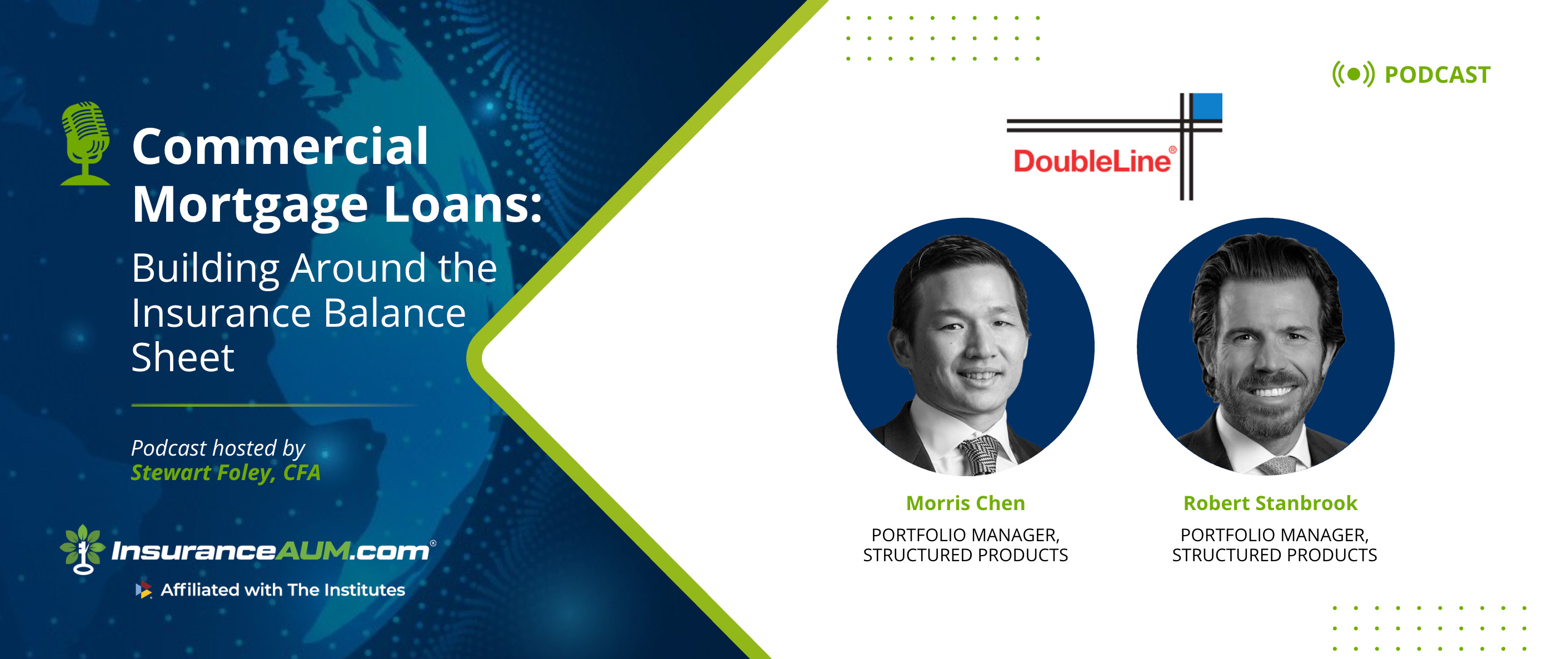
Commercial Mortgage Loans: Building Around the Insurance Balance Sheet

Image
IAUM_Podcast_DoubleLine_5.15_Web_2026


Stewart: Hey, welcome back to the home of the world's smartest money on the InsuranceAUM.com podcast. My name's Stewart Foley. I'll be your host, and we're thrilled to have you with us today. Commercial mortgage loans have been a part of insurance portfolios for decades, but the role that they play in how they're being structured and managed continues to evolve. And in a market where insurers are balancing yield, capital efficiency, duration, and downside protection, understanding where CMLs fit relative to public credit and broader private markets matters now more than ever. And the title of the podcast is Commercial Mortgage Loans: Building Around the Insurance Balance Sheet.

Stewart: And I'm joined today by two subject matter experts, Morris Chen and Rob Stanbrook from DoubleLine Capital. Morris is a portfolio manager leading DoubleLine’s CMBS and CRE debt investment teams, overseeing commercial real estate debt-related investments across the platform, and he's been with DoubleLine since its inception. Wow, that's impressive, Morris. Since its inception in 2009 and as a permanent member of the firm's fixed income asset allocation and structured products committee, Rob is a portfolio manager responsible for DoubleLine’s CRE loan platform as well as its CRE CLO portfolios. Prior to DoubleLine, he held senior credit and origination roles across bridge lending and commercial real estate financing platforms. Morris and Rob, welcome to the show. We're thrilled to have you.

Morris: Thank you, Stewart.

Rob: Thanks, Stewart. Thrilled to be here.

Stewart: All right, so icebreakers started right off. We'll start with you, Rob. Where'd you grow up? And if you weren't doing this job, what job would you most like to have instead?

Rob: So I grew up in a little bit all over, but we'll say LA for simplicity's sake. And if I wasn't doing this, I would likely do something either teach geography or something geography related. I've got great fascination with maps. I think there's no easier way to understand history, current affairs than through maps. So perhaps fitting that I ended up in real estate as a career because there's maps abound.

Stewart: That's super interesting. I've never considered that as a field. That makes me think. That's good stuff. All right, Morris, how about you? Where'd you grow up? And if you weren't doing this job today, what'd you most like to be doing instead?

Morris: I'm from Taiwan. That's where I grew up, and then ultimately immigrated to Sunnyvale, California, the Bay Area. So had a deep exposure to the Silicon Valley technology scene. In terms of what I do, what would I do? That's a really good question. I was trying to think of that as Rob was talking. The first thing that kind of jumped in my head, I would be a race car driver. So that's something that I like: cars. I like the mechanical nature of those things and the way it works. So probably something along those lines.

Stewart: I'm here to tell you, Morris, right now that we could stop and just talk cars and write for the next three hours, and I'd be thrilled. I just got back from Watkins Glen in upstate New York for the NASCAR road race this weekend, and I am absolutely with you 100%. So we're on the same page there. So let's get into it. If you could, and I think Morris, you're the right person for this. A lot of us have heard of DoubleLine. Jeffrey Gundlach is very well known and highly regarded in our world, but can you give us the kind of 20,000-foot overview of DoubleLine so that folks know the depth and breadth of the firm?

Morris: Sure, sure. I guess first off, we are an investment management company. We do manage a variety of different funds, both on the public side, mutual funds, exchange traded funds, as well as separately managed accounts on behalf of both retail, as well as institutional investors. Right now, $95 billion in terms of assets under management. As it relates to investment solutions, we run the gamut in terms of providing investors exposure to mortgage-backed securities, emerging markets, fixed income investments, commercial real estate debt as we're talking about it today on this podcast, as well as equities. And so think of us as a money manager that will provide investment solutions for investors led by Jeffrey Gundlach as well as investment team members such as Robert Stanbrook and myself. We're very excited to be here to help provide some insight into the commercial mortgage market, and let's go from there.

Stewart: And which leads me to my next section here, which is securitized credit to CRE lending. And as you mentioned, DoubleLine is widely known for its fixed income and securitized credit platform. How did that background ultimately lead the firm into CRE debt and commercial mortgage lending?

Morris: We've been in this business, in the mortgage-backed securities business, for a few decades now, starting from the early 2000s, at least with respect to exposure from myself in the commercial mortgage-backed securities arena. So as you think about investing in CMBS in the early 2000s through the global financial crisis and then coming out of that global financial crisis, you really have a lot of insight into what's going on in the securitized credit market as well as commercial real estate. So I would characterize DoubleLine's commercial real estate debt platform. We really grew out of decades of experience in structured credit and CMBS investing. Our team has been investing in commercial real estate credit since, as I mentioned, since the early 2000s, and I think more broadly after the GFC, a defining period for the asset class and commercial real estate in general.

Stewart: One of the things that happens on this podcast, Morris, is that some of my questions let our audience know the limitations of my knowledge. And so I'm going to ask this like this is the big Crayola question. So when you mention CMBS and you think about CMLs or commercial mortgage loans, is the collateral the same essentially, but in CMBS land, I'm going to tranche those cash flows and create a waterfall that gives me different credit ratings for those different tranches versus CMLs where I'm going to be owning the whole loan directly. Is that a reasonable way to frame, just for my own good, as far as I'm familiar with CMBS, used to manage that money. Can you help me with that transition to this topic in particular?

Morris: On a high level, I agree with you in terms of your assessment. The asset is the same. We're talking about commercial real estate property. The main difference between CMBS and a CML in itself is CMBS is in a security format where rating agencies come in and provide ratings based on its own assessment in terms of risk based on each class. On the CML side, you're really just talking about a whole loan. So you own the loan outright as a lender. That is your loan. You have the right, you're providing that loan to the borrower. And so the difference is CMBS, you're owning the security that's rated by a rating agency company, tranched into a particular slice of risk. On the CML side, you own the whole thing. That is yours.

Stewart: That is super helpful, and I appreciate that. It's somewhat, I guess, remedial by comparison to some of my colleagues, but it's helpful for me to know because I think a lot of times insurance investors are hesitant to look at certain asset classes that they don't thoroughly understand. And so that's why I think it's important. I'm certainly not embarrassed to ask the Big Crayon question. So let's talk a little bit about why CMLs matter for insurers and the loans make sense for insurance company portfolios, but can you talk a little bit about how they fit today and what role they can play relative to public fixed income and broader private credit allocations?

Rob: I think the most important thing to understand about CML in a relative value context and sort of use case for insurers, whether you're comparing to CMBS or broader, certainly public fixed income, we'll start there, is really just customizability. And so you can be very, very capital aware and liability aware as you're developing these portfolios. In comparison, public fixed income, there's generally a defined box where those securities are being manufactured, and that box may be defined in terms of credit risk, fixed versus floating, underlying sort of duration, loan structure, but you need some degree of homogeneity in order to make those markets work. Whereas every insurer is different. Their balance sheet looks different, their needs are different from a book yield or an RBC perspective. And so CML offers a high degree of curation and customizability as well as a risk framework customizability as well. So for instance, in CMBS, you're generally getting a cross section of commercial real estate property types.

Rob: Whereas on the CML side, we've had clients say, "Hey, we are overexposed to a corporate credit narrative across our assets." So can we look at a solution on the CML side that's more anchored in residential credit risk? So in the case of CMLs, that's predominantly apartment buildings. As it relates to private credit, I think the biggest differentiator is really that you are getting, number one, again, an ability to customize the format. It's harder to get true duration and sort of predictable duration and stable book yield at times via private credit. And then two, a more diversified broad-based underlying set of correlations than perhaps what you see in corporate direct lending and some of the more traditional private credit routes.

Stewart: And this next question is very closely related and you've touched on it a little bit, but versus between CMLs and CMBS and IG corporates, can you talk a little bit about from a yield, capital, duration, and downside risk perspective, like the insurance lens, if you will, at a high level, is there a way to draw some comparisons? Because as we all know, I mean, certainly those of us on this podcast know, you can't just say pick the highest yield. And I've used this analogy in the past, no CEO shows up at the chief underwriter's desk and says, "Hey, maximize premium revenue." That's not how they think, but when it comes to the investment side, they're like, "Maximize investment income." And that has got to be done in the framework of these other considerations beyond just yield. So talk to us about an insurance holistic view of this asset class compared to some other alternatives for the things that matter to these guys.

Rob: Yeah. We touched on it a little bit in the last topic that we were touching on, but our approach and our framework when we're talking to insurance clients I think is fundamentally different than how we help build solutions for non-insurers, which is to say for a non-insurer, oftentimes it is just a relative value question. And so it's absolute return and volatility considerations in the context of other available asset classes. And so it's a, I don't want to say one-dimensional, but it's maybe a two-dimensional kind of lens through which we're looking at the world and kind of framing the value proposition. For insurance clients, sometimes I feel like the number of dimensions never ends, right?

Stewart: Here is our Rubik's Cube. We had these Rubik's cubes made that had all these different considerations on here. There's only six sides, but as you well know, this could easily be 12 sides. So I think your point's well taken. It's not only more variables, but there's multidimensional correlations and interdependencies.

Rob: Yes. And to touch on a few of those, and obviously these are going to take varying degrees of importance for different balance sheets, but you're sort of moving through book yield, book yield stability, ratings migration risk, duration needs. In some cases, absolute return needs, liquidity, certainly an important consideration. I think with CMLs, they are private instruments. So there is liquidity tradeoff relative to public markets that may matter more for some clients than others. And so I think what's so interesting about the space is that there's limited areas in fixed income where you can kind of build to all four corners of the box within one product sphere. So typically what you'll see is that in any of the various fixed income sectors, they may solve really well for book yield stability or they may solve really well for ratings, migration risk or liquidity, maybe two, maybe three.

Rob: CMLs, I think, have an inherent market accepted degree of customization that lets you get into all the various corners of the Rubik's Cube, if you will. And a lot of that's really just born out of the fact that this is a market that's fundamentally anchored in private form. So the preponderance of commercial mortgage loans in the US are private and they have been since time immemorial. And so you have the ability as you sort of meet the demand side in terms of making these loans and the client needs to really draw your own playbook for each individual client.

Stewart: That's super helpful. When you were talking about the ways you can customize a portfolio vis-a-vis their existing investment holdings, I would think that some sophisticated insurers are going to be considering their liability book as well. I mean, what are they insuring on the other side? I mean, I remember having a client that had exposure to the Deepwater Horizon wreck in the Gulf and disaster in the Gulf and also had BP corporate debt exposure. And it's easy. It's what insurance folks call clash, but it's also a consideration. And when you're talking about being able to create custom solutions, I can see how that would be very helpful to folks who are considering those kinds of constraints as well. So let's talk a little bit about investment philosophy and underwriting discipline, which gets into risk evaluation too. So can you talk a little bit about DoubleLine's investment philosophy when you're underwriting CRE debt and how do you evaluate risk across the property borrower market capital structure?

Rob: Sure. Yeah. The easiest way to frame it is the well-trod trope of bottom-up, top-down underwriting. I'm sure I'm not the first guest to have said that on this podcast, but I'll talk a little bit about what that sort of means for us. So generally there's three legs of this stool that we think about. So the first is the actual collateral itself, understanding the real estate, understanding the market, the demographic fundamentals, supply demand characteristics, business plan, cash flows, leasing, and that's kind of the sticks and bricks part of the problem as we describe it. And so that was really addressed by having a team that comes from a fundamental commercial real estate background. I started my career on the equity side of the business, buying properties, transitioned into lending a few years after that. And we really have a sort of multidisciplinary fundamentals-oriented team construction as we look across our underwriters and analysts and credit team and originators.

Rob: So really coming at it from the collateral side and understanding what that story is around the collateral. So that's the first leg of the stool. The second, and it's a really important one for us, is your borrower and/or sponsor sort of story. Why is that important for us? I think born out of a lot of years of collective experience on our team, we've seen really good assets done wrong by bad borrowers and really tough assets done right by good borrowers. And so it is such an important part of the story for us because I think the nature of lending inherently, you are never going to have information equality to the first dollar risk holder. No matter how much underwriting we do and time we spend with the asset, the guy or gal who owns the building is always going to know just a little bit more than we do.

Rob: And so making sure that number one, we understand them, their track record, how they run assets historically is really important. And then number two, their sort of capital story. So we spend a lot of time focusing on that. How are they capitalized? Where are the dollars coming from? How much real equity do they have in there? We do very, very little lending around kind of appraised value and implied equity because to us, that's not real alignment. And then the final leg of the stool that I talk about, that is structure. So once we make sure that the collateral piece lineup and the borrower piece lineup, the third layer for us is structure. So the obvious parts of that are LTV, term, maturity, but there's all sorts of components of structure that are bespoke loan by loan. And that's kind of the market standard in commercial real estate lending and CMLs as an insurance solution.

Rob: And so that's where I think it gets really interesting from an insurance point of view is that you can build structure around insurer-specific needs. And so what do I mean by that? For instance, ratings migration. The NAIC has sort of a well-defined, well-trod matrix by which RBC is calculated. RBC charges are calculated on a loan-by-loan basis. And so you can sort of build a box on the structure side that solves the underlying need in terms of collateral story and risk mitigation, but also cuffs your NAIC rating migration risk. And so that's where I think it's kind of the fusion of that bottom-up collateral side, top-down from structuring and sponsorship.

Stewart: I want to make sure we're on the same page with the use of the word cuff. I think you mean limit because whenever I hear cuff, it's like a kind of a guess or, you know what I mean? "Hey, can you cuff that number for me?" I just want to make sure we're using the same language. All right, good stuff. So we've talked about customization in some of those terms. Can you talk a little bit about how CML portfolios can be customized across life versus annuity versus P&C versus health versus whatever other insurance balance sheet?

Rob: Yeah, no, happy to. And I will approach these very generically with a really big caveat, which is we will sit down with insurance clients who fit into one broad bucket or another with an expectation that they are going to have some flavor of the generic sort of use case, and they never cease to surprise us with some of the balance sheet needs.

Stewart: If you've seen one insurer, you've seen one insurer. I mean, it's like snowflakes. It's like they look the same even if you're relatively close to them, but when you get down to it and really look at them, they're all slightly different, and there are legitimate reasons for that, but that requires a conversation. It is not something you can learn at a distance. So your point's very well taken there. I mean, I can totally appreciate that firsthand experience.

Rob: Yeah. I mean, look, I think it's also why we love working with insurance clients so much is it's solving the Rubik's Cube. I mean, that's such a great kind of analogy. And so for folks like us who enjoy solving puzzles and being solution providers, it's the ultimate test in that expertise. So again, with really broad buckets, typically it sort of breaks down as follows. So life insurer general account tends to lean towards a fixed rate, longer duration profile. Again, CML is very interesting because you can have a very, very well-defined duration and book yield profile that again, you can use some of those structural and collateral level characteristics to make sure that that duration remains well-defined as it relates to extension or prepayment risk. That's really the classic CML use case that I think people think about when they think about the role that these instruments play in a portfolio.

Rob: For a business that's more annuity centered, the need may be a little bit different. So you're still certainly solving for some of the same considerations, but crediting rates can drive sales volume at the end of the day. So you're really having to, I think on the margin, be more book yield conscious with still the same considerations that you might think about in a core traditional CML business. And so what that looks like is perhaps building a portfolio that's half a notch out in terms of risk tolerance or curating certain property sectors where you can get a little bit more spread. For instance, today office would be an example of that. And there are very high conviction office lending opportunities, we've done several this year where you have long-term investment grade tenants in there, and from a yield perspective, you're picking 150 to 200 basis points to where that same ultimate credit risk's public debt is trading.

Rob: So I would say those two are closely related in terms of the use cases that we see. For P&C or health, that's where things shift maybe more markedly. So as Morris mentioned, we've been a direct lender for well close to 15 years now across a number of different spheres, and one of those has been on the floating rate side of the business. And so for P&C and health, oftentimes that is a more appropriate kind of use case that can take a whole lot of flavors. So there is a very core format of floating rate lending all the way up to what we describe as transitional lending. So a sponsor is buying a vacant, say, industrial asset with a plan to lease that up and then get permanent financing where you're going to get some pretty outsized spread on those profiles. And then there are also clients who are really absolute return oriented and that's when you get into truly bespoke market offerings, and those aren't always first mortgages.

Rob: So that could be mezzanine lending, preferred equity or participatory structured equity that can be certain bespoke structured credit solutions within CRE. So the flavors are kind of endless, but that's generally where they map out.

Stewart: That's super helpful. I want to look here and just ask this question. If I'm a CIO and I'm looking at this asset class, what differentiates a manager one from the other? Are there some things that you go, you need to make sure that this, this, and this are taking place? A lot of that has to do, I think some differentiation has to do with origination, where deals are being sourced. Your folks are on the West Coast. I don't know if that impacts that origination, but I'd love to know your thoughts on what should I be, as a CIO, looking for in a manager?

Morris: So from a CIO standpoint, I think one needs to really factor in obviously, does a manager have the capability to invest in this space? And I think the origination capabilities, I think these are all things, these are all good points. I think at the end of the day, we're all professionals in this arena as we think about the deployment and curating a customized solution portfolio. I think there's two important things. If you can check the box at least associated with, can the manager do it? I think we’ve all can check the box on that front. What sets us apart? I think the relationship associated with the manager and the CIO, understanding the CIO's needs specifically, I think these are very important dynamics. It's not just, "Hey, here's a mandate, go out and do it." It's, "Hey, here's a mandate. Okay, this is loan number one, number two, number three, number four, how does it look? What do you think?" And so I think it's a very two-way sort of dialogue and process. It requires relationship management. And so from our experience, a lot of our successes in terms of with our clients and with CIOs is understanding on a step-by-step process, how does the portfolio look between day one and month 12? How does the portfolio look from month 12 to month 36? I think these are things that is very, very important. I think what often gets lost in the weeds are we have managers that are so large with so many different clients that that communication sometimes falls by the wayside.

Morris: And so the targets, whether it's the CIO's needs for liability management or solving for a specific yield, bogey, those things, there can be a disconnect between that relative to the investment manager. So for us, I think that communication, open lines of communication, extremely proactive client service, that's number one. Number two, as it relates to the investment side, originations, origination capability, fact that a manager is based on the West Coast doesn't mean that we are only solely fixated on the West Coast. As a firm like ourselves, we have footprints across the country. I will also highlight that associated with the investments in the public market space as well as the private market space. A lot of our contacts using DoubleLine as a frame of thought, we talk to all the institutional heads in terms of brokerages that are out there. We have done well north of billions of dollars of deals on the commercial real estate side, whether it's a direct borrower standpoint dealing with direct borrowers and/or as well as brokers. And I think these dynamics in itself, in which I think some people may have heard from other managers, this also rings true for us.

Morris: So to drive home the point, the client service, the high-touch nature, we're here. We want to listen as a manager. We're paying attention. We know what you want. Once we know what you want, we're going to continue to be good stewards of your capital. I think that's very, very paramount when we're talking about whether it's a CML strategy or another investment strategy that we're providing an insurance solution for. So I'll kind of leave it at that, but that's what sets managers apart and one needs to pay attention to that.

Stewart: It's really a great point. I mean, when I was running money at two different asset management firms that focused entirely in insurance, there are lots of conversations. There are lots of discussions. And to your point, Rob, it's difficult. One of the things that was hard for me going from internal CIO to external manager was I was not as close to the business. To your point about being the owner versus being the lender, it's hard when you're not as close. I shouldn't say hard, it's just a different perspective. So I want to wrap here with this. Y'all talk to a lot of carriers and if you came in to talk with me, I've learned a lot on this podcast and I would've had some misperceptions about this asset class because I think sometimes my perception of an asset class is slightly dated. Is there consistency with where you find insurance investors who have a misunderstanding or where there's an educational gap that you see with some consistency?

Morris: I think from a use case standpoint in itself in terms of CMLs, we've seen a lot of insurers that kind of look at it as, well, our balance sheet is too small to get a diversified exposure to the commercial mortgage loan space, given that commercial mortgage loans may be large in size and we're not the large MetLifes of the world. Now I'll take a step back. The correction in terms of how I would correct that frame of thought is of course there are all different flavors of loans that you can make. If you walk around, you drive around a street, there are small commercial properties, there are large commercial properties. There's also loans that can be made on smaller commercial properties. And so there's this middle market commercial real estate loan space where I think it's best suited for smaller insurers where we can actually create a diversified solution.

Morris: And then I think number two, it's also not crowded. It takes as much work to do a $200 million loan to do the same amount of work to do a $5 million loan. And so from that context, understanding and wanting, if you have the desire to get exposure to the commercial mortgage loan space, we absolutely can. There are also other managers that are out there that are able to do so. So that's something that I would point out is you can create a diversified portfolio despite having a smaller balance sheet.

Stewart: It's interesting when I worked at Missouri Employers Mutual, small clients were very good risk and it gets back to proximity. The owner of the business isn't far from the newest employee. There's not thousands of people there. I could see you over there. I could see. So all right, so listen, a phenomenal education on CMLs today. I really appreciate that. I've got a couple of questions for you in the way at the door. One is really attempting to get at the culture at DoubleLine. So you've both been in this business a long time. What characteristics are you looking for when you're adding new members to your team?

Morris: I like to see grit. I like to see someone that has that tenacity to stay through, deal with difficulty, difficult situation, and see the other side. And I think there's no better sense in seeing someone go through challenges of ups and downs and survive through that and learn from that. And so as we make our own specific hiring decisions, that's a trait that I want to see. And so I'm sure Rob has his own views as well, but I saw that in Rob and we're very fortunate to have him as well on the team. Clearly, he's done very well.

Stewart: It's like playing around at golf with somebody, right? You'll learn.

Morris: Oh yeah. You're going to learn a lot, right?

Stewart: When they're in the trees and whatever. Okay. It helps. All right, Rob, how about you? What do you think?

Rob: Yeah, I think fundamentally the magic to DoubleLine's culture is just the flatness of the organization. And I think along with that comes a need for people to be willing to roll up their sleeves. And so that is sometimes difficult to quantify as you're looking to hire folks. I think we've been told we have a pretty slow and long interview process. It's maybe a measure 10 times, cut once. But I think ultimately what we've ended up with in terms of team construction is just an ultra-collaborative, free-thinking environment where folks aren't afraid to speak their mind from perhaps more junior places in the organization. And at more senior levels in the organization, folks continue to roll up their sleeves and they're involved and close to the day-to-day elbow grease, which I think comes together as a really kind of unique and holistic client experience as well.

Stewart: Yeah, that's awesome. All right. So when we have two guests, our final question is a little modified. And so it goes like this. We have a table for four, dinner's on us, and it'll be the two of you and you each get to bring one guest. Who would you most like to have dinner with, alive or dead? So we started this morning a little earlier. We started with you, Rob. So we'll go to Morris on this one. Who would you most like to have dinner with, alive or dead, Morris?

Morris: Well, you brought up golf, and golf is squarely in my head right now. I would bring Tiger Woods because I want to hear some stories about some of the tournaments that he went through.

Stewart: I suspect there's some stories there. I just think that's a very interesting dinner guest. All right. Rob, it's you. It's Morris and Tiger Woods. Who's coming with you?

Rob: It's a tough one, but if I'm limited to just one, I think you've got to go with the ultimate polymath, maybe five dinner guests and one, Leonardo da Vinci.

Stewart: Oh, wow. That would be amazing. It is incredible what he was able to do. It is incredible.

Rob: It's pretty stunning.

Stewart: Pretty stunning.

Rob: Maybe my answer would change if I had two or three invites on the list, but if you're going with one, you got to get the Swiss Army knife at dinner.

Stewart: Yes. I like it. I like it. That's a great explanation. That's awesome. All right. Great education today. Fun to have you guys both on, and I want to thank you. We've been joined today by Morris Chen and Robert Stanbrook from DoubleLine Capital. Thanks for being on today.

Morris: Thanks, Stewart. Thanks for having us.

Stewart: If you like what we're doing, please rate us, review us on Apple Podcasts, Spotify, or wherever you're listening to your favorite shows. You can watch us at InsuranceAUM Community on our YouTube channel. If you have ideas for podcasts, please shoot me a note at podcast@insuranceaum.com. My name's Stewart Foley. This is the home of the world's smartest money on the InsuranceAUM.com podcast.

Share this post

Sign Up Now for Full Access to Articles and Podcasts!

Unlock full access to our vast content library by registering as an institutional investor

Register

Contacts


DoubleLine Capital LP

DoubleLine has been managing money for insurers since its inception in 2009. The firm's focus on securitized fixed income and risk management positions it well to manage money for insurers. The firm offers an array of fixed income strategies including dedicated ABS, private ABF, CLOs, infrastructure debt, non-QM, commercial and residential loans, multi-sector fixed income and EM. We understand that the needs of each insurer can vary, and our insurance team is focused on providing our clients with unparalleled access to the investment team and creating custom solutions to meet their distinctive objectives. DoubleLine wants to be your fixed income partner.

Paul Schroeder, CFA   
Relationship Manager- Insurance  
paul.schroeder@doubleline.com
Direct: 213-372-3123 | Main: 813-791-7333

 

View the contributor page

Sign Up Now for Full Access to Articles and Podcasts!

Unlock full access to our vast content library by registering as an institutional investor .

Create an account

Already have an account ? Sign in

Ѐ Ё Ђ Ѓ Є Ѕ І Ї Ј Љ Њ Ћ Ќ Ѝ Ў Џ А Б В Г Д Е Ж З И Й К Л М Н О П Р С ΄ ΅ Ά · Έ Ή Ί Ό Ύ Ώ ΐ Α Β Γ Δ Ε Ζ Η Θ Ι Κ Λ Μ Ν Ξ Ο Π Ρ Ё Ђ Ѓ Є Ѕ І Ї Ј Љ Њ Ћ Ќ Ў Џ А Б В Г Д Е Ж З И Й К Л М Н О П Р С Т У Ф Х Ц Ч Ш Ā ā Ă ă Ą ą Ć ć Ĉ ĉ Ċ ċ Č č Ď ď Đ đ Ē ē Ĕ ĕ Ė fi fl œ æ ß