



Loomis Sayles-

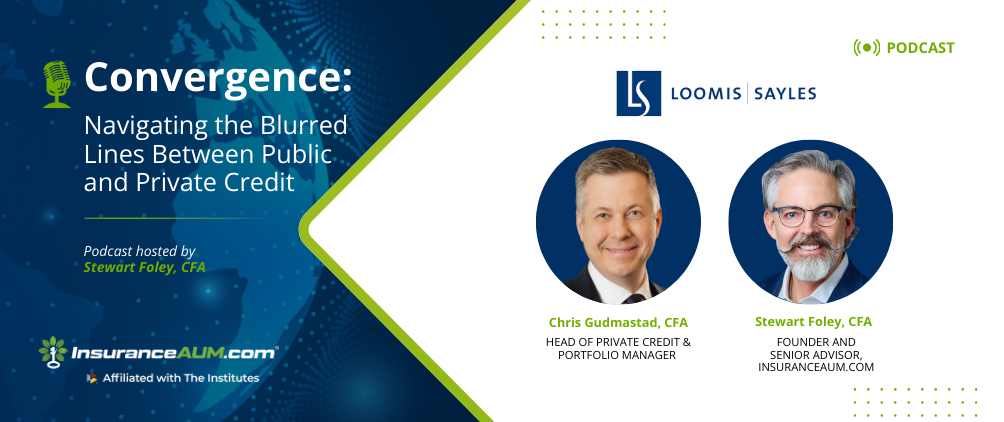
Convergence: Navigating the Blurred Lines Between Public and Private Credit

Image
01.26.26 Loomis Sayles_Web


Stewart: Hey, welcome back to the Home of the World's Smartest Money. I'm Stewart Foley. I serve as Founder and Senior Advisor of InsuranceAUM, and I have been the Principal Architect on the upcoming CIIM designation, which there's more to come on that. I will tell you I never have started a podcast like this, but I want to give you a Texas weather update. It was 18 degrees this morning here in Fredericksburg, Texas. I moved here as most of you know, from a northwest suburb of Chicago. When it is 18 degrees in Chicago, it is just, we call that Tuesday, and I know that our guest is actually from Minnesota, and I believe he would feel the same. I will tell you though, and for our guest benefit, there is no such thing as winterization here and our hot water heaters, they're tankless, are mounted on the outside of our house, which means we have no hot water.

And also for those of you who may not know, heat pumps stop pumping heat once it gets below a certain temperature. We have reached that temperature. So I got ready this morning by boiling water and pouring it into our bathtub and combining it with water that was exactly like 35 degrees and managed to get it done. So very happy to tell you that it's warming up a little bit here in Texas and we're going to be okay. But for those friends of ours that are up of North, you cannot believe how poorly prepared homes are here for cold weather. So let's get onto the business at hand here, which is the episode entitled Convergence: Navigating the Blurred Lines Between Public and Private Credit. This is a very, very good topic and one that is particularly timely. It is a topic that insurance investors encounter more frequently, but may not yet have a clean framework for, which is our purpose today.

What used to feel like two distinct markets, public and private credit are increasingly beginning to overlap. Understanding how and why those lines are blurring matters for portfolio construction, relative value assessment, liquidity and risk management. I guest today is Chris Gudmastad, Managing Director and Portfolio Manager of Private Credit at Loomis Sayles & Company. Chris has more than 20 years of experience across private placement, structured credit, and corporate lending, including senior roles inside insurance asset managers, which gives him a particularly relevant perspective for our audience. In addition, this is his second go around in our podcast. The first time was very, very early on. Lots has changed. Chris, we're thrilled to have you back on the insurance aum.com podcast.

Chris: Thank you very much Stewart and I certainly with your Texas weather, I empathize, right? I actually am sitting here in Miami and I left and it was roughly minus 30 below windchill and I'm here it's 80 degrees. So you're looking at roughly a 120, 130 degree difference.

Stewart: Yeah, it is shocking, right? It's shocking to the system. I have to say winter, I love winter in Texas, it's really great. It's like crisp fall days in the Midwest in the upper Midwest, right? There's days when it's really sunny and warm and we just haven't, and a lot of the country has just a super big cold snap and hey, we're doing our best. I mean, I have to say we're doing our best. I want to start this one off the way we always do, which is where'd you grow up? What was your high school mascot? And if you weren't doing this today, what job would you most like to have instead?

Chris: So I'm originally from the Midwest. I did spend some time out on the east coast, but born in South Dakota, moved to Minnesota when I was 10 or 11 years old and went on to Minnesota as a town of roughly 25,000 southeastern Minnesota, the Driftless region, Minnesota, Wisconsin, where there were no glaciers. So interesting topography.

Stewart: It's a beautiful, beautiful area.

Chris: It's absolutely gorgeous.

Stewart: It's beautiful.

Chris: So I grew up there, mountain biking, doing other things. My first job, I had a paper route, but my high school mascot was a rambler, which is a ram. So I went to Winona Cotter, Cotter Ramblers. If I didn't do this, I've been in private credit for a very long time. I think that's a great question. My parents are both teachers, so my dad was a band director, my mom was a middle school teacher, so I think a college professor in finance would be great.

Stewart: Yeah, that's cool. I've had the good fortune of holding down that position over several years, and I will say it is incredibly satisfying. People say, I want to do that in retirement. I'm like, well, you'll be working harder in retirement than you are during the day today. If you do it right, there's an awful lot to it, but you can have an incredible impact on students' lives and their future careers. I'm proud to say that we have several hundred folks who are finance students of mine that are gainfully employed and somewhere in our industry, and I'm thrilled about that. So let's get into it, right. So credit is credit, a universal skillset is sort of our first segment. You've said that you don't view public and private credit as two different markets, as I kind of pointed out in the intro, but as rather two delivery mechanisms for the same underlying risk. Can you walk us through that philosophy and how it shapes the way you underwrite and price credit risk?

Chris: Sure. No, absolutely. And a lot certainly has changed in the last several decades in private credit and in the last, let's call it five or six years. And one of the things I think is we're seeing strong converge is the public private markets. So just to help frame, when I started speaking to Loomis roughly four years ago to build out the private credit effort in the conversations I had, they were very detailed. They were around, oh, how do you look at credit? At its core, when we think about credit, it's assessing probability. Excuse me. It's assessing a probability default. You're looking at your loss given the default and you're pricing that risk. Yes, there's some nuances around the public and private credit markets in terms of origination and structure, but it's core, you're pricing that risk. And one of the things we're seeing today in terms of the private credit market, that core skillset is important in the public or private market. And as we've seen convergence, which we'll talk about today, we're seeing a more complexity come to the public markets and we're seeing also the private markets look more public like.

Stewart: Yeah, it's super helpful. I do think it is true that what we're trying to do is figure out, are we going to get our money back? And if we don't, what does that look like? And it's true that it's universal, right across anything that's got any sort of fixed income instrument. That's the heart of the matter. Right. Let's talk about the continuum of capital. You just mentioned this. We're seeing the traditional walls between private and public credit start to crumble as issuers and investors weigh speed and certainty against scale and pricing. How are you seeing this continuum of capital playing out in today's markets?

Chris: Yeah, I mean I think it's fascinating to see it play out over the last several years. Again, taking a step back, what we've seen happen over the past couple decades is the natural maturation of the private credit market. And this is just more of a history lesson if you will. Right, at one time, bank loans were considered esoteric or private nature, no longer are they considered private. So an example is if you look at upper middle market lending, leveraged loan market, you have issuers that can issue in the public market, high yield or bank loan or private direct lending market, and they opportunistically do so. So that's a natural maturation of the direct lending market. But when you look at the continuum, and I think what's more interesting from an insurance perspective is you're seeing more complex transactions that could go either to the public or private market. Data centers is a good example, with a lot of the data center issuance. And what we've seen on an increasing basis this year actually is we actually saw a transaction that was fairly large, that was syndicated like a private, the underwriting was like a private, was what I would call structured corporate and shared aspects of both the corporate and structured market. And it actually launched as a private and settled as a public. So you get the best of both worlds if you will, and we're starting to see that more and more.

Stewart: That's interesting. It's the first I've heard of that. So liquidity, it's interesting because I think oftentimes people somewhat forget the core five fixed income risks. You've got interest rate risk, you've got curve risk, which you've got to count. Curves don't go up and down in parallel ever.

Chris: Absolutely.

Stewart: You've got credit risk, you've got convexity risk or the likelihood that you're going to get your money when you don't want it. And then you've got liquidity risk. And a lot of this, you've talked about this, it has typically been the case that we just consider - we meaning, I don't know who we is, but the investment investing public think that public markets are liquid and private markets are illiquid, but you've argued that this binary view doesn't necessarily hold. How do you think about liquidity as a spectrum, especially with the growth of private secondary markets and new vehicles for private credit?

Chris: Yeah, no, I think that's a great question. The quote I always remember hearing, I don't know if this was Howard Marks or someone else, but it was, “liquidity is there until you need it.” And I think that's true.

Stewart: That is a great statement. It's true. It's like this is liquid and then it's like something goes bump in the night and there's no bid. It's like it's crickets.

Chris: Absolutely. Right. And I've been around long enough where I've been through a few cycles, but there actually has been liquidity in the private credit market over the years. So I think I started my career investing in private credits probably in the early 2000s. I did my first secondary trade probably 2008 time frame. But looking back, private credit has traded, right? When you look at the buyer base, it didn't trade much. In the investor grade space it was mostly insurers, buy and hold investors. And in the alternative space you did see private credit secondaries. But what's taking place today? You have new sources of capital coming online, semi-liquid, new investors coming online as well. And on the back of that, you're seeing a private credit secondary market mature and become more involved. There are some barriers, right? Information as symmetry data technology that will prevent this from looking public like tomorrow.

But when you look at some of the factors impacting liquidity in the public and private markets, in the public market, I think we've seen liquidity slowly decline. Dealers are holding less inventory, but on the private side, some of the information as symmetry barriers are being reduced. So we've actually looked at private credit secondaries where there's a whole data room. It looks like a poll, like an initial underwriting. So that barrier is going away. And I think what's going to happen here is you're going to slowly see liquidity improve over time. And I don't think they're going to converse tomorrow, but this is one of those cases where it's not a spectrum, it's a continuum. It's not binary.

Stewart: It's interesting your point about private credit secondaries. I've kind of argued on this podcast in the past or put it out as a point that the better that the private credit secondaries market functions, the more comfortable folks are investing in private credit because they can get back out. I mean, not for nothing, but what do you think about that kind of notion?

Chris: I completely agree with that notion. What you're going to see and what this will allow for is it'll allow for more active management of private portfolios as well. So let's think about this from an insurer perspective. What also should happen is there's been the historical cliff between investment grade and below investment grade. My guess is that will erode, liquidity will naturally improve.

Stewart: You make a good point. I've said this before on other podcasts, but insurers are particularly well suited for private credit. You think about finance 101 and you go, well, you've got an investor that's got a fairly known set of liabilities, there's not a run on the bank risk and they can manage the interest rate, risk and characteristics of their assets versus their liabilities - as opposed to a bank that's funding long duration loans with overnight lending, overnight deposits and having the FDIC stand behind them and say, if there's a run on the bank, we'll make it up. And to me, and I've been in rooms where there's a lot of concern about this, but I really think that insurers are being very prudent and being very, they're experts in evaluating credit instruments already. And the managers in this space, not just Loomis, but others are very good on the credit side. So I realize that things go bump in the night, but I do think it's a natural kind of fit, if you will. We've talked in the past about the rise of complexity. Asset-based finance is all the rage. Structured corporates as part of the corporate lending becoming increasingly crowded. You've pointed to asset-based finance and structured corporates as an area of opportunity. What's driving that shift and how should investors think about complexity and diversification in this part of the market?

Chris: That's a great question. When you look at the value of privates, I think it's composed of, there's three reasons why an would invest in privates, right? It's the premium over publics, the structure and diversification. And I think as I look at the asset class over time, I think some of the newer areas of private credit are where you can really generate alpha, I think today that is largely asset-based finance. I think that's an area that I would say five, six years ago did not really even exist, right? Maybe it's 10 years ago. And why is this an opportunity today? Well, when you look at who were the original asset ABF lenders or providers of capital, it was banks, but it was also the GE, CITs of the world who are no longer around. And what's happened on the back of low interest rates environments is you've seen a lot of alternative asset managers come into the market that were maybe more comfortable with structural complexity.

And this asset class has essentially emerged over time. But I think when you look at the opportunity, I think around complexity, I think when you look at the average insurer, you can get leveraged loan exposure directly through a direct lending transaction. One could do a NAV or a CFO - lend to a BDC or a closed end fund or an interval fund. So I think it's really important for insurers and investors today to understand the complexity they're taking in terms of portfolio management. You should have a view of where you want to add alpha across those options. And also track risk becoming increasingly important when you're seeing this complexity and structural conversion across the public and private asset classes.

Stewart: You're kind of leading me into my next area, which is transparency and a unified risk premium framework, right? So public markets have long benefited from transparency, private markets are evolving. I would add that my completely data less opinion is that the regulator is going to require greater transparency from insurers. I don't think that's a big hurdle to leap over. How does increased transparency allow you to apply a single risk premium and relative value framework across public and private credit?

Chris: That's a great question. And I don't mean to go back to history again, but when I started my career, we held a lot of our private credit instruments at par, or cost. And I think the next iteration was we actually would maybe matrix price based on quality or duration. And maybe that was quarterly. Right now, we price our private credit portfolio daily. And I think if you would've looked five years ago, I think very few people were doing that or institutions were doing that. Or even could. And we've seen this, the valuation providers emerge actually from valuation to actually price it. But what this allows you to do, it allows you to really understand the risk in your underlying portfolio. We've spent a lot of time since I joined Loomis, putting privates through the same risk framework that we do publics. And there's no reason why investors should not be able to do that. I think an investor’s foolish if they think that private assets don't fluctuate with the overall markets. So I agree with your statement, how it, in terms of the regulator is going to, the US regulator I think is going to look for more disclosure around this. So when we look at our risk framework and risk premium framework, I think no longer can I just come into an investment committee or talk to my boss and say, oh, our premium over publics is x, I think you really need to dig into the attribution around that.

So what we look to do is we look to price liquidity. Actually is the bond we're investing in liquid or not liquid and putting a price on them. We look to price complexity as well. How much are we getting for a complexity or structuring premium? And I started my career in banking and went through credit training. I mentioned earlier one of the key attributes of private to structure. Well, with that structure you have lower credit vol, less losses. We put a price on that as well in terms of basis points. So I think what you're going to naturally see is you're going to see more sophistication coming to private credit investors as they describe the alpha they generated over public markets.

Stewart: And that's super interesting. It's funny because exactly what you said, privates over publics, what's the spread? And that's like saying, what's the price of a car? I was like, I can give you an average, but is it a 20-year-old used car or a new Benz? A lot of difference. A lot of difference. And there's reasons, right? There's reasons for differences and the idea that you can price liquidity and price structure. It's no small feat. I mean, that is complex. It's not my world, but I've been in this business long enough to know, putting a price on liquidity is not easy.

Chris: It's not, but private credit is no longer a black box. It's becoming more transparent. I think the other thing we will likely see is more private indices up here as well over time. So I think it's an interesting time in the private markets for sure.

Stewart: Absolutely. Let's talk about one last thing here. Organizational convergence inside asset managers. And I'm fortunate to be kind of halfway behind the curtain with over 60 asset managers. And so we were starting to see organizational convergence where public and private teams are no longer siloed for a lack of a better term. And I know Loomis is interesting because there are some really interesting things going on there. Can you talk about how you manage bringing those teams together to make real time decisions on not only credit, but also portfolio construction?

Chris: Absolutely. I think this is another one of those areas where we're seeing real-time convergence happen in the marketplace. We saw this first on the sell side. We've seen a number of Wall Street firms reposition themselves to cover both the public and private credit market. When an issuer comes to the market, they're looking for a solution. They don't know if that solution ultimately might be public or private credit. And on the back of that, we've also seen the investors do the same. Attempt to reposition themselves for this new world where you're offering solutions across the markets. So when I interviewed with Loomis and first joined Loomis, my first interview was with the Head of Credit Research. Then I interviewed with the Head of our structured team, and I honestly felt like a kid in the candy store. We spent the first year, so I joined just over four years ago.

We spent the first year just understanding what Loomis' assets were and developed processes so we could actually integrate our structured team and our public credit research analysts into the process. And what this allows us to do is it allows us to look at transactions we couldn't, I didn't feel comfortable looking at it at our previous institution. So a good example is we've seen structured deals that are private out of Turkey with a Turkish bank. So I remember the first transaction that came across my desk probably 10 years ago. We turned down, we just didn't feel like, we don't lend on faith. We didn't feel like we had the skillset to look at that transaction. So we come into Loomis, we have a macro analyst that covers Turkey. And I'll preface this by saying there's no MNPI here. There's no private information that could be public, but the deal team consisted of our macro analyst who covers Turkey.

The transaction actually was issued by a Turkish bank. We actually own paper in that Turkish bank. We have an analyst that covers that Turkish brand. The transaction came in through the private team. So we're doing the structuring, but there is some structure here as well. So we loop in our structured team in terms of making a portfolio management decision, and I feel that is the right skillsets you need to bring together to analyze that and underwrite that particular transaction. Public or private - happens to be private. And as we look at our ability to, on a portfolio management side, look at transactions across the public and private market, that particular transaction is our preferred way to EM risk. We don't need to get into the detail. And we're doing that across our insurance portfolios as well as our mutual funds investing in this asset class as well.

Stewart: It has certainly been a thoughtful and timely conversation on the convergence of public and private markets, and one that is very relevant for today's insurance investment professionals. A couple of closing ones for you. The first one really attempts to get at the culture at Loomis, and you've been at this for a minute, and you've hired people on your team. I know. So what characteristics in your experience make for good hires at Loomis or other places you've been?

Chris: I think that's a great question. And I'll start off with the first thing I'm looking for. I'm not looking to hire five Chris Gudmastad’s. I want people that are different than me, that think differently than me, that bring different skill sets. So that's the first thing. But when I look at characteristics, there's really three things, right? Number one, when we're hiring analysts, individuals, we're looking for people that are naturally curious. They're problem solvers. I think that's critical in terms of underwriting, investing and being a part of the team. Number two, resilience. The ability to block and tackle through problems, right? Transactions in life is important. This is a skillset that's important, I think for all. When I talk to my 12-year-old daughter, this is something I'm also trying to build in her. And then finally, high EQ, just the ability to communicate effectively across individuals and teams is critical. I often say, and I'm known on my team as, if there's something that can be misconstrued, you have to deliver that message in person or speaking on the phone, not send an email. So I'm a big fan of that.

Stewart: Yeah, there's no context in an email or no tone, right? It can come across very differently. It reminds me, speaking of being a college professor, it reminds me of, I was asking a question. I said, define arithmetic mean, and define geometric mean or calculate arithmetic mean? Calculate geometric mean. And then my question was, what's the difference between the two? And I was expecting an explanation, but what I got in some cases was 2.36. What's the difference? They just subtracted it and it's like, you got to be careful what you're asking, right?  

So, you got to know this one's coming. Who would you most like to have dinner with alive or dead? And the rules are like this, dinner's on us. And you as a solo guest get to have up to three guests. Who's coming to dinner with you, Chris?

Chris: Yeah, I think this is a great question. So I mentioned earlier, my parents are both teachers. My dad was a musician, a band director, and the first person I would bring is Miles Davis.

Stewart: Oh, wow.

Chris: So I've always been a jazz fan and I was a trombone player, played jazz in college as well, but Kind Of Blue, was my entree into jazz. And I think Miles Davis, that album in particular, John Coltrane's on that album, it was done in one take. I think having Miles Davis coming there would be fascinating.

Stewart: That is fascinating.

Chris: Number two, so this is going back to my Minnesota roots, is Alan Page. So Alan Page for people that don't know, was a Hall of Fame defensive player for the Vikings who is still alive, but actually went to law school, while he was playing for the Vikings, and he was at Minnesota’s Supreme Court justice.

Stewart: Wow. I had never heard this story. That's so cool.

Chris: Yes, he's fascinating. He's a fascinating individual, still lives in Minnesota, and he's done a great job of also just giving back to the Minnesota community as well. And then my final guest, you need somebody to cook, tell stories, say be Anthony Bourdain.

Stewart: Oh, wow. Always a favorite of mine. Yeah.

Chris: Always - well traveled. Someone, my wife, my daughter and myself still watch his old episodes and I think he’d bring the group together nicely.

Stewart: Yeah, I think so too. I mean, that would be a great conversation with him and Miles Davis and Alan Page as well.

Chris: Absolutely. Very cool. It's a good group.

Stewart: Listen, thanks for being on. I really appreciate you taking the time. It's been a great education. You're obviously very knowledgeable in this area. We're very fortunate to have people like you come on and educate our audience. So thanks so much, Chris. Thanks for taking the time.

Chris: Yeah, no, thanks for everything you do for the insurance community and investment community around insurance. Much appreciated, Stewart.

Stewart: Thank you, sir. We've been joined today by Chris Gudmastad, Managing Director, Portfolio Manager of Private Credit at Loomis Sayles & Company. If you have ideas for podcasts, please shoot me a note at Stewart@insuranceaum.com. Don't forget to rate us like us and review us on Apple Podcasts, Spotify, or wherever you listen to your favorite shows. You can also watch us or listen to us on our new YouTube channel at InsuranceAUM community for more. Great content. Heard today that our average listening time on YouTube is about 50% higher than average. So very, very nice. Very good news there from our perspective. So thanks for joining us. My name's Stewart Foley, I've been your host, and we'll see you again next time on the Home of the World, smartest money at InsuranceAUM.com.


This podcast was recorded on 26 January 2026.

This marketing communication is provided for informational purposes only and should not be construed as investment advice. Investment decisions should consider the individual circumstances of the particular investor. Any opinions or forecasts contained herein, reflect the subjective judgments and assumptions of the authors only, and do not necessarily reflect the views of Loomis, Sayles & Company, L.P. Investment recommendations may be inconsistent with these opinions. There is no assurance that developments will transpire as forecasted and actual results will be different. Data and analysis does not represent the actual, or expected future performance of any investment product. Information, including that obtained from outside sources, is believed to be correct, but we cannot guarantee its accuracy. This information is subject to change at any time without notice.

Any investment that has the possibility for profits also has the possibility of losses, including the loss of principal.

Diversification does not ensure a profit or guarantee against a loss.

There is no guarantee that the investment objective will be realized or that the strategy will generate positive or excess return.

Past performance is no guarantee of future results.

This material is not intended to provide tax, legal, insurance, or investment advice. Please seek appropriate professional expertise for your needs.

Loomis, Sayles and Company, L.P. and InsuranceAUM.com are not affiliated. 

8743314.1.1

Share this post

Sign Up Now for Full Access to Articles and Podcasts!

Unlock full access to our vast content library by registering as an institutional investor

Register

Contacts


Loomis, Sayles & Company, LP

Loomis Sayles matches its long history of alpha generating capabilities with the complex needs of its insurance clients. The firm offers a suite of differentiated fixed income strategies, each with clear and consistent investment philosophies. Experience in providing custom solutions is layered in to generate specific portfolios, designed to fit client objectives.
 

Colin Dowdall, CFA
Global Head of Insurance Solutions
cdowdall@loomissayles.com
(617) 449-8782

Lauren McDermott
Director, Insurance Solutions
lmcdermott@loomissayles.com
(617) 816-6301

www.loomissayles.com
One Financial Center
Boston, MA 02111


View the contributor page

Image
LoomisSayles

Sign Up Now for Full Access to Articles and Podcasts!

Unlock full access to our vast content library by registering as an institutional investor .

Create an account

Already have an account ? Sign in

Ѐ Ё Ђ Ѓ Є Ѕ І Ї Ј Љ Њ Ћ Ќ Ѝ Ў Џ А Б В Г Д Е Ж З И Й К Л М Н О П Р С ΄ ΅ Ά · Έ Ή Ί Ό Ύ Ώ ΐ Α Β Γ Δ Ε Ζ Η Θ Ι Κ Λ Μ Ν Ξ Ο Π Ρ Ё Ђ Ѓ Є Ѕ І Ї Ј Љ Њ Ћ Ќ Ў Џ А Б В Г Д Е Ж З И Й К Л М Н О П Р С Т У Ф Х Ц Ч Ш Ā ā Ă ă Ą ą Ć ć Ĉ ĉ Ċ ċ Č č Ď ď Đ đ Ē ē Ĕ ĕ Ė fi fl œ æ ß