




American Century Investment Services-

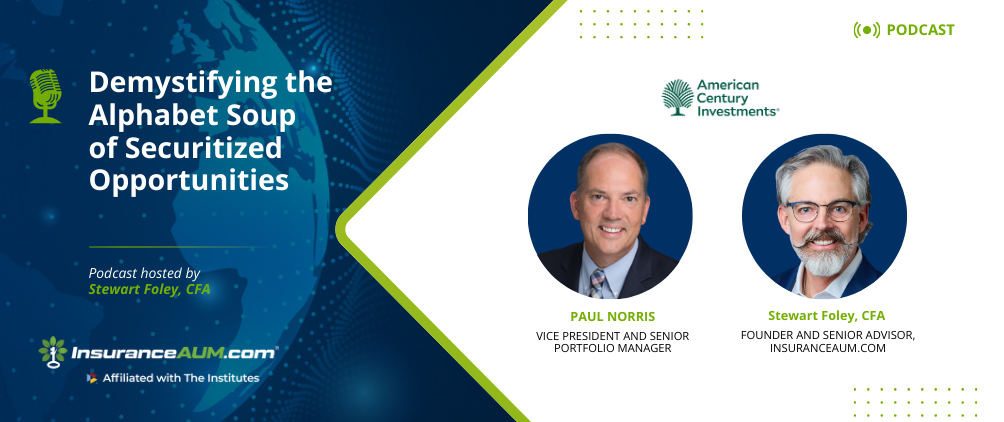
Demystifying the Alphabet Soup of Securitized Opportunities

Image
American Century Podcast header

American Century Investments does not currently manage assets according to the model portfolio guidelines presented. Model performance does not guarantee future performance of any account or portfolio.

This strategy may not be suitable for all investors. Investment return and principal value will fluctuate, and it is possible to lose money by investing. There is no guarantee that the investment objectives will be met. The information is not intended as a personalized recommendation or fiduciary advice and should not be relied upon for investment, accounting, legal or tax advice.  

The yield target is aspirational in nature and is not based on any criteria or assumptions. The target is not meant to reflect any projection or promise of performance. No guarantee or representation is being made that any account will or is likely to achieve the target shown.

The opinions expressed are those of American Century Investments and are no guarantee of the future performance of any American Century Investments portfolio. This material has been prepared for educational purposes only and is not intended as a personalized recommendation or fiduciary advice. It is not intended to provide, and should not be relied upon for, investment, accounting, legal or tax advice.  

Investment return and principal value of security investments will fluctuate. The value at the time of redemption may be more or less than the original cost. Past performance is no guarantee of future results.

©2025 American Century Proprietary Holdings, Inc. All rights reserved.

FOR INSTITUTIONAL USE ONLY/NOT FOR PUBLIC USE


Stewart: Hey, welcome back to the Home of the World's Smartest Money, the InsuranceAUM.com podcast. We're now affiliated with The Institutes, as I think everybody knows by now. My name's Stewart Foley, and today we're diving into a topic that is endlessly fascinating and, let's face it, a little bit opaque at times. The Alphabet Soup of Securitized Opportunities. The title of the podcast is Demystifying the Alphabet Soup of Securitized Opportunities, and we're joined by Paul Norris, who's a Vice President, Senior Portfolio Manager and Head of Securitized Markets team at American Century Investments. Paul, welcome.

Paul: Thank you, Stewart. Great to be with you. Great to see you as well.

Stewart: You too. We've known each other for a while.

Paul: Yes, sir.

Stewart: And you are a veteran of this business. Without a doubt.

Paul: Thank you.

Stewart: It's interesting. It's funny. Somebody said to me a long time ago, they said, so you're still in insurance? Like I had failed somehow. And now this was quite a while ago. Now this business, this space is super hot. Right. And I think it's for those like you and a bunch of my friends out there that have been in this business a long time. It is astonishing how much it's changed, I think, over time. But let's get into it. I just want to kind of do the same thing we always do, which is, although I will say we do have a new icebreaker for those regular listeners who are sick to death of my icebreakers. I hear you. And so we did something new. I'm a little scared, Stewart.

Paul: I'm a little scared.  

Stewart: Yeah, don’t worry. No, no, no, don't worry. We never want to embarrass. This is a good one. You'll like it. Where did you grow up and what job would you want if not this one?

Paul: Oh wow. I grew up in a really small town in La Plata, Maryland, which is nowheresville. What I would say what I would want besides this job. And I do love my job. I feel like I'm building portfolios and helping people earn income and do that sort of thing. I think what I would love to do is be someone who's building actual physical things, like building a building or a general contractor or an architect. I think that would be pretty cool to build physical structures as opposed to financial structures.

Stewart: Well, based on my experience with the home that I'm in right now, there's plenty of room for improvement. So, let's get into it. Right. CLOs, ABS, RMBS, CMBS, ABS is new again with ABF private credit. If you're an insurance CIO or PM, you're living in this world every day, but it's like where are the real opportunities and how do you separate the signal from the noise? Paul, you live in this space and have for a while. Let's start broad. I mean the securitized market is huge; it's evolving. Where are you finding the key opportunities in the securitized landscape?

Paul: As always, a great intro and great question, Stewart. I would say where we're finding opportunities today and thinking broadly, I'll give you a few topics. I think one that's interesting to us is the non-agency mortgage market, non-agency AAA rated spreads have kind of hung out there in a sort of wider range, let's call it one 40 to one 70 over treasuries, which frankly beats BBB corporates. So we think that's a good relative value, especially for the non-lifers out there where you have a more limited duration profile there. And then on the other side of the spectrum, on the credit side, more down in credit, we think actually there are some opportunities in spaces. People may turn off the podcast, Stewart, but I'm going to say the word subprime auto. We don't think that all subprime auto is created equally, and we think there's some great issuers out there and we think the sectors got beaten up because of some of the things that's happened over the last couple months. And then finally we think solar is an interesting place and we like solar because spreads have widened there. And frankly, we hadn't been invested in the sector for years because we were waiting for industry consolidation. And so now we're seeing that happen. Spreads have widen. We think that those that survive the issuers, servicers will be much stronger and we think it has really good relative value at each rating point versus competing assets.

Stewart: And just to be clear, I don't want to put words in your mouth, I just want to clarify. So non-agency mortgages are not subprime, but you like subprime auto?  

Paul: That's correct.  

Stewart: Thank you, sir. To be clear that nobody's, so let's talk a little bit about the alphabet soup. And I've listened to a couple of Secure Times presentations and honest to Pete, I thought I knew what I was doing in this space and I heard a whole bunch of new ones and I was like, oh, what's that? So CLOs versus ABS - two, very different risk profiles. How do you compare the opportunity set between the two right now and what should insurers be thinking about when they're weighing one versus the other?

Paul: I think for insurers obviously really important to generate income. CLOs over the last few years have been amazing income generators at a very high level in terms of rating and across the rating spectrum. And we were big fans of CLOs and that's really changed over I would say this year. And especially right now for us, we think that CLOs are unattractive really because of three things. Number one is spreads are really tight historically. Number two is CLOs. Even though this might not be a big deal for insurers, spread durations are particularly long. So CLO, that's AAA that has a seven-year spread duration. If we get a material widening, that insurer might have some issues in terms of that price dropping below 80 or more to the point, it's probably further out on the risk spectrum where BBBs might drop below 80. So we don't like the setup there.

And the third really important point is we think the Fed is easing and will continue to ease. And so we can see probably income off those securities dropping. So mostly for the relative value and the income reasons, we like asset-backed securities in that we think for say single A minus or single A rated non-traditional ABS offers really good entry and the ability to get income just to drive the point further home. If we were to measure where we are today, we think that if the Fed were to continue to ease the income on a single ABS versus CLOs, you're going to pick up say 50 basis points roughly in greater income by choosing the ABS option.

Stewart: It's a useful distinction, particularly for those folks who may lump those securities together because they're both air quotes securitized.  

Paul: Right on.

Stewart: So the thing I'm going to venture into, I'm going to wait out into the pool that I don't really know what's in there, but when you mentioned the dollar price of 80, is that the level that triggers OTTI? Is that why that price is important?

Paul: Well, yes sir. 80 starts the conversation for OTTI. Right. So if you can kind of determine through your process that that price wasn't driven by duration or was driven by duration, then potentially you don't have any impairment issues. But if it were driven by a spread widening or something that's more credit related, then you could potentially have some issues with OTTI. So we're trying to find places where the spread duration, frankly, Stewart isn't that long because spreads are on the corporate side or 25-year tights, or at least they were securitized are certainly on the tighter end, but still look better than corporates. But if spreads were to widen, you could have some OTTI issues. So we want to keep that duration spread. Duration a little bit shorter.

Stewart: That's super helpful. So one more step, here we go. We're hearing a lot about ABF, asset-based finance private credit. We've done quite a few podcasts on private credit and often mentioned in the same breath as ABFs. Sorry, just for clarity, ABS, just to be sure, how do you compare ABF private credit to traditional ABS in terms of structure, transparency, liquidity and fit for insurance companies?

Paul: I would say more macro. If I could take a little bit of liberty, I would say let's say five years ago, or even obviously longer than that, I think ABF, asset-based finance and private credit were incredible opportunities. And I think a lot of firms adopted those very early. And were a lot of insurance firm bought those very earlier and their were amazing. I think right now as we sit, and let's just generalize, and some of your listeners might not like this, but just to keep the conversation going, let's just generalize private ABF and private credit together, even though they're different. And I think the pendulum in general has swung so far the other way that you're not really getting paid for the risk. And so for us, what we think is that today you're not earning the yield and the compensation that you want for the private side in relation to publics.

And I think one place that I'll give a couple of examples I guess is in asset-backed securities, which is what we're talking about, we see a combination of private deals, some could come private credit, some could come public. And what we've noticed is that there's so much competition for the private side of the ledger that an issuer that could issue in the public or private market is getting lower yields and tighter spreads by coming in the public market because there's so much competition and so little supply. And so for us, the relative value has swung so far in the other direction that we think publics a lot better. And the other thing, I think there's been a lot of, I guess, comments about the private market, and this would include asset-based finance. My fear is that it's happening so quickly and there's so much competition that I worry that really, I would say the verification and audit frameworks and all the things that go into what makes private so great, I worry that they're not getting done in a proper way. And so for me, two things work together. One is the valuations aren't there. And I think if you were to take an investment grade private or investment grade asset-based finance, subtract out the generous fees that are paid, you're right back to what you could earn in a public market, but you don't have the liquidity. So from my vantage point that right now at this particular time, publics just look a lot better for the risks that you're going to take on in privates.

Stewart: That's interesting. So let's talk a little bit more specifically with SSE securitized markets. Are there sub-sectors that you and the team find particularly attractive right now? And I kind of have a thing if we're going to talk about what's attractive, are there things that you're cautious on? Obviously some of the private markets you've covered, but sub-sectors where you're less constructive?

Paul: I would say the major place where we're probably unlike, I don't know if we're like or unlike, I guess the one place I really don't like is data centers. And it's not anything in particular about data centers, but right now, I wrote to our clients last month that we have data center coming out of our ears. So the issuance is off the charts. We've got it coming in commercial mortgages, we've got it coming in, asset backed securities. We see it on the corporate side, we see it everywhere. We see it in the privates. And so my thing is that there's a couple of things that bother me. One is technology is changing really fast and the makeup of the roll rates for the leases sometimes doesn't match how far we have to think into the future for what the technology is going to look like.

So I don't know what the technology is going to look like in seven years, but you're asking me to make a bet that all these corporations will want to continue to lease your data center based on your current technology. If we were getting paid a lot more in terms of spread compensation and the supply weren't so off the charts, I'd probably have a different viewpoint. But when I put the three of those together where I'm not sure what technology's going to look like in seven years, I don't know if a DeepSeek is going to come and knock all this off the charts. And I'm not saying that's going to happen, but as a debt person, we're supposed to underwrite this risk and we want to get paid for it. I guess what I'm saying is I don't feel like we're getting paid for it given the uncertainty and the amount of supply that's coming.

Stewart: It's interesting because I've said that before on this podcast, which is what happens if technology changes? And so right now with AI, there's this hockey stick of projected demand for compute and data storage, right? Compute, power data storage. And maybe it's because I'm a bond guy, I don't know, but I am always wanting to take the opposite side of a big trade that goes one way and I wonder the same thing as you, which is, and these data centers are impressive and they have their own power plants and it's incredible, right? It's amazing. And what I wonder is, it's funny, and I know you know this, but when IBM came out, the first computer took up a room and it was 1K, and they made the bold prediction, which was bold at the time that said, ‘Hey, someday a computer will fit on your desk.’ And we carry around in our pockets, compute power and memory storage that was inconceivable not that long ago. And I got to think that there's advancements coming and it's just difficult to say what those advancements might be. I think even if you were in that industry, it's hard to get visibility across it because nobody's publishing what they're doing. It's like, oh, hey, we came out with this thing that'll go grocery shopping for you, whatever. But we talked about your cautious. Is there a subsector where you think there's good opportunity or more than one sub-sector that you think offers compelling relative value?

Paul: I mentioned before we're looking at solar. That's more of a small, nimble opportunity that certainly has a lot of income potential spread tightening potential. We think the other place that we think is interesting is along the same lines is select, commercial mortgage-backed securities. That's more on the commercial side. And then I would say on the ABS side, it's really been about the newer entrants, the newer issues that aren't data center. So I guess to cut to the chase, Stewart, I think we think fiber is pretty interesting. So fiber is a necessary technology less likely to get interrupted in terms of, it certainly could get interrupted. I'm not saying it couldn't or it won't, but you're putting fiber in the ground. Starlink or some of these other competing technologies for fiber are certainly out there, but the reliability of fiber in the ground has just proven itself. So if you're laying fiber into a big community or neighborhood, we think that has pretty good life, at least five years for the time that we're underwriting these bonds and the spreads are attractive and we're not going to see the issuance that we might see in something like data centers.

Stewart: It's interesting, as somebody who lives kind of far out, Starlink is a possibility. It's just challenging to get enough bandwidth. And particularly for us, and this is a unique problem, but because of having the studio here, it's the upload speed that we find challenging way more than the download speed. We can stream video, whatever, but a lot of people don't necessarily realize that one gig internet has, it can be slow on the upload or on the uplink. That's changing, but we'll see. So just talk about a little bit about ABS for an insurance investor fair, I want to make sure that people know my biases case it matters, right? I've always been more on the structured side and I've always worked more on the P&C side. It's just where my clients and where I worked, they had a bias, they had a greater capabilities on the structured side. So I was exposed more to it and I'm more familiar with it. And there's a lot of times when that structure can help you. You can get specific about the durations, but talk to me about why, and you've been in this insurance asset management business for a long time. Why do you think ABS makes sense for insurance companies in general?

Paul: I think it's really about a couple of things. One is that we can prove to them if we're talking with the CIO or risk manager, that we can run these scenarios back to say the great financial crisis and talk about what the outcomes might be and show them. So that's good. So we have some history two and three is number two. The yields and spreads are really great. So if we're comparing them to corporates, they're picking maybe 100 points or 50 to a 100 basis points versus competing corporates. And from a risk-based capital perspective, you're getting a rating point that's much more advantageous than owning say a BBB corporate. So I think when you add those up, you're able to provide to a P&C company a year bond or a three year bond that generates somewhere between 50 and 100 basis points more than a corporate bond. So I think for me it's really the great compliment to a portfolio that gives it a lot of diversification and definitely provides some uplift to the income possibilities for the portfolio.

Stewart: That's interesting. My final one here, and we talked a little bit about this when we were talking about this podcast, there have been some asset classes that were in fairness, less familiar to me that are getting securitized, right? Example would be like music royalties. I don't know if, I mean for me, I was back in the day when the earth was cooling, insurance companies had mostly core fixed income and ABS was basically autos cards and a smattering of other things. But today there's new collateral types and I know that you remember back when the CMO market came into being away from used to just buy pass-throughs. That was it. And when that stuff first came out, there was significant value there. But my question is how do you get comfortable with a new collateral type where you don't have eons of historical payout patterns or historical performance over in economic cycle like you would in some of the other ABS that I mentioned?

Paul: Yeah, I think that's a really difficult proposition, but I think something that we're actually pretty good at in terms of figuring out what could work, what might not work. And one of the things that we pride ourselves on is our process. And what I would say is many of these businesses that come, whether it's music or data center seven years ago, or gosh, fiber optic, these businesses aren't necessarily new. They're new to the ABS market. So we do get some history and I think what we try to do is take that history that they give us and then apply it to similar businesses and basically use correlation and some quantitative analysis to help us figure out what that business closely matches and then understand what that might look like in a recession. And so our preference though is for businesses to have been around for 20 years and so that we can see what the cash flows look like over that recessionary period because everyone looks great during the go-go times.

I would say the other thing that we look at that has been especially helpful for me in underwriting new businesses is actually talking to management. And it's really about the qualitative side. And so I've learned over the years that I'm not going to realistically be able to underwrite a business without talking to the decision makers and understanding what kind of people they are. And I will say I've found over the years that when we go look at litigation of the company or litigation of senior members, that's a little bit of a tell for us when we're trying to underwrite a new business. Is there a lot of litigation? Is there no litigation? And so I would say senior management, corporate culture, and then finally the tell for me is are they giving us a lack of disclosure when we ask for information? Are they saying, oh, we can't provide that for me? That's kind of a signal that we probably want to go the other direction. So it's really both a qualitative and quantitative approach, putting the two together and then getting a sense for people. I think at the end of the day, it still is a bit of a people business.

Stewart: Absolutely. Super education on this. Demystifying the alphabet soup of securitized assets. Couple of fun ones for you in the way out the door. One is, and you've been in this industry as we've talked about for a while, right? So what characteristics do you think are important or most important when you're adding to members of your team? And the point is, I'm trying to get at the culture of American Century, a firm that's very well known and is becoming a much better known name in the insurance asset management space. But for those who may not know, a lot of times folks, they have a lot of exposure to a particular firm. But I do think that culture at American Century is unique and I think that'd be a good thing to kind of add in here.

Paul: Yeah, thank you for asking the question. I think it's a really good one. I would say that even though we have our Midwest roots and I work in New York City, I think we're very competitive. But we're also, and this is the part I love about American Century, we look for people that are humble, hungry, and smart. So whatever it is that you do, whether you're an athlete or whatever you're competing in, we want to look at you and understand that you can compete, but you're also going to compete in a, let's just say a good manner and not be the, some say people, the biggest ego in the room. So we're looking for people that are humble, for sure.

Stewart: That's awesome. Alright, last question. What's coming? Who do you most want to have dinner with? Alive or dead. There's been some really good answers to this and really interesting. A recent guest said, Mandela and Abraham Lincoln would be an incredible conversation. Here's the rules, we sold the firm, but I still say dinner's on us, but you can have one, two, or three guests who do you almost want to have dinner with, alive or dead?

Paul: I think I'm going to go biblical here. I think I want to have dinner with Moses and Pontius Pilate. And understand what it was like for Moses to roam around the desert and then that guy Pontius Pilate. I want to know what was going through his head through all those crazy times he was living through. So I would love to hear those guys compare notes even though they're both deceased in different times. That might be a little crazy, Stew, but that's my off the cuff answer.

Stewart: I like it. I really do. I think Buffet is the leader in the clubhouse. Jesus is not far behind, but this is interesting. I mean, that's a different take on a biblical reference and I got to say it's a good one.  

Paul: Thank you sir.

Stewart: Thanks so much, Paul, for being on really a great education on the asset class and thanks for taking the time. It almost feels like I feel a need to pay it forward to folks who are earlier in their careers and the education, the experience. I mean, I had an old CEO that said, experience is what you get when you thought you were going to get something else. And I think that's true. So good. So experience the passing along the benefit of your experience is super helpful. So thanks so much for taking the time.

Paul: Thank you, Stewart. Appreciate you, man.

Stewart: Thank you. We've been joined by Paul Norris, Vice President, Senior Portfolio Manager, and Head of the Securitized Markets team at American Century. If you like what we're doing, it is super helpful. If you'll rate us and review us on Apple Podcast or Spotify or wherever you listen to your favorite shows, we do video as well. Not today, but sometimes we do. And our podcasts are also available on our YouTube channel under Insurance AUM community. My name's Stewart Foley, I've been your host. We are the Home of the World’s Smartest Money on the InsuranceAUM.com podcast.

Sign Up Now for Full Access to Articles and Podcasts!

Unlock full access to our vast content library by registering as an institutional investor

Register

Contacts


American Century Investments®

American Century Investments is a global asset manager dedicated to making a difference. For our insurance company clients, that means understanding your industry’s unique investment needs and challenges, including balancing liquidity with returns, along with managing complex accounting and tax-reporting requirements.

We can help you through our diverse range of fixed income, equity, and private investments. Our fixed income team’s mindset—dynamic approach to management, disciplined risk-taking, and deep relationships with clients—aligns particularly well with insurers’ needs. Insurers see that value, as 20* insurance-related clients entrust American Century with more than $3.7B* in assets under management. Overall, we manage more than $279B* in assets on behalf of individuals, intermediaries, and institutional investors.

*As of 6/30/2025

Kevin Eknaian
Head of North America Institutional
Kevin_Eknaian@americancentury.com
+1-646-658-7710

 

View the contributor page

Sign Up Now for Full Access to Articles and Podcasts!

Unlock full access to our vast content library by registering as an institutional investor .

Create an account

Already have an account ? Sign in

Ѐ Ё Ђ Ѓ Є Ѕ І Ї Ј Љ Њ Ћ Ќ Ѝ Ў Џ А Б В Г Д Е Ж З И Й К Л М Н О П Р С ΄ ΅ Ά · Έ Ή Ί Ό Ύ Ώ ΐ Α Β Γ Δ Ε Ζ Η Θ Ι Κ Λ Μ Ν Ξ Ο Π Ρ Ё Ђ Ѓ Є Ѕ І Ї Ј Љ Њ Ћ Ќ Ў Џ А Б В Г Д Е Ж З И Й К Л М Н О П Р С Т У Ф Х Ц Ч Ш Ā ā Ă ă Ą ą Ć ć Ĉ ĉ Ċ ċ Č č Ď ď Đ đ Ē ē Ĕ ĕ Ė fi fl œ æ ß