




Alliance Bernstein-

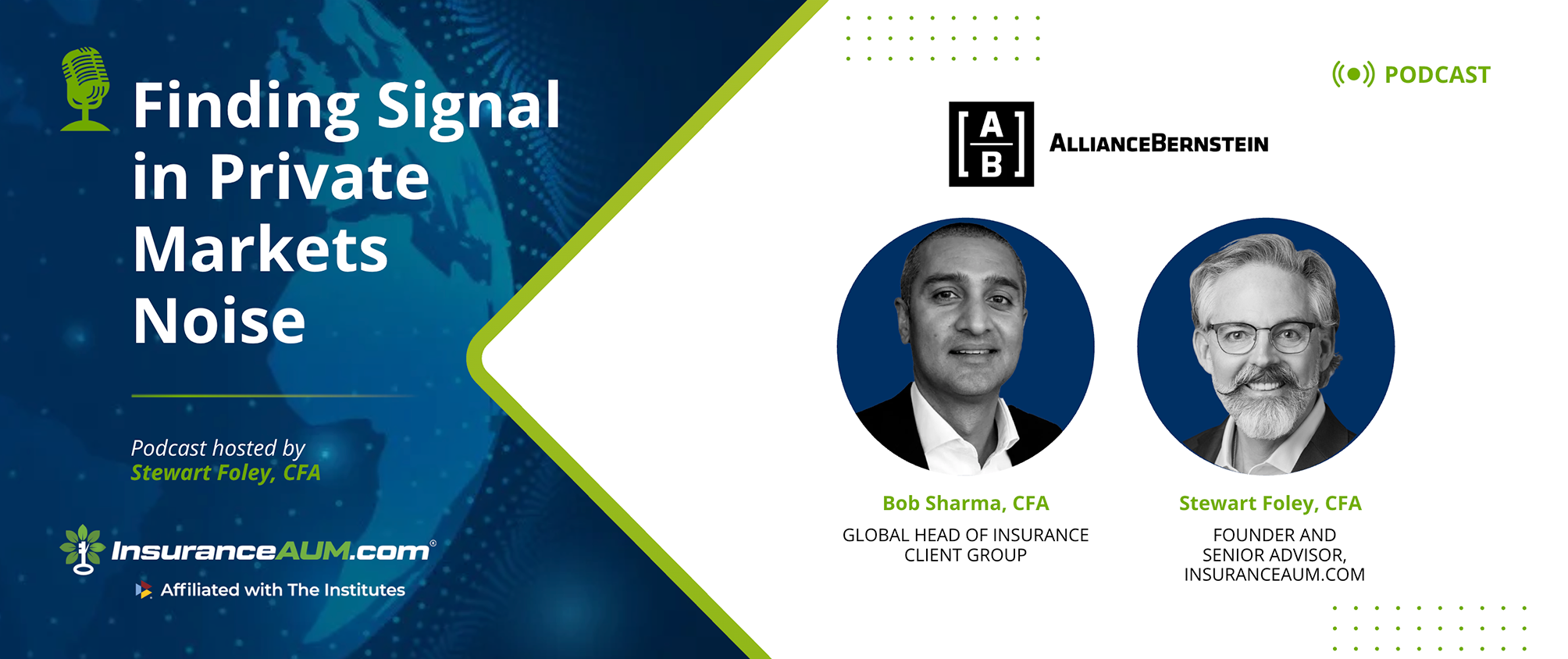
Finding Signal in Private Markets Noise

Image
IAUM_Podcast_5.23.26_Web_2026_v02


Stewart: I'm Stewart Foley, CFA, and I'm your host, and we're thrilled to have you with us today. I just want a quick shout out to our team. I mentioned this on our last episode, but we were the recipient of five podcast awards, which is beyond my wildest dreams when we started this thing. And I want to say that I get way, way, way too much credit for this. And there's a team of folks that work with me that are really consummate professionals in this business. We have a really small team, and it's because of them that we received these accolades. And I really, really want to thank them and thank all of you for being such great listeners. We're approaching 375 episodes. And I just want to say thank you so much. There's a lot of gratitude on this end of the microphone. So thanks so much. Let's get to it. And what I would say here as a lead in is that in private markets today, there's no shortage of information, but there is a real shortage in clarity. And for insurance investors in particular, separating the signal from the noise has been one of the most important parts of the job. And the title of today's podcast is Finding Signal in Private Markets Noise. And I'm joined today by Bob Sharma, CFA, Managing Director, Global Head of Insurance Client Group at AllianceBernstein. Bob has been in this business. He's what I would refer to as an OG. He advises insurance clients globally on portfolio strategy, asset allocation, and developments across both investment markets and the insurance landscape. He joined AB in 2024 after two decades with our friends at Wellington Management. Bob is based in London and holds a degree in economics from the University of Manchester, along with a sustainability and climate risk certificate. Bob, welcome. I want to talk more about the University of Manchester, but we're thrilled to have you.

Bob: Thank you, Stewart, and appreciate you having me on the show. Before we get started, I just wanted to say congratulations on the accolades at the Podcast Awards. That's wonderful to hear.

Stewart: I really appreciate that. The category was like industry podcast, right? It's not like our audience is small and really narrow, but we really do have a group of folks who are pretty dedicated listeners to the show, and they're also personal friends of mine. And I hear from other people that they hear from their friends when they're on. I don't ever hear from anybody about these podcasts, which is why ... And weirdly enough, we didn't apply for this. They found us. And I got an email yesterday, somebody saying, "Hey, we've got some awards and we want you to apply," or whatever. And it's really humbling because all we're trying to do is educate people by dumping the knowledge out of really smart guys like you. I'm just the conduit here. And so I genuinely feel like we bring a personal aspect to this business where we're trying to get to know people a little bit more than here's what the asset class is and here's how it works and here's what you should know and whatever is like there's a human being that's talking here and that they're deeper than just that. They have other interests, other interests that you may share with them. And at the end of the day, whether you're on the buy side or the sell side of this business, it's a pretty small community and it's a very high quality group of people, not just knowledgeable, but a really good group of people. And I'm eternally grateful to be a part of it. I really am. And so thank you so much. All right, so let's get into it. Okay, here's our icebreakers, Bob. Where'd you grow up? And if you weren't doing what you were doing today, what job would you most like to have instead and what job would you be terrible at?

Bob: So I was born in Calgary, Alberta, which surprises people because people can often not hear the Canadian accent, which I lost many years ago. But yeah, I was born and raised in Calgary, Alberta, and then my family moved to London in the late '80s. But I really, I guess I sort of consider myself a little bit of a global citizen. I know that's a little bit of a cliche to say, but I was born in Canada, as I said, and have really spent most of my life growing up in the UK. My parents were born in East Africa, in Kenya, and then obviously settled in Canada and then the UK. My grandparents are originally from Northwest India. And so I guess the way I tell the story is each generation of my family moves to a new continent. And so I've already warned my children, we're going to have to move to South America or Australia at some point.

Stewart: Well, Antarctica's open.

Bob: That’s another choice. Fantastic.

Stewart: Exactly. So a friend of mine asked me, so you went to University of Manchester, the person said, ask him if he spent more time in the library or at something called the Hacienda. What's the situation with that?

Bob: Yes. Well, actually, you've got a well-informed friend there. The Hacienda, I did spend some time in the Hacienda. It was a legendary place. Unfortunately, it closed a couple of years after I finished in Manchester.

Stewart: That's interesting.

Bob: It was a legendary venue. Lots of great musicians have played there. And yeah, sadly, it's now a block of flats.

Stewart: There was a place called The Shack at the University of Missouri. It was where the comic that did Beetle Bailey famously engraved his name in the table there, but it was one of these places that wouldn't have passed a building inspection. I'm 6'2", and there were many parts of that bar that you had to duck down because the ceiling was so low. I mean, I'm sure it was not safe by any means, but so let's talk about at the top. So we have a CIO call that is a private call, and there were about 30 people on that call. And I would say that half of those folks felt were concerned about headlines, and half of those folks viewed this as an opportunity. So you are in front of insurance clients all the time. What are insurance clients most focused on right now when it comes to private markets?

Bob: Yeah. Before we get to the private markets, I think the macro environment is really at the forefront of people's minds. Obviously, we have this conflict in the Middle East. Uppermost in people's minds are, what are the implications of that? Obviously, inflation, but there are many second and third order effects that people are sort of working through. Higher rates for longer is obviously a key factor. And then outside of that, AI as a positive force, but also potential negative implications. So on the one hand of the ledger, everyone's excited about the productivity gains, what it means for margins and health and life longevity, but clearly it's going to come with some dislocation, whether that's in the labor market, wealth inequality. So there's a lot. I think the macro side of things is uppermost in people's minds. And obviously within that, allocations to private markets are contingent.

Stewart: Is it fair to say that the macro environment is macroeconomics, but it's also macro geopolitical because there are things impacting markets that are driven by decisions being made by people that are hard to predict and advance. And so there's some uncertainty that is introduced there that could have an impact on the economy, but it's not really purely economics. Is that fair?

Bob: That's 100% right. Yeah. I mean, a lot of these events, you can't really model. There isn't a model that allows you to assign probabilities and figure out the outcomes. And so, you're right, I think levels of uncertainty are very high. And so, there's a direct implication of how you manage your portfolios and what that means for allocations. I think in many respects, it requires a higher degree of agility and ability to turn exposures around. And to a certain extent, that flies in the face of private markets because these are not typically assets that you can trade. There isn't as liquid a secondary market for many of the things that we talk about in the private space. So, it is certainly a consideration and the ability to keep portfolios agile, I think, has been central.

Stewart: I think a lot of our CIO friends would tell you and insurance companies have a relatively long SAA view and they're built to withstand some market volatility. And if they stay the course on what their long-term objectives are, I think that sometimes I think we talk a lot more about the noise than really the noise maybe deserves. I don't know. But let's talk about the role of private markets and portfolios. I remember, I've been at this for a minute, as you can tell by looking at me, and I remember people saying like, "Hey, when the treasury, when the 10-year gets to 4%, you're going to see money flow out of these private markets, blah, blah, blah." Remember that? It's like, "Oh yeah, as soon as this ... " Yeah, and that's exactly not the case. And it's interesting. So how are insurers thinking about the role of private markets within the overall portfolio today, but also you're a veteran here. How has it changed?

Bob: Yeah. So I mean, if we go back, I think the initial demand for private markets and insurance portfolios was largely driven by the search for yield. So when rates were zero or very low, insurers felt compelled to find yield in other places. And private markets, private debt in particular, private credit became ... That was the starting gun for this flow and this allocation that we've seen. And you're right, there was talk of, as rates normalize, are we going to see this reverse? And we haven't seen that. If anything, we've seen increased flows into a wider range of underlying private asset types. And so I think the rationale for that is largely lower returns available from the public markets and the diversification benefit that you get from this wider range of private debt asset types. Some of that is inflation protection as inflation levels are higher and a little bit stickier than they have been in the past. And then some of it is, as I say, I think lower returns from public markets, lower returns from beta and the need to seek active returns in a wider range of areas. And in the private markets, that means seeking a liquidity premium from these asset types and a complexity premium at times.

Stewart: I don't have to tell you this, but there's been quite a bit of headlines lately. It's been a big theme. I'll say something that's relatively controversial, I guess, or maybe, but there's career risk for senior investment officers. And depending upon how their relationship with their investment committee or board or CEO impacts perhaps they don't feel like there's an issue, but they feel pressure from a career perspective. And that may not be a popular thing to say, but it's real and anybody who knows this business knows it. So that's why I mentioned earlier that on that call we have some folks viewed it as an opportunity. How do you see these headlines influencing how insurers are pacing and allocating to private markets?

Bob: The headline risk you can't ignore. I mean, I would say it comes up in almost every conversation that we have with insurers. And the way I would characterize it is a little bit of stakeholder management. I think a lot of boards read the headlines and ask questions of investment teams, CIOs. And I think some of it is a case of providing context around the headlines. I think in some respects, the headline risk is around a couple of unrelated topics. If we take the liquidity mismatch in the BDC space for retail investors, that's very separate to, we've seen a couple of credit issues, fraud issues in a number of names. Those are sort of unrelated issues. They're unrelated topics. And then you have the AI disruption in software. Again, they're not directly related and they're different parts of the private credit universe. So I think it's more a case of giving people the context, giving people the comfort around some of these issues and not hiding from the headline risk that is out there.

Stewart: Yeah. And this is a self-serving comment, I think, but getting balanced and accurate information in front of people that it's easy to just say private markets or private credit with one gigantic umbrella. But to your point, these are some pretty specific areas and not related. So I think it's a great point. So let's talk for a minute about capital and regulation and structuring. So I think I've said this before to people, I think sometimes the structure of the investment matters as much as the collateral underneath it. And regulatory and capital charge considerations are at the front of mind for anybody allocating insurance investments. So can you talk a little bit about the importance of structuring when you're building private markets exposure for insurers?

Bob: Yeah, I 100% agree with that. I think the capital efficiency and the capital, the regulatory capital considerations of these exposures are crucial. And again, that's one of the reasons why insurers have continued to be drawn to this space because many of these underlying private asset types lend themselves very well to structure and be optimized for insurance regulatory capital considerations. Now obviously there are different regulatory regimes in different parts of the world. The NAIC and the risk-based capital charges in the US are different to where I'm from in the UK where Solvency II is very prevalent. But I think the underlying rationale remains the same. If you can use the different underlying collateral types to create and structure an exposure that is optimized for the relevant capital regime for that particular insurer, then that is a key attraction of this asset class.

Stewart: One of the things that's interesting about insurance is the only way to really know what's going on is you got to have your ear to the ground. It's not like there's like people are reporting on this stuff left, right, and center. And so someone in your position has some insights into where allocations are shifting. I mean, these insurance investment professionals talk to each other, they attend similar events, they hear similar messages from us and others. Where are you seeing the biggest shifts in insurance allocations today? And how do you think about the private markets going forward from here?

Bob: So I would say most insurers have been on a somewhat similar journey in the private markets. And for many, that journey started in the direct lending space, the corporate direct lending space. And the shifts that we're seeing now are greater acceptance into areas around asset-based lending. And the attraction is clear. These are areas where banks are retrenching, you can have much more flexible terms and better covenants. And so again, it allows you to create a set of exposures that can be optimized for the regulatory capital regime that is under consideration and attain really interesting and attractive spreads that bring a bit of diversification to your overall portfolio. Now having said that, we talked about the headline risks. I think one of the things we are seeing is slower and more deliberate allocations, making sure that boards and stakeholders are comfortable with not only the existing allocation, but any additions to that allocation over time.

Stewart: It's interesting. I think one of the things that we've talked about here is the need for board education, investment community, the board education. I think there are folks who'd say, "Hey, I want to make sure I know what you're telling the board." But I do think that as these markets get more complex, the bar continues to be raised in insurance asset management. I think that's clear. And with all the changes that have happened in our industry, the days of sitting around with your arms crossed and saying, "We've been doing it like this for 25 years," those days are gone. And so I do think that we all are, I think the sophistication level in our industry has increased, particularly over the last five years or so. But let's talk about this for a second. What do investors get wrong? So as the private markets, we talked about complexity. Where do you see insurers mis-evaluating opportunities or perhaps not understanding the portfolio fit of certain things? Do you see things like that over time that you could say that you could generalize anywhere in there?

Bob: Yeah, I don't know if it's about getting things wrong, but you touched on it earlier. I think it's classifying the private debt landscape, which is varied. There's lots of different types of underlying collateral types and asset types, but I think sometimes people kind of put them under the same umbrella and tar it with the same brush. And so when people say private credit, do they mean direct lending? Do they mean asset-based lending? Do they mean commercial real estate debt? There's lots of different flavors, as I say. And I think sometimes talking about that entire category as a single category is a little bit of a misrepresentation because they all behave slightly differently, have different drivers, have different characteristics, have different duration profiles, and have different drivers and play different roles in portfolios. And so I think maybe that's one thing when people say there are these headline risk issues in private credit, I'm not sure that's true across all aspects of the private debt landscape.

Stewart: Very, very good. You're not old enough to remember this phrase, but this is the $64,000 question, Bob. As we wrap up here, how should insurers think about navigating private markets today, particularly in separating signal from noise?

Bob: I think we've been, really since the financial crisis, I think we've been in a period of suppressed volatility. If you look at the dispersion of returns in particular areas, it's been low and we've got to remember these are credit assets. We should see some losses. We should see some cyclicality to the return profile. And I think we're probably in a period where we're going to see some of that. And I think we should welcome that because the bigger concern is as insurers have allocated to these areas, if underwriting or credit standards have not been at the levels that they should be, then that's where you're going to see losses, that's where you're going to see issues. And so I think that is a risk, but also a potential opportunity because on a go forward basis, if dispersion is slightly higher, then you'll see the managers that have kept underwriting standards tight. You'll see that in the performance that they deliver. And so that, again, is a risk and an opportunity on a go forward basis.

Stewart: That's great. It's been a phenomenal education today, Bob, and I appreciate you coming on very much. I've got a couple of fun ones for you on the way out the door. One of them is, I mean, you're a longtime guy. You stay at firms a long time. You don't jump around and you've seen others come and go. And the question is really attempting to get at what I believe to be culture at AllianceBernstein. What characteristics do you look for when you're adding to members of your team and what's been successful for you over time?

Bob: I think that's a really important question and I'm glad you brought up the topic of culture because I do think that's a really important aspect. And I think that's what keeps people at organizations for long periods of time. And that's one of the things that drew me to AllianceBernstein. I think it's a really strong culture here. People stay a long time and the culture is ... Some of these words are sort of cliches, but I think they're true. It's a very collaborative place. I think people support each other and want to see their colleagues succeed even outside of their own areas. So when I think about the characteristics of colleagues and team members, I think collaborative mindset is at the top of that list for me. Intellectual curiosity, this is a tough business.

Stewart: Yes, it is.

Bob: And I think you need to be surrounded by people who are curious. I also think it's a fascinating business to be in. You get to learn a lot, you get to meet a lot of smart people, and it's humbling. And so I think it's important to stay curious. And I think you need humility as well. I think humility and conviction in balance, right? I think those would be some of the key characteristics that I'd look for.

Stewart: Yeah. I mean, there are some really bright people. I feel blessed to be able to interview people who are really at the top of the game, kind of all over the place. And I mean, one of your colleagues, I mean, Jeff Cornell is a guy that I came to know several years ago, and there are people who have an understanding of markets and insurance asset management and how it fits together and just have a command of it. And it's humbling. I agree with you. Every time I'm with this bunch, I always learn something. Somebody's always doing something interesting. They're going someplace interesting. There's some factoid, I learned this or that. It's interesting.

Bob: So, Jeff is one of the reasons I joined AB. And before I joined, I spoke to a sort of longtime mentor of mine. And one of the things he said to me was, "If you get the chance to work with Jeff, you should take it because not only is he really smart and creative and you'll learn a lot, but he's just a decent human being. He's a nice guy and you'll have some fun along the way." And I think ultimately that's hopefully what we're looking for when we go to work every day.

Stewart: Absolutely. All right, last one. You can have dinner with up to four ... Well, you and three guests, four total. I don't know why I'm having a hard time getting that out. You can have one, two, or three guests, dinner's on us. Who would you most like to have dinner with, alive or dead?

Bob: Well, I'm going to struggle to fit that into three guests, but let me give it a shot. So I'm going to start with Leonardo Da Vinci, possibly one of the greatest minds of the time.

Stewart: Super interesting. Amazing.

Bob: Across a range of categories, art, science, engineering, philosophy, I think he would be a fascinating individual to speak with. If I wasn't in the investment business, I would love to be a travel writer. I really enjoy traveling and seeing different parts of the world. And so I would have to choose between either David Attenborough or Anthony Bourdain.

Stewart: I was going to just say that. I could see you in an Anthony Bourdain kind of thing. I mean, Bob, you never know. I mean, I know it's good at AB, but when you retire, maybe you go out and you do that. I mean, that's an interesting idea.

Bob: And then the last one, I wanted to have someone from the investing world. And I mean, the two names that are in my mind, Ray Dalio and Howard Marks, I find them both, they're great macro thinkers. And I think everything that we've talked about with debt levels and geopolitics where we are today, I think they would have an interesting perspective to share. And then the wildcard, I'm going to go for a fourth guest, I think Michelle Obama, because partly I think it's important to have a female on the list, but also someone with a degree of kindness, warmth, and she's just cool.

Stewart: Yeah. Yeah, I'm with you. I have to say, Howard Marks spoke at our event last year, and I want you to know, I feel comfortable admitting my finance geekness on this show. And so we were at the University of Chicago's Gleacher Center and he stands up and he walks over to the board and he's going to draw on the board. And I don't know, I was sitting next to Nick Smith at Nationwide and I whacked Nick Smith on the arm and I was like, "He's going to draw something." I felt like a little school kid. And I will say, as a professor of seven years, everyone knows that the markers in the tray are dead. That's why they're there. You have to bring your own markers, right? So we didn't have any ... The marker that he picked up was dead. And I was like, oh no, but we survived anyway. But that's a cool table, Bob. I think that's cool. And it's been great to have you on. It's been a great conversation and thank you for your insights and sharing a little bit of personal stuff with us too. So thanks so much for being on.

Bob: Absolutely. My pleasure. Thanks for having me.

Stewart: And we've been joined today by Bob Sharma, CFA, Managing Director and Global Head of the Insurance Client Group at AllianceBernstein. If you like what we're doing, please rate us, review us on Apple Podcasts, Spotify, or wherever you're listening to your favorite shows. You can also watch this podcast on our YouTube channel at InsuranceAUM community. We appreciate you listening. We hope you join us next time. We are the home of the world's smartest money on the InsuranceAUM.com podcast.

Share this post

Sign Up Now for Full Access to Articles and Podcasts!

Unlock full access to our vast content library by registering as an institutional investor

Register

Contacts


AllianceBernstein

At AB, insurance is in our DNA. We understand insurance investors’ biggest challenges because we’ve lived them from the inside out. For more than a half century we’ve managed insurance client assets. Our dedicated vertical, deep resources, distinctive investment capabilities and forward platform are designed with insurers’ needs in mind. With an uncommon approach, a collaborative culture and a commitment to innovation, we drive flexible solutions that unlock potential across balance sheets and the full market spectrum- from fixed income to private markets and equities. We’re built to be long-term partners in the evolution from traditional asset-liability management to the new reality of strategic portfolio construction. AllianceBernstein (AB) is a leading global investment-management firm serving institutional investors, individuals, and private-wealth clients in major world markets. Our diverse, connected, collaborative culture encourages different ways of thinking and differentiated insights. We embrace innovation to address increasingly complex investing challenges. And we pursue responsibility throughout our firm- from how we work and act to the distinctive solutions we design for clients.

https://www.alliancebernstein.com/

AllianceBernstein
501 Commerce Street,
Nashville, TN, 37203

Robert Amberger
Client Advisor – North America
robert.amberger@alliancebernstein.com +1 212-823-2890

Bob Sharma
Global Head of Insurance Client Group
bob.sharma@alliancebernstein.com +44207-170-0688

 

View the contributor page

Sign Up Now for Full Access to Articles and Podcasts!

Unlock full access to our vast content library by registering as an institutional investor .

Create an account

Already have an account ? Sign in

Ѐ Ё Ђ Ѓ Є Ѕ І Ї Ј Љ Њ Ћ Ќ Ѝ Ў Џ А Б В Г Д Е Ж З И Й К Л М Н О П Р С ΄ ΅ Ά · Έ Ή Ί Ό Ύ Ώ ΐ Α Β Γ Δ Ε Ζ Η Θ Ι Κ Λ Μ Ν Ξ Ο Π Ρ Ё Ђ Ѓ Є Ѕ І Ї Ј Љ Њ Ћ Ќ Ў Џ А Б В Г Д Е Ж З И Й К Л М Н О П Р С Т У Ф Х Ц Ч Ш Ā ā Ă ă Ą ą Ć ć Ĉ ĉ Ċ ċ Č č Ď ď Đ đ Ē ē Ĕ ĕ Ė fi fl œ æ ß