




Apollo-

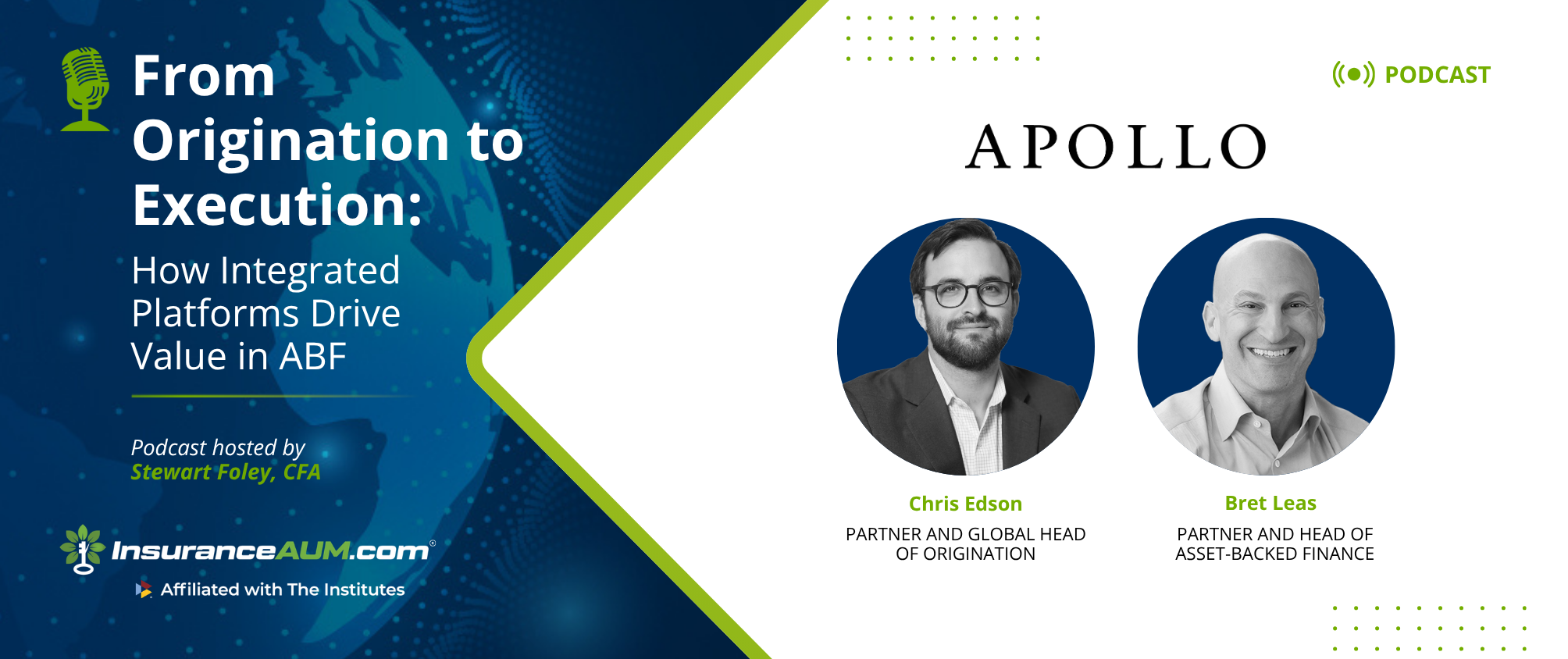
From Origination to Execution: How Integrated Platforms Drive Value in ABF

Image
05.21.26 Apollo_Web


Stewart: Hey, welcome back to the home of the world's smartest money. I'm Stewart Foley. I'll be your host and we have a great podcast for you today. I also want to make mention that it's been posted on social media, but our podcast actually won five awards, including one for host and also for one of our episodes. And I just want to say that the podcast really, it's my face and in my voice and whatever else, but there are a group of people who really work hard to make this work. We have Lindsay on our team, Jennifer, Mazed, and others who put this together and make it rattle and hum. And I just want to say thank you so much. None of this happens without them. And I just want to say thank you to everybody there. So our lead-in today is that in private markets, access used to be the differentiator.

Today, it's something else. It's control: control over the origination, the structure, and ultimately the outcomes. And the title of today's podcast is from Origination to Execution: How Integrated Platforms Drive Value in ABF. Today, I'm joined by Chris Edson, Partner and Global Head of Origination in Apollo, and Bret Leas, Partner and Head of Asset-backed finance. Chris oversees Apollo's origination ecosystem, outsourcing and structuring approximately $300 billion annually, and has held leadership roles across private equity and financial institutions investing. Bret leads Apollo's asset-backed finance business and sits on several key boards across the platform. Prior to Apollo, he worked in credit structuring at Barclays and began his career in law. Bret and Chris, welcome to the program. We're thrilled to have you.

Chris: Great to be here.

Stewart: Let's start it off the way we always do, which is where did you grow up? And what job would you most like to have if you weren't doing this? Let's start with you, Chris, and see how we do.

Chris: Sure. I spent half my childhood in a small town in New Hampshire. I spent the other half of my childhood in Chicago. If I weren't doing this job, I won't steal my partner’s because I have a pretty good idea what his job might be, but I would love to do something out in the wild, out in nature, somewhere away from the big city, and really just mix it up.

Stewart: I love that. How about you, Bret?

Bret: Sure. Good morning. So, I was born and raised in Philadelphia, Pennsylvania. And so, I spent the first part of my childhood there, and then the second half in Rockville, Maryland, where I ended up going to University of Maryland as well. So mainly on the East Coast of the United States. And if I wasn't doing this, as Chris knows quite well, I would be a cowboy.

Stewart: Wow, there you go.

Bret: Just full on, outside, on the range all day, every day.

Stewart: It's interesting. I live in Fredericksburg, Texas. And you hear about... Growing up in Missouri, I heard about people like that. And when you see them, you know it. There are some folks who do some things for a living that I just think to myself, I would not survive that. And it is an honest living, and it's super interesting. That's a really cool answer.

So let's start off with what origination really means and really start at the top, Chris. At Apollo, what does it mean to be the global head of origination in a way that's different from most firms?

Chris: I think there's two things to cover here. First, starting with the definition of what origination is. When we think about origination, that is when we are actively talking directly to a borrower. We are doing direct due diligence. We are structuring a solution. We are funding it directly. We are servicing it. This is very different than the way a lot of investments are made, which is buying a liquid CUSIP in the credit markets, off a trading desk, or through an intermediary, where there isn't that direct relationship or due diligence or any of those sorts of things. And as you've mentioned, for us, origination is not every dollar of our investment, but it's a large portion of it. And for us, that was about 300 billion of origination volumes last year. The second thing when we think about origination is really firm structure. A lot of traditional asset managers and investment institutional investors are set up in silos.

They have equity businesses, they have credit businesses, they might have hybrid or other types of businesses. Each one of those businesses is a standalone business with a standalone team focused on absolute returns in their area of focus. We are the opposite. And really what we have tried to build is an ecosystem across our firm that connects all of the different teams and groups that have industry knowledge, that have access to different types of opportunities and help us increase our funnel, that help us underwrite, that help us structure and service. And really this ecosystem includes thousands of employees. We focus on this one Apollo approach, and these people sit both in the firm and in our affiliated origination platforms. And of course, my partner, Bret, is really key to this ecosystem and has helped a lot of us build this over the last 15 years.

Stewart: It's super interesting to me because, and this is a naive question and I apologize, but if you're buying these structures from whoever it is, there's a markup, some sort of a markup in that. Has to be. They can't work for free. You as an originator and ultimately investor there, does that have an impact on the net yield on the instrument?

Chris: Yeah, so this is an excellent question. The cheapest form of borrowing is a standard liquid CUSIP in the market. Our form of lending is a custom solution that is typically a little bit more expensive than that public instrument. So why would anyone want to call us for something that is a little bit more expensive? Well, they do that because it adds value and it provides a solution. And as we've shifted the firm to this solutions mindset, companies need lots of different things. People need lots of different things. If you want to borrow money in the liquid CUSIP market, you have to borrow it today and you get it today. If you need it in five years, you need to go to the market in five years and borrow it then. We can provide structures that have drawdowns over time. Why would someone want to draw down over time?

Well, there's been a huge amount of volatility in the market over the last six years. Yet COVID, Russia, the interest rate rise, the regional bank crisis, Tariff Liberation Day, and of course the Iran war and the sovereign concerns right now, those things change the access and ability to borrow in the future. So if a company knows they need to spend money over the next five years, they often would rather have certainty funds committed in a drawdown structure, even though that costs a little bit more because that provides protection. The other thing that people look for on the solution side is think about the other knock-on effect of that volatility, supply chain interruptions, supply chain shocks, the chip crisis or the chip shortage that we had during COVID. Lots of companies want to hold more inventory on their balance sheet. They need a custom solution to be able to hold more inventory.

There's also this industrial renaissance that's going on. Tens of trillions of dollars, trillions, not billions, of CapEx is expected to be spent over the next couple of years, sourcing this, the diversity of different capital providers, custom solutions, all of these sorts of things. And then of course, asset-backed finance. Asset-backed finance, everything from transportation to equipment to fund finance and different things that institutional investors are thinking about these days.

Stewart: That's super interesting.

Bret: And maybe just one other thing to add on to Chris's answer. Imagine just for a moment, you're the CFO of a large company and you're trying to plan out your borrowing needs for years. Well, the first thing you'll know is, I don't want to put all my eggs in one basket. The public market may be cheapest, but it's fickle. Diversification works in investing, but it also works in financing too. The rules we live by and part of our life apply to all parts of our life. And I think what Chris just explained very eloquently is really that fact, which is being a good planner, having a multitude of options benefits you all the time, and it is just prudent risk management.

Stewart: It's interesting to me because Apollo has almost, I think, invented a model that many others have tried to copy. It has been an exceptionally successful model. So how did Apollo's insurance business influence the decision to put origination at the center of the platform? And what problem were you trying to solve early on?

Chris: It all starts with risk-reward. Investing 101 is try to earn the highest return and take the least risk. The question we always ask is, how do you know? How do you know? How do we think we know? We think we need to be able to see almost every asset that is available. We need to be able to have the expertise to put a risk score on every single asset that's available. And so we create this really wide funnel. Then we have to have the capabilities to service this because buying a corporate bond is very different than doing an inventory financing partnership with a large company. So capabilities are important. And what we did is we looked out at the market about 15 years ago and we said, spreads are at historical tights. The demand for yield is immense. So what's happening to documentation? Documentation's getting looser.

So risk is increasing and rewards are decreasing because of the dynamic in the market. So we want to control our own destiny. So Bret, myself, and a number of others set out to really build this ecosystem, this origination ecosystem, so that we could source these assets, control these assets, control our own destiny, and generate the best risk reward for our balance sheet. Because as you said, this was a growth in an insurance business, an insurance business that sits on our balance sheet. So we think it with the principle mindset in all of this. So we've built this in a way that we think drives the best risk reward for where we have our own capital at risk.

Stewart: That makes sense. Okay. I appreciate that. There's a lot of good information there, and it's interesting. I mean, it's interesting to me because so many people know of your platform, but the interesting thing to me about this podcast is like getting to see under the hood. So it's interesting for me. I'm learning a lot as here as well. So Bret, I want to come to you and really Chris talked about this, integration across the platform and the One Apollo concept. What does the interaction actually look like between origination and the investment teams, and how do you determine where to source assets at any given time?

Bret: Sure. So it starts with one key mindset, and this comes from Chris. It's my favorite. It starts with a key mindset that begins with the phrase “yes, if we're trying to find people's problems, we want people to tell us their problems.” Well, when people tell you their problems, you can't just say, "No, I can't solve your problem. My capital isn't good for that. My risk appetite isn't good for that." You say, "Thank you very much. I'm so happy that you trusted us enough to share your problems. Here's what we can do for you." And so the interaction starts with, did we capitalize our business right so that we can solve all manner of problems at any risk point? Did we create the expertise in the business, both from the people that work in the origination platforms, which are owner, operators of businesses, which are asset creators, and then combine them with professional investors, risk managers, modelers, quants, et cetera.

And did we map the entirety of the universe so that we can see value? If we do that, then we put ourself in this really good luxury of choice where we say, "We're going to solve your problem for you. We're going to talk about price. We're going to talk about risk, but we're not going to say we can't solve your problem." That only happens together. I can't do it alone. Chris can't do it alone. It only happens together. And so this firm has made a choice. Not everybody made this choice. We made this choice. And to be a solutions-oriented firm means you're effective in origination. To be a markets oriented firm means you're not effective in origination. We're a solution oriented firm, and that means we have to work together. Nobody here can go alone. And I realize that sounds like a bit of a platitude, but it's not because every single day, Chris and I talk. Every single day, all of our teams talk. And if we're solving people's problems, what do you get? You get repeat business, you get a reputation, you grow, you're more effective. That's what it looks like.

Stewart: Yeah, I think that's well put, and it's a great distinction. Right now, asset-backed finance is white hot. There's a lot of attention being focused there, and it seems to be evolving. How do you define ABF at Apollo, and where are we in the evolution of this asset class? I think this one goes to you, Bret.

Bret: Sure. So Apollo takes an incredibly broad definition of asset-backed finance, and I'd love to tell you that we're right. It's a matter of opinion though, but this is how we do it. So the first thing is, there's only two ways to lend money in this world. One is you're an enterprise value lender. You lend money to the companies. You could be unsecured if they're high credit companies like investment grade or secured if they're low credit companies like high yield. But what you're really doing is you're trusting management and you're taking the full faith of management, the cash flow from operations, the value of the business, and you're extending them credit. A lot of trust in there. It's what the world knows. Well, the other side of the coin though is asset backed finance, which is diversified, cash flowing, mission critical assets where you're not lending to the company itself, you're lending against this pool of assets.

You're divorcing the company's operations from the performance of the assets and you're relying upon credit enhancement, diversification, and cash flow. It doesn't make one right or one wrong, but they're different. When you look at them between those two lenses, the asset-backed market has two really important features. One is it finances every second of every day. Companies, like what Chris said, a company may choose to finance once every three years. It doesn't have daily needs to finance. Companies that create assets, whether it be auto loans or mortgages or credit cards or even planes, they need to finance them every day. They're critical to their operation as part of serving their customer. And when you take that unbelievably broad view, globally, the market is so large, it's hard to wrap your head around it. We at Apollo take that broad view. That luxury of choice is amazing, but most importantly, you touch it, feel it, see it every single day, even if you don't know it.

Do from the second you woke up today, the minute you go to bed, you touch this market. I don't care if you got to work by walking and listening to music, that's asset backed, the music. If you were in your car, that's asset backed. That's how your car is financed, lease or loan. If you took the train, those train cars are financing your asset backed market. It's this amazing thing that just kind of clicks around in the background and provides credit where it's needed. So we define it that way almost as what it is not rather than what it is. Chris, I don't know if you can give a different view.

Stewart: It's interesting that you say that because I have friends, lots of friends that have nothing to do with this market. Do you know what I mean? They're like, "Oh, those Wall Street guys, blah, blah." I'm like, "Listen, every time you swipe that credit card, everything you do, like your car, your house, whatever, ends up in an investment portfolio someplace." And that's what keeps the world going around. I mean, to your point, it's not some nebulous outer space concept. You live this stuff every day.

Bret: You do. You know what's funny? So outer space, rock and park, You're there too. Asset backed.

Stewart: It's so true. That's interesting. Chris, I didn't mean to keep you out of there. Go ahead. I'm sorry.

Chris: Oh, look, my partner said it well. It touches everything. And we often find ourselves looking around as we're in our car, as we're traveling somewhere. And everywhere we look, we see a building, we see a piece of equipment, we see something flying above, we see a container, we see a train moving. Everywhere we go is asset-backed. It's all the digital payments. It's how we consume things. And so it really touches everything. And having the ability to understand and originate and structure and service, that is the complexity. The underlying thing is actually not the complexity.

Stewart: Yeah, that's interesting. And it leads me into my next question, which is one of the defining features of ABF is structural protection. How do you think about collateral documentation and capital structure when you're underwriting these investments? I think this goes to you too, Bret.

Bret: So protections like this are key to asset backed. You have a defined pool of stuff. That's all it is, right? I'm not relying on the enterprise value of something, pay me back. It's the defined pool of stuff. And so what you have to do is you have to know that that defined pool of stuff is performing as expected. And the second it's not, you have to take action. There isn't flex. There's no covenant light in asset backed. It doesn't exist. It's all very prescribed, very rules-based, very focused, very tight documentation. Now, of course, there's shades within all of that, but it is based on that premise and that principle, and that when it's time for creditors to act, they need to act. That's step one. Step two, asset-backed is largely bankruptcy remote. And so these sorts of things we see in other markets where creditors are going at each other through courts of equity, that really isn't a concept in asset backed.

So that provides the predictability you need. And in fact, the market has been tightening, not loosening over many, many, many years. And it really doesn't matter which form you do this in, whether it's public, private, whole assets, warehouse, doesn't matter. It's always the same technology.

Stewart: So the next area is public and private convergence. And I'll tell you just a little story. So years ago, I went to see Eric Kirsch, who was at that time, CIO of Aflac, and he was extremely generous with his time. He had done an interview with us and I brought him some ... We used to do hard copies of our publication. And I asked him about public versus private, and this goes back. And he said he thought that private markets could be bigger than public markets at some point. And I thought he was crazy. In fairness, when I started InsuranceAUM, he thought I was crazy. So here we are, right? And it goes to you, Chris. How do you think about the convergence between public and private and what's driving the borrower decision to issue in one or the other? You touched on this, but I think the convergence aspect of it is important.

Chris: So to start just with the definition, because you mentioned scale, there's a lot of discussion on what private credit is right now in the market. The key headline that we would point you to is the other 95%. And what do we mean by this? Well, the discussions in private credit that are mostly being talked about in the press are talking about sponsor lending, LBO finance, non-investment grade, high yield type corporate lending to private equity funds. This is a one to $2 trillion market. This is a tiny fraction of the overall private credit landscape as we think about it. We focus on the $40 trillion market, the other 95%. This is primarily high grade risk. This is mortgages, consumer finance, commercial real estate, trade finance, transportation, equipment, infrastructure and project finance, all of these sorts of things. These don't sound like things that are new. These are things that have been around for decades.

These are things that have been private for decades. And these are the types of assets that we think about when we think about the private credit landscape. And what is happening in this market? Well, these markets are very similar to what they used to be. The big shift has been over the last 15 or 20 years, a focus on ALM, asset liability matching. If an asset has a 20-year maturity, it should be funded by a 20-year liability, not an overnight liability.

Stewart: I have made this point. I made this point. I have made the same point. Keep going. I think it's a great point.

Chris: Yeah. And what we've learned over the last 20 years is the number one cause of systemic issues or shocks to the system is really a mismatch in ALM. Whether that is people funding long duration assets with commercial paper, short duration commercial paper, or whether that's a pristine mortgage book with the 10 or 20-year wall, weighted average life being funded by uninsured deposits. Those are the areas of concern. And so what's happening is this is happening at the same time as there's been the new Renaissance. We're calling this sort of the industrial Renaissance. And what's happening is there's tens of trillions of dollars of capital need, mostly for long duration things, AI, energy, infrastructure, defense, all these sorts of things. There is a need for long duration liabilities. The same way insurance companies funded the Industrial Rent Revolution a hundred years ago, there is a similar focus for long duration insurance liabilities and institutional funds being the right source of funding for this next trend.

And then there's two reasons. One is, why do the lenders want it? Well, we and all of our insurance company partners that we work with in the industry like these assets because they have a little bit extra return and they have less risk. They have less risk because of all the things Bret walked through. They're collateralized with diversified pools of collateral and extra collateral. They don't have single point of failure because of that diversification. There's a direct dialogue with the borrower. There's due diligence access. There's real underwriting. There's tighter documentation with triggers and with covenants versus public bonds typically are much looser. So all these things drive this excess return per unit of risk. And then why do the borrowers want it? The borrowers want it for all the reasons we've been talking about, which is the solutions providing, the drawdown over time, the more efficient use of capital.

You don't need to own your fleet of vehicles. You should be taking that capital and investing in growth if you're a company. You should have an asset-backed finance partner that owns that fleet of vehicles. All of these sorts of things are really driving it on both sides. It's not a new asset class, it's just being matched in the right way and focused on solutions.

Stewart: Yeah. I've made this exact point. There's all this concern and, oh, this private credit's on insurance company balance sheets. And it's like, first of all, banks don't lend or banks are not lending for a million reasons, but the insurance industry is really driving economic growth. And to your point, you think about a bank. I mean, bank makes long-term loans funded with overnight liabilities backstopped by the FDIC. And you saw with Silicon Valley Bank, ALM 101 got tossed out the window and you don't have that same situation, you're not going to get a run on the bank in homeowners or in auto. It's impossible. So I agree with you. I think that the ALM ... And it's a really interesting point you make, and it's so true that the ALM problem is the catalyst for issues. And I just think it's a really good point that doing this, matching the assets to the liability makes an awful lot of sense.

Chris: Yeah. And the banks serve a key purpose. As you pointed out, they're providing cash management, they're great with volatile funding structures, which aren't as great of a fit for an insurance company. And we're seeing a lot of partnerships with the banking space because there's a lot of logic to this, matching the products that fit well on a bank balance sheet and with bank services, with the bank, matching the long duration assets, with the long duration liabilities and an insurance company.

Stewart: So let's talk about scaling the opportunity. And there's a question in here that is everybody wants me to ask, I think. As the ABF market expands, where are you seeing the most attractive opportunities and what becomes the real constraint at scale? Is it capital or origination capacity? And I want to go back to what Bret said, which is when you have a broad lens and a global scope, the opportunities are vast. There are people who listen to this podcast who say 300 billion a year Globe Life, as an example, and I just looked it up before the podcast, is about 30 billion all in. And when you're originating 25 billion a month, people say, "Is that sustainable?" Can you talk about what becomes the real constraint at scale? Is it capital origination capacity? Just talk us through the scaling of the opportunity.

Bret: I'll start and then Chris and I'll go together. So we get lost so easily in large numbers. It's so, so, so easy, but I want you to think about this. The asset backed market is a tens of trillions of dollars market that's growing by trillions of dollars a year. $25 billion a month is not a drop in the bucket. It's a drop in the ocean. In the ocean. It is turning over very, very fast. The average life of most things in asset backed are usually one to three years. You're making fresh decisions all the time. Go back to what I said about financing every single day. And so we haven't even begun to scratch the surface of what this market is and how fast it's growing. In In particular, as the remainder of the world becomes more and more developed, adopts this technology to grow its housing markets and its consumer finance markets and its transportation markets.

So with that backdrop then, let's just take the easiest market to really understand and where the most need is. Global housing. We are short housing United States. The UK is short housing. Saudi Arabia is short housing. Australia is short housing. Mexico is short housing. You could spend your entire life just trying to solve that financing need. From land banking to home building to second leans to HELOCs, all of it, to build to let, to buy to rent, to investors properties, right? Multifamily. You can spend the rest of your life and never have enough money to deal with this issue. And that's only one small piece of the market. Actually, it's not a small piece of market. It's one big piece of the market, but it's only one piece of the market. And so we get so, so, so lost in these big numbers sometimes and we forget that the opportunity set is so much greater and it's expanding.

It's not shrinking. Now, what is a problem? And where are we wrong way? There are certain nascent markets, especially in FinTech. And in consumer lending where the number of good credits, the number of good underlying borrowers is finance. And what people do is they enter these markets, they saturate them quickly, and the only way to keep growing is to either loosen your credit box, well, that's not fun, or tighten your pricing, or both. And so where we see people go wrong way is they lean into the very, very tiny, nichey end of the market. And there some markets are 25 or 50 billion in size. Okay. Well, then you as a good risk manager, you as a good investor should only be a piece of that. And once it becomes commoditized, once it becomes public IG corpse, it's time to move on to something else.

And this is where Chris and I spend most of our time together. Where is something a real opportunity? Where is something necessary or not? But beside housing, the second biggest opportunity, and I'll turn it over to Chris, is what we will loosely call corporates with assets. Companies have so many assets that weigh down their balance sheet that eat up their valuable borrowing capacity. And so corporates with assets along with housing I think are the two big ones, but Chris, you may have a different view.

Chris: Well, I think you said it well. And then the other question around constraints, our constraints really origination. And the demand for high quality assets is very strong. So we don't lose sleep over finding a really interesting opportunity and not being able to get it done. We want to make sure that we're continuing to find more and more good opportunities. And we have to find trillions of dollars of opportunities to do hundreds of billions of origination every year. I think that's an important thing that a lot of people miss. And we have to make sure we're adding value and that we are continuing to be a relevant partner to borrowers. Because if we are not adding value, we're just a trade and maybe we can fool someone once or twice, but that's not a business, that's not a franchise. That's why we've built this ecosystem with thousands of people to see all of these different opportunities and to really understand, Bret said it earlier, we're looking for problems.

We're problem hunters and we're problem hunters because we want to bring solutions. We want to help solve people's problems so that they can make more products or they can have more facilities or they can do any of these sorts of things. That problem solving mentality is core to everything we do that is at the heart of our culture and that is where we're focused.

Stewart: And so from a origination perspective and an investment perspective, where do you see the biggest disconnect between how these assets are created and how insurers actually evaluate them?

Chris: I'll start and then Bret should jump in. Ratings are a big part of insurance company balance sheets. So ratings do not substitute underwriting. Ratings are an output. They're not the input. So we have this team of thousands of people that are helping us underwrite things and really understand the risk. Everything has to start with the risk. Once the risk reward is something that we think makes sense, then we go to make sure we get it rated and we do what we're very active in the rating market. We probably do a thousand ratings a year. We have about 30 people that focus on ratings. This is an important piece, but it's also important to remind everyone this is the output, not the input.

Stewart: That's super helpful. Go ahead. Did you have more, Bret?

Bret: Think about it for a second. They've kind of mastered the game of IG Corps, and you can do that internally low cost. But of course, a lot of the efficiency has been moved out of that market. And so what do you do if you want to access something where you know it's safe, you know you want it, you know it offers excess yield, but how do you go about doing it? Well, building a small team to cover a small corner of a giant market is typically inefficient. And so what you do is you create partners. You either hire them or you enter into a partnership with them and you say, "Okay, I want to effectively use your mind share, use what you're doing, and then I want you to do something different. I want you to help me do for me what you do for yourself as a principal." And we see that all over.

And it's not to say that we're right or we're perfect, we partner with other people too. This world is better when you are open with it. This world is better where you're sharing information, where you're transparent about what you're doing and why you're doing. And what we've seen is a bunch of people have now over years said, "Wow, look at Apollo, 15, 16, 17, 18 straight years of doing this. Well, maybe, just maybe I should talk to them." And that's what we're seeing in the insurance market. And we do the same exact thing with others, but insurers are really, this is more of an outsource than insource product right now.

Stewart: That's super helpful. As we wrap, how should insurers think about ABF today as it becomes a core allocation?

Bret: I think they really need to think about though, just the way you said, which is you need to make a core allocation. You need to have that allocation thought about as part of your big strategic asset portfolio, where it plays a role and what risks you're taking versus the other risks in your book. It's a tremendous diversifier. It can offer excess yield, which may allow you to alter your risk profile elsewhere. It offers an ordinate amount of opportunity internationally. And so it needs to become exactly what you say. It needs to become a core part of what they do, not an episodic part of what you do because none of us can sit here today and tell you where the market is going tomorrow or in three years or five years. But what you can say is the asset backed market is huge and I can seamlessly move around that market in value so long as I make it a core allocation and I'm executing at some sort of scale. So no science projects, have to commit, have to be in it, and have to be at for the long term with a view on value.

Stewart: Yeah, it's super helpful. And it's been a phenomenal education on ABF today, and I really appreciate you both being on. I've got a couple of fun ones for you and the way out the door. I'm going to go to Chris on this. And you've been in this business a long time and you've been at Apollo for a long time. The question is to intended to kind of get at the qualitative piece of Apollo, and it goes like this. What characteristics are you looking for when you're adding to members of your team?

Chris: It's a great question. So and culture is so important to everything that we do. I think the key things that are really important, number one, is collaboration. The ability to work across the platform, the ability to work with different types of people, and the ability to do that in high stress and low stress environments. And that's easier said than done, but that's number one. Number two is grit. There's no substitute for hard work and focus. And there are things that will be additive to hard work and focus, but there's no substitute for it. And this comes back to that can-do attitude, the anti-complacency focus. The old Who Move My Cheese book is a critical read. One of my other favorites is a book my dad gave me when I was a kid called Failing Forward. And that really is key to everything. Nobody bats a thousand, nobody is perfect.

The people that are the best experience is the summation of all of your errors and mistakes. So true. So if you can think about it that way and use it that way, we call that tuition here. That is one of the most important things that we really focus on.

Stewart: That's awesome. All right, last one. When we have two guests, we have to do a little different. So it's dinner for four, dinner's on us, right? You each get to bring one guest. Who would you most like to have dinner with alive or dead? Bret, we're going to you. We just went to Chris and it would be the two of you and you each get to bring one guest. Who's coming with you?

Bret: I'm bringing Demis Hassabis, the founder of DeepMind.

Stewart: Wow. Interesting.

Bret: He's coming to dinner with us and we're going to get into it. We're going to get the future of AI. We're going to get into intelligence. We're going to get into religion. We're going to get into all of it.

Stewart: I love that. All right. And so Chris, who's coming with you?

Chris: This is a cliche one, but I'm still going to go with it. It's Warren Buffett. And I think he's the definition of halo. I think he's the definition of sound reason. I think there's a lot of change and there's a lot of dynamism going on. And I think sometimes it's helpful to be grounded in some of the basics and not lose sight of some of the key formations of value driving. And he's the king of that.

Stewart: Yeah, it's

Chris: Interesting. And I think mixing him with Bret's invite will be fascinating.

Stewart: Yeah. I mean, I was fortunate. He owned one of a company I worked for. Got a chance to listen to him speak a few times. And he is the leader in the clubhouse on this show, followed by Jesus actually. But the DeepMind connection is awesome. And so I want to thank you both. It's been a great podcast. We're a little longer than we usually are, but the discussion was phenomenal. So I just want to thank you both.

Bret: Thank you. Great pleasure.

Chris: Yeah, good stuff. You never have to twist our arms to do something together. It's not just a shtick. We're actually attached at the hip.

Stewart: That's phenomenal. We've been joined today by Chris Edson, Partner and Global Head of Origination at Apollo and Bret Lees, Partner and Head of Asset-backed Finance. Thanks for listening. If you have ideas for podcasts, please shoot us a note at podcast@insuranceaum.com. Please rate us like us and review us on Apple Podcasts, Spotify, or wherever you listen to your favorite shows. You can also see this podcast on our YouTube channel at InsuranceAUM Community. My name's Stewart Foley. This is the home of the world's smartest money on the InsuranceAUM.com podcast.

Share this post

Sign Up Now for Full Access to Articles and Podcasts!

Unlock full access to our vast content library by registering as an institutional investor

Register

Contacts


Apollo

Apollo is one of the world’s leading alternative asset managers, operating an integrated asset management and retirement services platform with a 35-year history of innovation in private markets. Through Athene, our retirement services business, we strive to be the leading provider of retirement income solutions for institutions, companies and individuals to enhance outcomes and enable people to retire better. In our Asset Management business, we are focused on generating excess return per unit of risk through a variety of investment strategies across the debt and equity spectrum.

www.apollo.com/institutional/homepage

9 W 57th Street,
New York, NY, 10019

Michael Pagano
Partner, Global Head of Third-Party Insurance Client Management 
ICG3PI@apollo.com

 

View the contributor page

Sign Up Now for Full Access to Articles and Podcasts!

Unlock full access to our vast content library by registering as an institutional investor .

Create an account

Already have an account ? Sign in

Ѐ Ё Ђ Ѓ Є Ѕ І Ї Ј Љ Њ Ћ Ќ Ѝ Ў Џ А Б В Г Д Е Ж З И Й К Л М Н О П Р С ΄ ΅ Ά · Έ Ή Ί Ό Ύ Ώ ΐ Α Β Γ Δ Ε Ζ Η Θ Ι Κ Λ Μ Ν Ξ Ο Π Ρ Ё Ђ Ѓ Є Ѕ І Ї Ј Љ Њ Ћ Ќ Ў Џ А Б В Г Д Е Ж З И Й К Л М Н О П Р С Т У Ф Х Ц Ч Ш Ā ā Ă ă Ą ą Ć ć Ĉ ĉ Ċ ċ Č č Ď ď Đ đ Ē ē Ĕ ĕ Ė fi fl œ æ ß