



Bayview Asset Management-

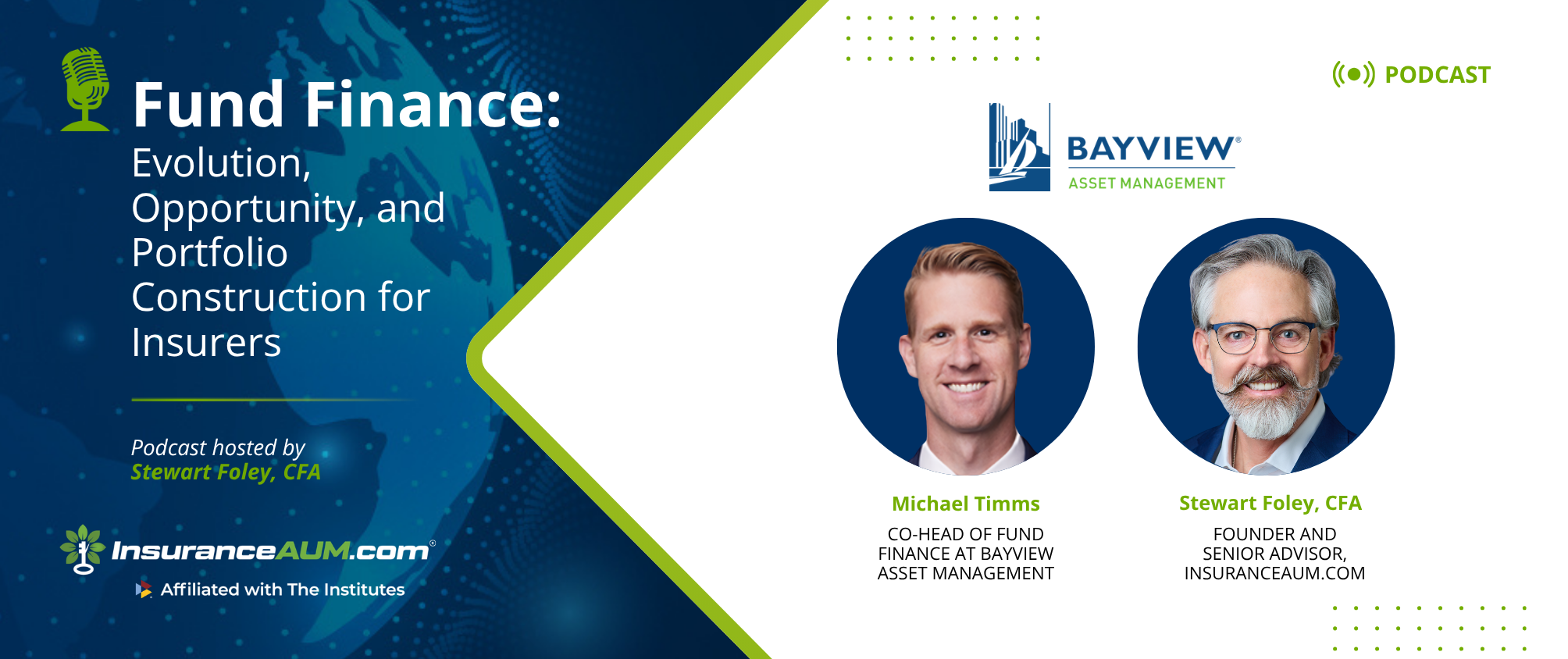
Fund Finance: Evolution, Opportunity, and Portfolio Construction for Insurers

Image
04.01.26 Bayview_Web


Stewart: Hey, welcome back. It's great to have you on the InsuranceAUM.com podcast. My name's Stewart Foley. I'll be your host and you've found the home of the world's smartest money. The title of today's podcast is Fund Finance: Evolution Opportunity and Portfolio Construction for Insurers. And we're joined today by Michael Timms, Managing Director and Co-Head of Fund Finance at Bayview Asset Management. Michael has a deep background in the space. He joined Bayview in 2025 from 17Capital, where he helped lead the firm's US investment business  

Prior to that, he spent eight years helping build a market-leading fund finance business at Wells Fargo and began his career as an equity sales trader at Bank of America, Merrill Lynch. You and I share that background, Michael. I was at Merrill Lynch back when the earth was cooling as well. Michael earned a BS in Economics from the University of Virginia and an MS in Commerce from the McIntyre School of Commerce. Really interesting. Michael, welcome to the podcast. We're happy to have you on.

Michael: Appreciate it, Stew. Happy to be here.

Stewart: Before we dive in, a little background. Where'd you grow up? What was your high school mascot? And if you weren't doing this today, what job would you most like to have instead?

Michael: So I grew up in Virginia Beach. My high school mascot was fittingly a dolphin. I wasn't doing this today. I'm not sure. It's not something that I spend a lot of time thinking about. I enjoy my job. I've been in fund finance for most of my career at this point. And as we'll talk about today, it's an exciting space to be in. But probably potentially going into coaching or something similar as a second career down the road would be interesting to me, but that's not anytime soon.

Stewart: We've talked prior, and you were a lacrosse guy, right? You played lacrosse back in the day.

Michael: I did. I played in college. I played a little bit after college in the pro leagues as a kind of a part-time job.

Stewart: Oh, wow.

Michael: For a few years. But I can't say I've played anytime recently, but certainly still involved in the sport.

Stewart: Oh, do you still play?

Michael: No, no, I don't play anymore. More just from an alumni standpoint.  

Stewart: I love it.

Michael: Staying involved and my kids are starting to get into it. They're only six and seven, so they're still young.

Stewart: That's awesome. Alright. So let's set the stage a little bit before we get into the details. Can you give us a quick overview of your background and how you came to Co-Lead Fund Finance at Bayview? And maybe more importantly, why Fund Finance is such a relevant topic today for insurers right now?

Michael: Sure. Yeah, so you did a nice job of giving my background. I've been in fund finance since 2013, I believe, is when I got into the business. And if you ask someone who worked in fund finance 15 years ago what their job was, it's likely quite a bit different than what it is today. So over that period of time, the industry has grown tremendously. It's evolved in terms of the types of investments that are available in the market, the types of borrowing that the firms were lending to need to manage their business. So specifically how I came to Bayview, I was doing this off of a bank balance sheet at Wells Fargo. It was largely a bank market in the 2010s. I had the opportunity to join 17 Capital, which was doing NAV lending and GP financing more from the private credit lens, so kind of the opposite end of the spectrum.

And for me, and I think others in the market, it became increasingly apparent that there is sort of an intersection of private credit and insurance capital that is playing a much more meaningful role in the fund finance market. And Bayview, I know you've hosted my boss, Nancy Handel on the podcast before. She came over to build Bayview's insurance asset management business several years ago. And having that infrastructure and that team and that pedigree in place and really thinking about fund finance as one of the key pillars of what is going to be a part of the broader insurance asset management platform is what drew me to Bayview.

Stewart: That's super cool. Let's talk a little bit about, and you kind of touched on it, the evolution, right? So market evolution and opportunity, the question goes some version of how has fund finance evolved from traditional subscription lines, and I'd love for you to define what that means in today's broader ecosystem and what's driving that expansion?

Michael: Sure. So for listeners who are less familiar, a subscription line or a capital call facility is effectively a revolving line of credit that is secured by the investor's uncalled capital commitments in the fund. So it is a very useful liquidity management tool that most closed-end alternative asset funds use. Now, the way they use it has evolved over the years whereby it really started out as a means to bridge capital calls, limit the number of times you need to call capital and distribute capital to investors to once a quarter or twice a year. I think folks throughout the 2010s, when the market kind of almost 10x in size for the subscription lines, folks started looking at it more as an efficient financing vehicle, more than just a bridging facility. And so borrowers, instead of only needing a subline that was 10% of the fund size, it became 30% of the fund size, and every fund pretty much started using it.

And then as the alts landscape continued to grow, that's really what drove the growth of that business. Throughout that period of time over the last really, I'd call it five to seven, maybe 10 years specifically, I think GPs have come to understand that there's other types of financings that can be accretive to their funds and accretive to the GP itself and accretive to LPs besides the subscription facility product, namely NAV lending, that could be primary funds, it could be secondaries funds. You've got GP financing needs as these GPs continue to grow and scale and need to finance their own businesses, whether it's commitments into their own funds, whether it's strategic decisions at the business level, moving into other lines of business or recapitalizing a business that was maybe seeded by a strategic investor, things of that nature. And then LPs as well, as LP portfolios became more heavily invested in alternative assets, their liquidity needs have evolved too.

And so more solutions, more capital providers have come into the space as a means to kind of fill a gap. And as more capital comes into the space, I think more borrowers of all kind of three types funds, LPs, GPs have just all become more familiar and knowledgeable with the tools that are available to them today that weren't necessarily available five, 10 years ago.

Stewart: It's my job to some extent to ask the questions that maybe are too simplistic, but when you're doing fund finance, are these private equity funds? What is the nature of the fund that you are financing?

Michael: It's a good question. And I don't think fund finance or other folks have defined their businesses as NAV lending or GP financing or portfolio finance. There's a lot of acronyms out there that are not well-defined. So I appreciate you asking the question. When we think about fund finance, it really means the whole spectrum of alternative asset classes because these tools can be used by private equity buyout strategies, they can be used by credit strategies, by commercial real estate strategies, and the list goes on. Now, through the lens of where we're deploying capital, we're leveraging the broader Bayview platform to focus on the asset classes where we feel we can appropriately underwrite the collateral and structure good investments for our investors. And we're fortunate to have a reasonably broad set of capabilities at Bayview that allow us to be active across most asset classes where some firms tend to focus on one or the other.

For us, it's about seeing as many interesting opportunities as we can source and being extremely selective and choosing where we deploy capital. So we think that broader aperture is helpful in sourcing the best opportunities.

Stewart: Yeah, it's interesting. I mean, I think that deal flow is underrated. You need to see opportunities so that you can select the best ones, and that makes sense to have the broader aperture that you mentioned. Let's talk about fund finance and portfolio construction. So how should insurers think about the different types of fund finance investments today and how they fit into a portfolio?

Michael: Sure. I think going off the previous question on how are you defining fund finance? I think that is probably the starting point, right? Because across the spectrum of opportunities that exist in fund finance from subscription facilities, which are very low risk, highly rated, shorter duration investments through NAV loans to direct more concentrated pools of assets, they offer kind of a broad range of risk adjusted returns that some investors may feel fit their portfolio one way or another. So defining what it is you're looking for and then deciding how best to access the market. Now, our view and part of the strategy of the Bayview Fund Finance lending business is that by having multiple pools of capital that have appetite for the various product sets within fund finance and being able to invest across most asset classes, that allows us to be a very useful lending partner to the GPs and LPs that we're working with.

And fund finance has historically always been and remains somewhat of a relationship-oriented business in the sense that when you're lending to a fund, or even more so when you're lending directly to a GP, these tend to be strategic decisions. You have access to a lot of information that is sensitive. The borrowers want enough lenders so that they're not reliant on any one lender if something changes in the appetite of those counterparties, but they don't necessarily want more lenders than they need. And so that's where we think we fit in well as really a compliment to the traditional kind of banking partners that they have in their lender group. We can come in and address the opportunities that are better suited for either our insurance capital or our private credit capital where the banks are less helpful.

Stewart: And it seems as though that the void is widening. It certainly doesn't seem like the banks are going to get more active in this space, which is interesting to me. So, let's talk a little bit about where the opportunity lies today. Where are you seeing the most compelling opportunities across fund finance right now and how should insurers think about timing their entry? Whenever I ask a question like this, I also want to tack on, are there places where you are more cautious? Certainly, headlines out there cause some folks some heartburn. Can you just kind of give us a, what do you see as opportunistic and are you cautious anywhere?

Michael: Sure. It's a good question. What I would say, I think it kind of goes back to your comment about where the banks are and what their appetite for risk within the fund finance market is. And understanding that we're not really trying to compete directly with the banks in most instances. We're trying to be a solutions provider to the borrowers where the banks stop being helpful. And that dynamic, along with sort of just where the broader kind of market cycles drive demand in, fund finance kind of leads where we tend to spend more of our time. And I'll give you an example. After the regional banking crisis a few years ago, the spreads in the subscription facility market widened out meaningfully where there was very strong risk adjusted returns to be had for a period of time that peaked a lot of interest, particularly from non-bank lenders, insurance companies specifically, start moving into that space.

But after a few years of softer fundraising environments, less liquidity coming back to LPs, the demand for subscription facilities has subsided, and that's driven spreads back to where they were before the regional banking crisis. And today we find that it's still very solid risk, but just the returns are less interesting than the other side of that equation is because there's more assets in the ground that are being held for a longer period of time, there's more need and demand for NAV and NAV-oriented lending solutions than there was a few years ago. And so we find that part of the market to be particularly interesting, both at the kind of primary fund level, also certain situations within the secondaries and NAV lending space are quite interesting to us. One of the, I'd say more significant developments in the fund finance business in recent years has been the adoption of structured finance into kind of an overlay of how to access exposure to private markets.

So we're seeing a lot of opportunity to invest in really what was historically not a very active space. It's not, none of this is new technology, so to speak. These structures have been around for a long time, but the demand for them, both from the borrower and the investor has really made that quite an active area. And within that, you can access different parts of the capital structure to kind of optimize for what your portfolio allocation plan may be.

Stewart: And it's interesting because several years ago there were studies done of why do you outsource it? Why do insurance companies outsource? And the why is really they don't have the internal expertise, or they don't see the deal flow or both. And so sort of by definition, the manager is more knowledgeable about the asset class than the insurer. And that sometimes I think it's hard for insurance investors to differentiate between managers. So as the market evolves here, where are you seeing real differentiation among managers in fund finance today?

Michael: Yeah, it's an excellent point. And we certainly, as we're speaking to insurance companies, there are certainly many out there that have spent a lot of time in the space and understand it quite well. And I think part of the consideration to work with a firm like ours is really the ability to access differentiated investments that they're not able to access directly, whereas others are much earlier in their kind of understanding of what the space is. And then it's firmly both the access and the expertise that we're delivering. And specifically, as it relates to my asset class in fund finance, I do think because it is an evolving space, it doesn't look in its current form much like it looked even just five years ago. Having folks that have been doing this for a long time and understand the trends and know the counterparties on the other side, one of the things that we always focus on is the ability to work with strong GPs really across the different products, whether it's sublines or nav lines or CLOs, rated notes, GP financing.

Ultimately, you are relying on the go- forward success of the franchise in addition to obviously the underwriting on the assets that are supporting the financing and the structuring that you're doing. But if any of these things go wrong, it's really kind of a manager level event at the end of the day. So steering clear of non-institutional managers is kind of the first piece of our funnel and making sure we're understanding how our value proposition fits with the high-quality managers relative to the banks or other incumbent lenders is really how you find the right opportunities to spend time on.

Stewart: Yeah, that's super helpful. And one of the things that happened, we put out a survey on LinkedIn, and this question was one that was kind of unanimously voted as you should add it, which is, what set of circumstances would create headwinds for fund finance in this opportunity set? In other words, what would cause you some heartburn if ... Is there a set of circumstances that create challenges for this strategy?

Michael: I'd say yes, there certainly are. Those might be different sets of circumstances for different risk exposures within the spectrum of the fund finance market. What might cause someone who is lending in a capital call subline facility to lose sleep might be different than someone who's lending against a portfolio of concentrated private equity or commercial real estate or other types of private assets. So I do think it is sort of industry by industry and structure by structure to some extent. But I think as it relates to the majority of what we're doing, which as I mentioned, we're not spending a lot of time in the subline space. We're much more focused in lending against the value of the assets, whether it's at the fund level, the LP level, or the GP level, making sure we're eyes wide open as to how we feel about how those assets are performing, how they're valued, how the GP has acted and behaved historically through cycles and how they've managed their portfolio to make sure we're thoughtful about how much value we're subscribing and how we're structuring a transaction to make sure we're protected, even if things in the portfolio go very poorly from when we enter the transaction.

Stewart: Yeah, super helpful. So thank you. As we kind of wrap here, how should insurers think about fund finance today within the broader portfolio?

Michael: Listen, I think fund finance, because of all of the evolution and adoption that's occurred over the last five-ish years, I think it's a space that insurers are spending a lot more time on. And if they're not, they should be spending a lot more time getting educated and beginning to think about a portfolio allocation strategy that would make sense for their balance sheet, how to think about the best way to access the market, whether that's partnering with folks like ourselves or trying to access it directly. And the answer is going to be dependent on the objectives ultimately. But I think the growth of the fund finance market, it's still early innings on most of the products. I mean, the subscription market is pretty mature at this point. It's also very large, about over a trillion dollars, so it will continue to grow. But the growth rate of the non-subline products I think are certainly expected to meaningfully outpace as adoption kind of continues to grow.

And I think that's probably one of the biggest pieces as well, is the adoption of these solutions is still so low relative to the amount of capital that has been raised across private markets, that even if the private markets don't continue to grow, I mean, I know they're all forecasted to continue to grow, but even if at their current levels, just marginal changes in the use rates create a ton of demand for capital to be invested into the space.

Stewart: Super helpful. Your background includes building some businesses, and that involves hiring folks to be on your team. In your experience, what characteristics are you looking for when you're building a team, and you're interviewing obviously usually folks who are earlier in their careers? And the purpose of the question is to get those folks some information about what a successful senior person like you is looking for when you're interviewing.

Michael: Yeah, it's a great question. And I'd say the answer to it's changed a little bit over time because earlier on in my career as we were building businesses and hiring folks, there was almost impossible to find people that had direct experience in fund finance because it was such a new space. So it was really about finding folks that have demonstrated high aptitude and success in other areas that have translatable skills. If it's younger folks coming right out of school or recently out of school, attitude and aptitude and willingness to be part of a team. And we've been fortunate, we being folks who have been in the fund finance industry for the last 15 years, that it's been largely growing, which has created a lot of need to hire new people, a lot of opportunity for folks to expand into different roles. But on the other side of that equation is it's always changing and evolving. So you need to have people that are adaptable and you'll like that aspect of the job versus think it's a negative.

Stewart: Yeah, no, that's very helpful. All right, last one. You can have dinner with up to three guests. Dinner's on us, by the way. I haven't cleared this with a new owner, but keep in mind, I'm kind of going with it. Who would you most like to have dinner with, alive or dead? You don't have to have all three guests. I want to make the rules clear. One, two, or three, who's coming to dinner with you?

Michael: Oh, if it's alive or dead, that's an easy one for me. I lost my parents when I was younger, so either one of those would be one or two. There you go.

Stewart: Alright, good, good, good. That's good. That's nice.

Michael: And then for three, probably more of a point in time response than anything. But I think Jensen Huang, who is seemingly the person that is most at the center of everything that's happening with AI these days, I know you get to hear him speak publicly quite frequently, but I think it would be pretty interesting to have an off the record type of a dinner conversation with him.

Stewart: What I think would be interesting, Michael, would be, can you imagine your parents' reaction that AI exists? I listened to a podcast not that long ago where the guest said, "Oh, we're decades away from generative AI." And like 10 minutes later, ChatGPT shows up and you go, "How can you be that wrong?" Just the idea that, I mean, even if you could show your parents an iPhone and just go here, and can you imagine? I mean, that would be a really cool dinner. I'm sure that I think you'd learn a whole lot. I think everybody would learn a lot.

Michael: Maybe all three at the same time would be an interesting one for sure.

Stewart: Absolutely. Well, it's been a pleasure to have you on. I really appreciate it. We've been joined today by Michael Timms, Managing Director and Co-Head of Fund Finance at Bayview Asset Management. Michael, thanks so much for being on.

Michael: Thank you, Stew.

Stewart: If you like what we're doing, please rate us, review us on Apple Podcasts, Spotify, or wherever you listen to your favorite shows. You can also catch us on YouTube, on our YouTube channel at InsuranceAUMCommunity. And if you want to start your journey or broaden your expertise in insurance asset management, don't forget about the Chartered Insurance Investment Manager designation, CIIM is the an acronym issued by The Institutes. We're thrilled to be partnered with them on that. Thanks for listening. We'll see you next time. This is Stewart Foley. We'll see you next time on the InsuranceAUM.com podcast. 

Share this post

Sign Up Now for Full Access to Articles and Podcasts!

Unlock full access to our vast content library by registering as an institutional investor

Register

Contacts


Bayview Asset Management

Bayview Asset Management, LLC’s Insurance Asset Management (IAM) group combines Bayview’s premier residential mortgage loan origination and Asset Based Finance (ABF) platforms with portfolio managers who have decades of experience managing insurance assets. We deliver customized, capital efficient investment solutions that align with insurers’ liability profiles and risk/return objectives by combining bespoke data and modeling, market insights, and critical sourcing relationships with disciplined pricing and execution.


Alex Latella
Senior Vice President, Insurance Asset Management
alexlatella@bayview.com
+1.917.419-9152

bayview.com
4425 Ponce de Leon Boulevard
Coral Gables, FL 33146


View the contributor page

Image
BAM_Logo2017

Sign Up Now for Full Access to Articles and Podcasts!

Unlock full access to our vast content library by registering as an institutional investor .

Create an account

Already have an account ? Sign in

Ѐ Ё Ђ Ѓ Є Ѕ І Ї Ј Љ Њ Ћ Ќ Ѝ Ў Џ А Б В Г Д Е Ж З И Й К Л М Н О П Р С ΄ ΅ Ά · Έ Ή Ί Ό Ύ Ώ ΐ Α Β Γ Δ Ε Ζ Η Θ Ι Κ Λ Μ Ν Ξ Ο Π Ρ Ё Ђ Ѓ Є Ѕ І Ї Ј Љ Њ Ћ Ќ Ў Џ А Б В Г Д Е Ж З И Й К Л М Н О П Р С Т У Ф Х Ц Ч Ш Ā ā Ă ă Ą ą Ć ć Ĉ ĉ Ċ ċ Č č Ď ď Đ đ Ē ē Ĕ ĕ Ė fi fl œ æ ß