












Ares Management Corporation -

In the Gaps: Ares Alternative Credit Newsletter - Spring 2026

Desert landscape framed by two large reddish rock formations, overlooking a dry valley with scattered shrubs, distant mountains, and a small rural settlement under a clear sky


Wanted: Dead and Alive
Nearly a century ago now, a great debate took place among physicists like Werner Heisenberg (of Breaking Bad fame) and Erwin Schrodinger (of feline fame) about the nature and properties of tiny things, like atoms and electrons.

Heisenberg posited that such particles do not have definite properties until they are observed and measured; only then can one define them as one thing or another. Schrodinger countered with a now-famous “cat in a box” thought experiment to show the potential absurdity of Heisenberg’s premise.

The thought experiment, if you are less familiar, goes something like this: a cat is placed inside of a box along with a device. The box is then closed with a lid. The device has a 50/50 likelihood of causing the cat to die. One cannot know the condition of the cat without first lifting the lid.

Because of the closed lid and the uncertainty about the cat’s status, Heisenberg’s theory would require that the cat be considered both alive and dead… until someone opens the lid and confirms reality. Schrodinger’s point was that Heisenberg’s theory must be, at best, incomplete… or at worst, broken badly (sorry), because it’s impossible for the cat to be simultaneously alive and dead. In essence, Schrodinger’s point was that uncertainty does not describe reality; it only describes our limited knowledge of it.

Image
Picture1

The financial press and some in the market seem to be in full tilt “sky is falling” mode around a number of topics lately. In many cases, they are commentating on boxes whose lids they will never open themselves or even care to understand. They are merely speculating about what could potentially be going on inside.

Credit investors must regularly grapple with and ultimately resolve risks and uncertainties to an acceptable standard. In our experience, the only way to accomplish this is to lift the lid and dig in. If for some reason one cannot lift the lid on an investment’s risk, one simply moves on. Paranoia and humility – a credit investor’s best character traits – demand it. Consequently, on our list of “nevers” (sectors or deal types we will never pursue) are blind pools, common in the SRT market.

In this edition of In the Gaps, we will endeavor to lift the lid on a number of topics that are front-and-center today. In the process, we hope to offer a path forward for investors to proceed with confidence.

We have a “triple header” charity spotlight in this edition. First, we wish to share some truly exciting news: the launch of Promote Giving. Inspired by the Pathfinder family of funds, Promote Giving is an independent initiative that is scaling this model of philanthropy through the participation of other managers and funds across the investment industry.

Second, we have an update on some of the grants that we made to some truly deserving charities and initiatives in health and education.

Third, we are excited to introduce you to Lever for Change. This non-profit acts as both a research resource and intermediary, connecting donors looking for charities that align with their goals to organizations of all sizes, around the world.


The F Word
Let’s talk about the F word, shall we? With scant details available, recent reports of fraud in the market have left many with the impression that fraud can happen anytime, anywhere, to anyone... and there’s precious little you can do about it. That is just not true.

Because the actual facts and circumstances around recent fraud stories are still unclear, we will not speculate about how or why they occurred. It is enough to know that fraud in financial markets is nothing new, neither are the means by which fraud is carried out.

Fraud is a crime of opportunity. In that sense, fraud is not much different from home burglary, and neither are the perpetrators. Vulnerabilities and gaps in security are identified, often cultivated, and ultimately exploited. Most victims don’t realize they are as vulnerable as they are.

Mitigating fraud is largely about minimizing both the means and opportunity. Because one can’t fully eliminate the risk, it’s also about detecting it as quickly as possible. It’s about locking the front door, installing security cameras and alarm systems, and placing a trained guard dog in the house for good measure.

It’s also about avoiding the neighborhoods known for such crimes. There are certain sectors in the ABF market that almost inherently create both means and opportunity for would-be fraudsters. Trade finance, high-rate consumer lending, life settlements and many corners within litigation finance.

These sectors have intrinsic features that inhibit or prevent investors from mitigating fraud risk. Consequently, they tend to be bad neighborhoods. Avoiding those high crime areas is a first step: you can’t be robbed if you don’t live there in the first place.

Fraud mitigation occurs across all phases of the investment process. It starts at the point of deal origination and sourcing. It continues throughout the due diligence phase. It becomes memorialized through legal documentation and reporting requirements, and it is enhanced through KYC and other investigative efforts.

Let’s talk about what those locks, security cameras, alarm systems and guard dogs look like in asset-based finance. Because fraud in financial markets is nothing new, and the means by which fraud is carried out are well known, there exists a set of best practices and minimum standards. They are borne of the market’s experience with previous fraudsters.

What follows is a list of many of these standards and best practices, and some very brief observations. These standards and practices are well known across the ABF market. When consistently employed, they are effective at identifying vulnerabilities, means and opportunity.


"Mitigating fraud is largely about minimizing both the means and opportunity. Because one can’t fully eliminate the risk, it’s also about detecting it as quickly as possible.”


Image
Picture3

LOCKING THE DOOR
Many types of risk can be mitigated (or avoided altogether) by first controlling who gets through the front door in the first place. This includes assessing the quality and integrity of a counterparty’s operations. Once inside, it includes controlling their activities and access, especially to collateral and cash.

  • Investigative background and KYC checks. In addition to one’s own due diligence efforts, investigative background and KYC checks can confirm (or not) the integrity, reputation, important relationships, and civil and criminal histories of key persons involved in a transaction. Knowing your counterparty is as fundamental as it gets.

    It mystifies us that there are investors who do not do this given the number of times a background check resulted in our passing on a transaction.

    More perplexing to us are those cases where background checks were conducted, serious issues were uncovered, and the parties moved forward with the transaction anyway. Believe it or not, that happens.

  • Governance and operational controls. Setting up appropriate transaction level controls essentially creates checks and balances – providing the counterparty the required authority and access to fulfil their role – subject to limitations, oversight and transparency. These typically fall under three categories:
    • Verification. In its essence, verification confirms that the information in each contract corresponds to the information in the data and systems, and is complete, correct and legally valid.

      While the process of verification is usually straightforward, even in the best of circumstances it requires significant effort. Third parties are often brought in to do some of this tedious work… and it is tedious.

      This process also presents the first opportunity (of many) to check the operational integrity and sophistication of the counterparty; importantly, this includes learning who has access to files, systems, cash, etc., and the limits of that access.

      It is typically not enough to limit the scope of this verification to the discrete pool or portfolio associated with one’s own transaction. One also needs broader transparency to confirm that assets are not pledged to more than one facility.

      In one recent fraud case, the counterparty themselves wrote the document that defined the nature and scope of these verification checks, not the investors. For a would-be fraudster, that is the dream scenario – to control which information investors get to investigate… and which they do not.

      In some subsectors, verification is incredibly challenging – perhaps impossible – owing to the nature of the obligations; receivables factoring or inventory finance come to mind because the receivables portfolio can turn over rapidly every month. This is one of the many reasons that trade finance is a sector we avoid.

    • Legal controls. Underlying assets must be confirmed as valid, enforceable and eligible (pursuant to criteria). These are evidentiary checks that include verifying that underlying contracts actually exist, are properly documented and executed, and were properly originated pursuant to federal or local laws and regulations.

      Legal documentation must demonstrate legal assignment of collateral, validity of contracts, and the release of all other liens (if any). Controls would provide access to the manager (and its agents) to verify and review collateral as requested through time.

    • Cash controls. Best practices place the ABF manager (or a third-party trustee) in direct control over bank accounts and provides complete visibility into these accounts. Access to these accounts by any other party requires explicit approval.

      There are situations where cash first passes through the hands of the counterparty before it is diverted to dedicated lockboxes and bank accounts. Typically, the counterparty is required to deposit such cash receipts into the bank account within two days. Done properly, this reduces the counterparty exposure to just a day or two of cashflow.

The above are a few of the most important elements of “locking the door.” They serve to identify concerns or operational weaknesses; if none exist, they establish an ongoing ability for the ABF manager to evaluate and control both assets and cashflow, the lifeblood of ABF transactions.
 

Image
Picture5


SECURITY CAMERAS AND ALARM SYSTEMS
It’s not enough to simply possess security cameras and alarm systems. Someone needs to always be monitoring the video and making sure the alarms are set. This requires a lot of time, effort and resources.
 

  • Collateral audits. The same type of collateral diligence undertaken during the initial underwriting process is essentially repeated over and over throughout the transaction’s life. It involves the same verification elements described above, plus an audit of the counterparty’s systems to identify any changes to access or controls.
  • Reporting and data. Asset-level reporting data is a significantly better window into the underlying portfolio compared to a trustee report. Best practice is to receive comprehensive sets of raw data to independently perform data integrity checks and to detect anomalies that may require further investigation.
  • Cash and Data Reconciliation. Best practice has the ABF manager tracing cash received from an underlying borrower through to the bank accounts. Reports provided by the counterparty are independently verified and recalculated. Verification includes confirming reports tie to underlying contracts. Reconciliation efforts are among the most tedious and time-consuming undertakings by ABF managers; however, they remain one of the best ways managers can detect manipulation via missing cash, missing accounts, or unexpected activity or performance.
  • Regular site visits. It’s hard to overstate the importance of periodic site visits by members of the deal team. Every such visit we have conducted has yielded insights and information we could not have obtained in any other way.

    Importantly, it provides team members with the ability to observe a business in action, and to observe the interactions among the team. One of the “Three C’s of Credit” after capacity and capital is character. Character can certainly be revealed in background checks, but also by observation.

    Furthermore, we think site visits are a great way for team members to identify best practices in the industry. They witness for themselves the degree to which platforms differ in their sophistication, capabilities, resources, policies, procedures, systems and operations.
     

Image
Picture7

GUARD DOGS
Most ABF transactions benefit from a set of third-parties contractually obligated to perform their duties for the benefit of the ABF investor and provide operational leverage to the deal team.

  • Custodians. The custodian’s responsibility is to hold the underlying contracts for the benefit of the ABF investors. Ideally, the custodian is holding all of an originator’s contracts and is thereby in a position to know (and report) if an asset is moved “from one vault to another” to avoid double pledging.
  • Back-up Servicers. The best arrangements are those where the back-up servicer is selected at closing and is contractually obligated to take over servicing at the direction of the ABF manager (likely as a result of a performance issue, default or other event).

    In the best cases, back-up servicers are a third set of eyes on the data and reports (after the deal team); they receive updated data frequently and have it integrated into their own systems.

  • Third-party auditors. One of the benefits of today’s ABF market (compared to the early days) is the development of an entire ecosystem of specialized auditors. These auditors support ABF investors in everything from forensic accountancy, contract review, legal and regulatory compliance, and systems.

    When used consistently, these professionals complement and enhance the work that sophisticated ABF managers do on their own. They help identify potential areas for further investigation and are an important window into best practices.

  • The Team. Even the most rigorous and intensive underwriting processes represent only a fraction of the work that goes into each ABF investment; the lion share of team’s time, effort and resources is undertaken in the quarters and years after closing on the investment.

    All of ABF’s inherent benefits – granularity and diversity of underlying risk, cash flow profile, structural protections – come at the cost of a lot of ongoing work for the team. There are no short cuts or off-the-shelf systems that alleviate this burden.

    It is neither easy nor inexpensive to develop and maintain an ABF platform, or to employ an experienced team to conduct all of this work to a high standard. Great processes and infrastructure are developed over years and decades as gaps are found and subsequently filled. We think scale and tenure of the team is too often underappreciated for the value it brings in terms of operational sophistication.

With that said, let’s return to the topic of home burglary. Crime statistics show that in nearly 40% of all home burglaries, the intruder entered through an open door or window. While you’re pondering that statistic, consider that in most countries, about 10% of the population leaves their doors unlocked when they leave home. This includes people who have door locks, security cameras, alarm systems and perhaps even a dog at home.

Why? Could it be because they don’t perceive a threat? Do they feel safe, secure and unlikely to be a target? Perhaps it’s because there haven’t been break-ins in their neighborhood recently.

Do some investors occasionally manifest that same trusting human nature? Yes. It can be an insidious vulnerability because the longer one leaves the front door unlocked and no robbery occurs, the more one is convinced that risk is lower than it is.

We have always said, because we believe it’s true, that if a bad guy wakes up tomorrow hellbent on committing fraud, and there’s both a means and opportunity to pull it off, there’s almost nothing that can truly prevent it. But that isn't the same as saying there's nothing one can do to minimize means and opportunity, or the ability to detect fraud before it grows into breathtaking size.

Combined with a healthy dose of humility and paranoia, we think there are many things that ABF managers can do to render their investments less vulnerable to the aspiring fraudster. This includes investments in resources and processes designed to detect it quickly and thereby hopefully attenuate the resulting losses.

As we’ve said many times, when ABF transactions go off the rails, it’s almost never the collateral’s fault… it almost always has something to do with the counterparty. In that sense, fraud risk mitigation is about avoiding the bad neighborhoods and, even in a good neighborhood, keeping the lid wide open and digging deep.

"Fraud risk mitigation is largely about keeping the lid wide open.”


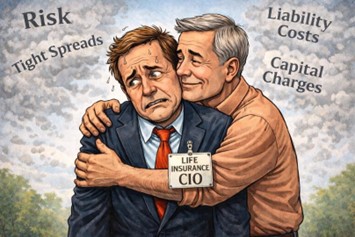
Hug an Insurance CIO
Insurance CIOs are having a rough time. If you happen to run into one, you might want to give them a hug. They could use the emotional support. They have an incredibly difficult job these days: generate attractive ROEs (returns on equity), targeting 15% or so, all while operating within risk and regulatory capital limits and supporting their company’s liability origination ambitions.
 

Image
Picture8

As a reminder, an insurance company generates ROE by investing in assets that produce a yield greater than the cost of its liabilities; it is a relatively simple asset-liability arbitrage condition. A complicating factor in generating that arbitrage is that investments having higher yield also tend to possess higher risk and carry a higher capital charge.

Image
Screenshot 2026-04-30 093557


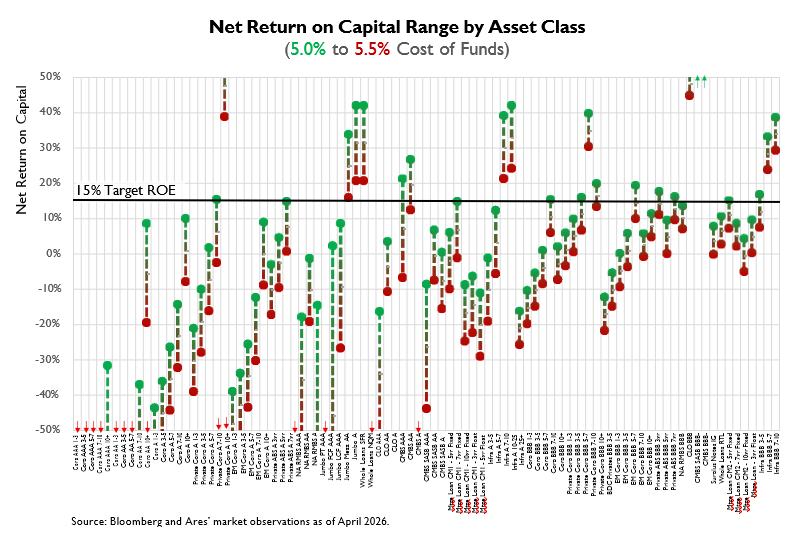
Thus, insurance CIOs are always looking at an investment’s contribution to ROE based on capital-adjusted yields. These yields are then reduced by expenses (management fees, etc.) to derive what is called a Net Return on Capital, or Net ROC.

To determine the true asset-liability arbitrage, one compares an investment’s Net ROC to the insurance company’s liability costs. A positive difference reveals investments that contribute to equity returns; a small or negative difference is dilutive to those returns.

The chart above is worth taking a moment to carefully peruse. Viewed through the economic lens of an annuity issuer, each asset class is shown in terms of its ability to generate returns on capital inclusive of capital charges and average expense ratios. The range depicted for each asset class captures liability costs between 5.0% (green) and 5.5% (red), which is where most annuities are being issued today.

Looking across the various ABF and traditional fixed income sectors, one can easily identify the very few sectors – at today’s yields – that are clearing the target 15% ROE bar and are thus “attractive”… and which are not. The inherent leverage of an insurance company’s balance sheet magnifies spread and yield impacts, thereby producing a wide range of ROEs (from very positive to very negative).
 

Obviously, insurance CIOs would have an easier time creating positive Net ROCs if their investment activity could concentrated on the few sectors that clear the bar. Unfortunately, rating agencies and regulators require investment portfolios to be very diversified; CIOs are compelled to allocate to traditional fixed income sectors like IG corporate bonds which, as you can see, are highly dilutive to returns these days. Many Net ROCs are literally off the chart.

For every dollar CIOs are compelled to invest in a dilutive sector, they must compensate with investment allocations into accretive sectors. Alas, the list of accretive sectors is shrinking, as is the availability of assets in those sectors… unless one can somehow manufacture them oneself. All of this is being done while managing and mitigating investment risks in an increasingly uncertain world.

Even though fewer and fewer ABF sectors clear the bar, they largely remain economically better alternatives to most traditional fixed income sectors. Consequently, as we have discussed previously ( and ), inflows of insurance capital into the ABF market have been breathtaking. Without hyperbole, we likened this phenomenon to the syzygy tides in the along with its concomitant impacts on yields and credit spreads on those sectors into which those inflows have been most pronounced (e.g., consumer loans).

From a non-insurance ABF investors’ perspective, these inflows continue to present, essentially, three simple trading strategies for finding value and avoiding some of the market’s excesses:

(a)    Anticipate the markets or sectors into which insurance capital is likely to enter… get there first and ride the wave.
(b)    Anticipate the markets or sectors out of which insurance is likely to leave… wait patiently for the outflow and subsequent reset of value.
(c)    Identify the markets or sectors that insurance cannot (or cannot easily) access… as areas of potentially attractive relative value.


From this perspective, the previous chart could help to identify the markets or sectors into which (or out of which) insurance capital is likely to flow, to the extent it is free to do so. However, and to be crystal clear, we are not suggesting that one should trade ABF sectors on this basis.

Rather, this kind of analysis is aimed at anticipating shifts in relative value. The challenges facing your friendly neighborhood insurance CIO are not going away any time soon, and neither are these economic forces driving capital flows. However, given how significant these flows have become in ABF, it is especially important to remember our Lesson Learned #12: Watch the Flows.


Image
Picture9

Falling off the Bandwagon

Bandwagon behavior is nothing new. A few years ago, it was popular to rebrand business models as being “disruptors” in their respective markets. More recently, businesses are attaching themselves in every which way to the AI revolution. Some of these are legitimate connections, some are not.

The growing popularity of ABF the past few years has likewise enticed some to relabel and rebrand substantively non-ABF transactions as ABF in order to capitalize on a market looking for such opportunities. Opening the lid is often the only way to know what is truly inside the box. But open the lid one must.

We have written about several of these poseur asset classes in these pages. One year ago, we about Spirit Airlines’ mileage program bonds that had been dressed up and sold as ABF securities. It was a popular offering at the time but did not end well. We wrote, “Substance trumps form every time. Mileage bonds had the form of asset-backed securities but were substantively corporate risk.”

Two years ago, we about another financing trend that was wearing an ABF jersey but not actually on the team. These were the so-called e-commerce aggregator financings. Aggregator platforms sought to roll-up independent online sellers (roll-up strategies are, in general, tricky). In so doing, they would create economies of scale thereby achieving margin and multiple expansion.

The (faulty) thesis at the time assumed top-rated sellers could be underwritten as recurring cashflow streams. This is like thinking of a grocery store as a recurring cashflow stream. It may have sales revenue, but none of it is contractual.

Image
Picture10

The transactions relied on an “advance rate” or a Loan to Value (LTV) against these future recurring revenues. Somehow in the process of these transactions getting executed, some investors overlooked the fact that these e-commerce businesses were corporate enterprises where earnings and multiples fundamentally matter to the value… and lacked contractual cash flow.

Ultimately and awfully, as recent headlines have demonstrated, without the substance of contractual cash flows, the “V” in those LTVs stood for Vapor, not Value. Loss rates were exacerbated as purchase price multiples on these businesses grew from 3-4x to 6-8x… and as equity valuation multiples on these aggregators grew to over 20x.

Such excesses of the underlying assets’ value left many aggregator businesses highly vulnerable to changes in market conditions. Even a modest deterioration in sales (revenue) was sufficient in many cases to turn earnings negative. That is exactly what happened in a few cases, resulting in credit defaults and big losses.

We repeat what we wrote two years ago: “While it is hard to overstate operational excellence, it is very easy to overstate the impact of financial engineering… We take no pleasure in the meltdowns that many aggregators face today… As investors, we should always be learning from mistakes, whether they be others’ or our own. There are a lot of good lessons to learn from this.”

For those interested in a deeper dive on the economics of e-commerce aggregators, and why these transactions could not legitimately be deemed ABF (and our warnings about that) to our Winter 2024 newsletter; turn to the section entitled “Aggregators’ Aggravations”.


The Other F Word… Fragility
Conditions arise that might, on the surface, appear to be benign. It’s a feel-good market environment: defaults are low, liquidity and leverage are abundant. Asset values increase (yields decrease) contributing to good return performance.

Beneath the surface of such markets, returns can become increasingly dependent on leverage. Leverage transforms lower asset yields (ROA) into higher equity returns (ROE). Increased leverage renders those returns more sensitive to everything.

Small deviations or frictions (on either side of the balance sheet) are amplified to become material misses and headwinds. The whole set-up creates vulnerability to large losses if those deviations or frictions themselves become significant. The most vulnerable are the most leveraged or the most dependent on leverage to generate returns.

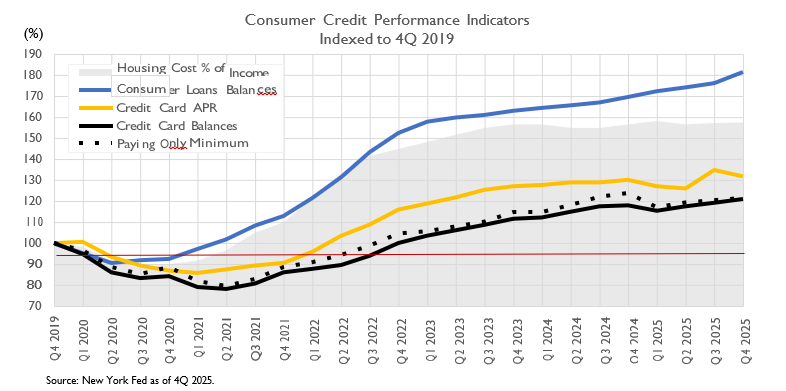
The graph below shows weakening performance indicators in consumer credit. This is what lies behind the increases in delinquencies and defaults we’ve been highlighting in these pages and that you’ve been hearing about in the press.

Indexed to 4Q 2019 (right before COVID), it’s easier to perceive how different conditions are today. Housing costs as a share of household income are nearly 60% higher, on average. As we discussed in some detail last edition, housing is the new credit curve – as important as FICO score in describing consumer credit performance and household financial health.

Image
Screenshot 2026-04-30 095218

But housing is not the only source of financial fragility. Consumer loan balances are today 80% higher (as a percentage of household income); credit card balances are nearly 40% higher. This is occurring even as the cost of borrowing (APRs) has increased over 30%. Those pressures are pinching household budgets: the share of consumers making just the bare minimum payment on their credit card debt is up over 20%.

Despite credit performance indicators and actual credit performance deterioration, the financing markets are behaving as if risk hasn’t changed. In fact, financing against such assets has only become cheaper and more aggressive. Returns on the leveraged equity look higher, potentially leading some to conclude that the market opportunity in consumer is better today than it has been in years.

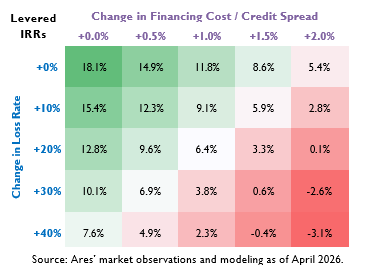
The following “heat map” reveals the embedded fragility in those returns with numbers based on the team’s analysis of a number of recent consumer transactions (actual structures, terms, collateral).

Starting in the top left corner, we essentially have today’s market and expectations for consumer credit performance (losses). If you are hearing that consumer loan ABF equity can produce mid- to high-teens IRRs, that’s because the models are showing that kind of result based on today’s financing  costs  (and  leverage ratios) and expectation of losses that we would describe as optimistic.

Moving in any direction away from the top left corner, you can see the impact on returns. Even a relatively modest 20% increase in losses causes returns to fall by 30%. In our experience, when actual losses are worse than expected, there tends to be a reaction in the market: credit spreads widen. Thus, there tends to be a combination impact on equity returns arising from higher loss expectations and more expensive (less efficient) leverage. Even modest increases in the cost of financing can have a very large impact on ABF equity returns.
 

Image
Screenshot 2026-04-30 095628


This is what we mean by fragility.

Fragility in markets is often hard to perceive until it’s too late to do anything about it. A team member recently described it this way: “It’s lurking like the sandworms in Dune with many in the market stomping around on the surface blissfully unaware.”

Now consider what seems a lot more obvious right now: weakening labor market, macroeconomic weakness, spikes in energy prices and cost of living, and weakening housing. Having seen this particular movie before, here is what we would expect to happen next.

First, we would expect actual credit losses to be worse than what many investors are currently expecting based on the transactions we are seeing and pricing of consumer credit pools.

Second, deteriorating credit performance tends to cause lenders to tighten underwriting standards to reign in loss rates and “bend the curve.” Credit tightening tends to have an unintended consequence: it tends to cause default rates to initially rise because borrowers lose the ability to refinance their way out of a credit problem.

Third, investors experiencing loss rates in excess of their expectations tend to slow down, pull back or altogether reconsider their capital commitments to the sector.

Fourth, and this is particularly true for insurance investors, unexpectedly weak performance and greater uncertainty about future performance increase the risk of rating downgrades; that threat is typically enough to affect insurance capital appetite.

All of this could create a potential window of opportunity. Usually when we see a retrenchment of capital, a rationalization of credit expectations, and credit tightening, we get a little excited. Those environments tend to produce pools and portfolios of newly-originated credit having better performance characteristics, giving rise to transactions on terms that would finally make sense to us. Stay tuned.

"As investors, we should always be learning from mistakes, whether they be others’ or our own.”


Housing’s Good News Bad News
In the last edition we highlighted and emphasized how housing costs are a window into consumer and household financial health. We entitled the section: . If you missed it, consider taking a moment to review. It’s useful context for what follows.

One of the housing sectors associated with overall weaker consumer credit performance is renters. Whether renting an apartment or single-family home, over the past few years, rents have increased to the point that they consume 30%+ of household paychecks (“Rent Payment to Income” ratio), putting a squeeze on household budgets.

Thus, the direction of rents can be an important indicator as we project whether those financial pressures are poised to increase or decrease. Turns out, the answer to that might depend on whether someone is willing to move.

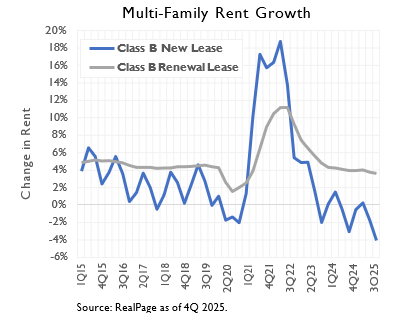
The chart below depicts broad market rent data in multi-family apartments. We show Class B only, but the pattern and story are generally the same for all classes. New leases reflect rent decreases where renewals are still showing increases.
 

Image
Screenshot 2026-04-30 095954


The grey line depicts changes in rent for lease renewals; the blue line reflects changes in rent for new leases. One can easily see the run-up in rents for new tenants from late 2020 through 2023 with annual increases well into the double digits for part of that time.

Over the past year or so, rents have started falling… if you were willing to move. Rents decreased 4.1% on average in 4Q25. If you are unwilling to move, your rent probably continued to increase. That difference is a big deal for households already struggling with high rent payment to income ratios.

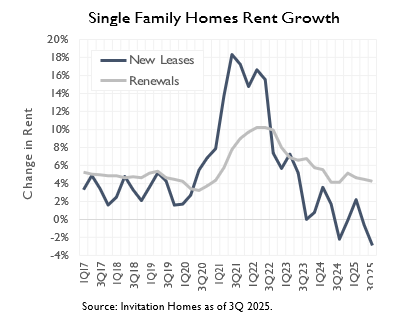
The same phenomenon is happening in the market for single-family home rentals as the chart below shows. This data is from Invitation Homes, one of the market’s benchmark platforms spanning a portfolio of over 86,000 homes. The grey line depicts changes in rent for lease renewals; the dark blue line reflects changes in rent for new leases. One can easily see the run-up in rents for new tenants from late 2020 through 2023 with annual increases well into the double digits for part of that time.

Image
Screenshot 2026-04-30 100205


What does this all mean? Historically, and what we also expect in this cycle, new lease rates are a leading indicator. While they are also more seasonal and more volatile (as is clearly shown in the charts), they tend to be directionally more important – and they are clearly headed lower. As “shelter costs” are an important element of inflation indices, lower housing costs is clearly deflationary.

Like many things in today’s market, this is a good news, bad news situation. Lower rents are obviously hopeful news for renters and could help ease some of the financial stress with which many households are grappling. However, lower rents are an economic headwind for commercial residential operators absent mitigating offsets (e.g., higher occupancy rates, lower inflation, lower interest rates, lower operating costs, etc.).

There are obvious implications for non-renters of single-family homes (e.g., owners) as the economics of rent is also a factor in home purchasing (the classic rent vs. buy analysis) and often suggests a direction of travel for home prices generally.

As the saying goes, however, all real estate is local. There will always be exceptions and situations bucking the trends above. That said, these are trends worth watching given the impacts on both strained households and commercial real estate economics.


Lessons Learned v2025
Our team has a tradition that takes place at the end of each year. We pause to reflect upon the year and the lessons we learned, individually and collectively, professionally and personally. We could not recommend this process more highly as a key ingredient in continuous improvement (“Kaizen”) and protecting culture. The responses are always thoughtful, often surprising, and consistently grounded in the principles that guide how we work, and how we work best together.

Here are some of the questions we asked this year:

  • What are your top lessons learned professionally this year?
  • What are your top lessons learned personally this year?
  • What were this year’s biggest surprises, and why were they surprises?
  • What is a personal accomplishment this year that means a lot to you?
  • What is something you intend to change or do differently (personally or professionally) in the coming year, and why?
  • What would you change about our team or platform if you could, and what should we persist in doing?

We wanted to share some of what we learned from this process and a few of the themes that emerged. One of the dominant themes was the importance of credit discipline in aggressive, even frothy, markets. The temptation to move quickly and/or to stretch on risk can be powerful. As one team member wrote, “You must be extra careful and diligent in a competitive market… underwriting is even more critical in frothy markets.”

Another theme that dominated the feedback was the impact of communication and transparency on relationships. Success as investors rarely comes from individual effort alone. It derives from trust, collaboration and clarity. One response captured this especially well: “Communication is the most important aspect of professional relationships.”

Many reflections focused on the critical importance of experience. Good judgment develops over time as one navigates cycles and unexpected events. While technology and the tools we use to do our jobs continue to improve, they are no substitute for experience. As one colleague observed, “You can’t teach wisdom that is gained through experience over time.”

Fortunately, our team is always eager to offer constructive feedback that contributes to positive change. We relish in such feedback. Here are a couple of highlights: “Protect the pillars: purpose, relative value, patience, Kaizen, culture, continuous feedback, over-communication and Lessons Learned.” Here’s another one: “I love how our Investment Committees are public and that anyone is able to join and learn. Keeping Investment Committees open to the broader team fosters learning and transparency.”

Some of the most striking responses were personal. A number of colleagues reflected on the fragility of time and the importance of perspective. One response captured it simply: “Time is your most precious resource.” Another offered timeless advice: “Consistency beats intensity—the ‘boring’ things like health, routines, and family time keep everything else working.”

Reflecting upon and sharing our lessons learned is one of our team’s favorite traditions. The most durable lessons are often the simplest: maintain discipline, communicate clearly, support one another, and keep perspective on what ultimately matters. Markets will change, technologies will evolve, and opportunities will come and go; what endures are the principles that guide good judgment and contribute to character.

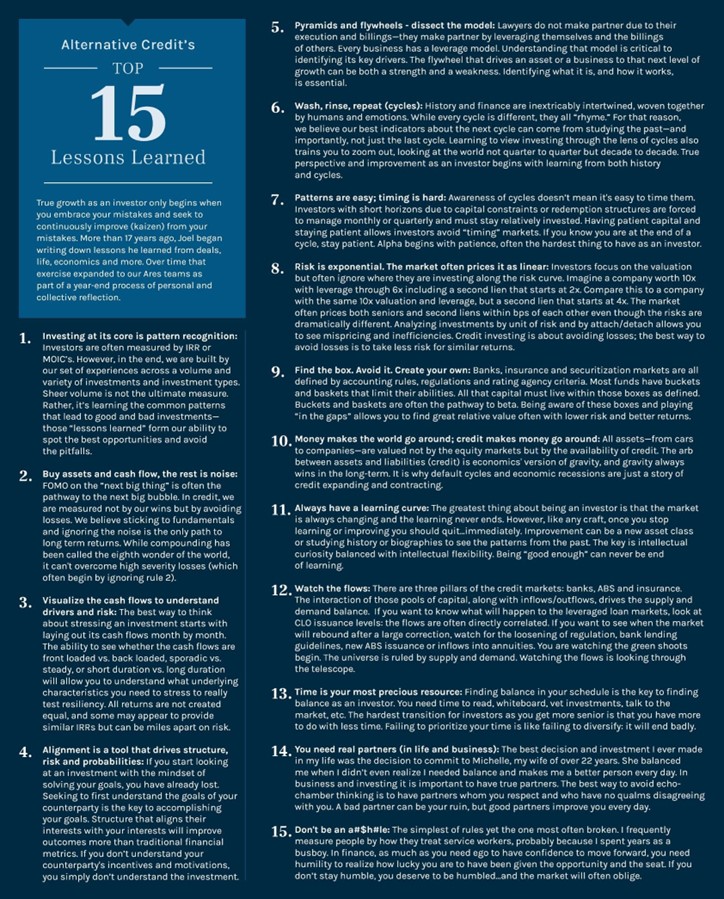
Growing as a person, and as an investor, is about Lesson Learned #11: Always have a learning curve. It’s important to regularly reflect on and share lessons learned as one ascends those learning curves.

"Bull markets and periods of irrational exuberance are exciting and economically intoxicating. No one wants to leave the party early, even if they know it’s about to end abruptly.”


The Path Forward authored by Joel
Time has a relative feel to it, especially in markets that tend to myopically focus on the next month, quarter, or year. As we move from the Information Age to the AI Age, it’s becoming clear that ADHD is no longer a diagnosis exclusive to individuals; it is becoming commonplace among societies and most investors.

It’s easy to presume that investors and economists have access to and are grounded in the same set of information, giving rise to Efficient Market Theory or Modern Monetary Theory. Both theories, among others, are fundamentally flawed because human beings are involved. Each individual brings to the table a very personal set of experiences; these are inherently limited and therefore biased.

This year we are celebrating Alternative Credit’s 15th year anniversary at Ares… and nearly three decades as investors for a number of our team members, including Kevin, Keith, and me. It seems like just yesterday when, in 1997, I started my journey as an investor. It also feels like a lifetime ago. Experience shapes everything.

I start every job interview with the same question of a candidate: Where did you grow up, and what did your parents do? Our experiences form us and create context. In 1997, the economy was booming and the internet was exploding. As a 22-year-old, I had a front-row seat to all that innovation, but no appreciation (yet) for economic and credit cycles.

The market painfully educated me, resulting in Lesson Learned #6 and #7.

Bull markets and periods of irrational exuberance are exciting and economically intoxicating. No one wants to leave the party early, even if they know it’s about to end abruptly. The late ’90s taught that lesson well. Valuations had become detached from fundamentals. They were anchored instead to narratives and momentum – adopting a lottery ticket mentality.

Then came the cracks: Asia, Russia, and eventually the dot-com collapse. The early 2000’s layered on recession, 9/11, and the accounting scandals—Enron, WorldCom, Tyco: the F-word at massive scale.

Markets recovered, as they always do. By 2003, confidence had largely returned and pivoted to the next rocket ship: housing. This time, however, I was paying close attention. Market volatility wasn’t something to fear; it was something for which to prepare. The Great Financial Crisis delivered volatility in the form of both pain and opportunity, in near-equal measure.

We are defined by our experiences. As much as we tend to lean “perma bear” in our views, so does an entire generation of investors and market participants who started their careers between 1986 (Black Monday, Savings & Loan crisis) to 1998. Those experiences created a natural skepticism, a set of lessons learned having experienced the truly unexpected.

Markets and valuations have a physics to them. They often move like a pendulum, swinging at times toward the extremes; but gravity eventually (quietly, persistently) returns them to a normal state. Newton’s third law also applies: every action has an equal and opposite reaction.

Relative value is always about risk, and risk is almost always worse in expensive or bad neighborhoods. We’ve highlighted this repeatedly in In the Gaps on a number of topics from and to and .

In this edition we once again highlighted some of the excesses we see within insurance, driving credit spreads to unnaturally tight levels in corporate bonds, public ABS and consumer whole loans, driving risks higher through aggressive structures and misaligned flow agreements.

It is only a matter of time before the pendulum starts to swing back. We are starting to witness some of that real-time, as valuations, structures and risks peak. The Greeks gave us a useful concept: theta. A non-linear change of value as a function of time.

As useful in the valuation of options, it is equally useful in the evaluation of risk. As a function of time, the longer valuations remain stretched to their limits, the faster and more violently they tend to snap back… often overshooting in the opposite direction.

"As a function of time, the longer valuations remain stretched to their limits, the faster and more violently they tend to snap back.”

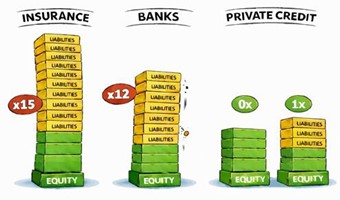
Leverage is another useful lens through which risk and value can be understood. Banks operate with 10–12x leverage, insurance at 12–15x. Private credit? 0–1.5x. When regulatory pressure or RWA makes certain assets less attractive inside the “box,” they move outside (or in the gaps). Even relatively small changes can have an amplified effect due to leverage.

When leverage is available and accretive, the focus tends to shift from an asset’s inherent yield (ROA) to its leveraged yield (ROE). So long as highly-levered institutions can generate ROE by accretive leverage and capital treatment, spreads will compress because the focus shifts from return on assets to return on equity.

The following two things are true right now. There are assets you can leverage to 15x to earn 6-8% returns (e.g., many insurance companies’ ROEs are now down to 6-10%). Why buy complex when you can buy simple: many of those same assets generate 6-8% returns unlevered. That disconnect is one of many signals today that the pendulum is reaching its turning point.

Banks operate with significant financial leverage, generating levered equity returns but with a fundamental mismatch between longer-term assets and short-term liabilities. For banks, their liabilities are usually the source of liquidity stress… thus requiring access to the Fed window in the event of liquidity shortfalls (such as we saw a couple of years ago).

Insurance generates equity returns in much the same way, with significant financial leverage. Their asset-liability mismatches arise less from their liabilities, and more from their investment portfolios. Changes in interest rates can cause large swings in investment portfolio durations; the use of derivatives in hedging interest rate risks can cause liquidity shocks (such as UK pensions experience in their LDI programs a couple of years ago).

By contrast, private capital funds – if they employ leverage at all (and many do not) – are typically match funded between its assets and leverage, mitigating the type of potential liquidity stresses that are common to banks and insurance, and which require regulatory capital excesses and access to liquidity.

As all three types of capital (banks, insurance and private capital) are active in the ABF market, these structural and capital risk differences become especially important as they can cause liquidity and capital flows to change suddenly, even dislocate. This is a phenomena we have seen roil markets and create capital dislocations, several already in the past five years.

Image
Picture11

For illustrative purposes only.

Investing through this requires discipline. It’s one of the reasons we focus so much on avoiding asset-liability mismatches, or counterparties who are susceptible to them. We never want to be forced sellers – or pressured buyers.

One also has to tune out the noise. One must anchor into lessons learned, past experiences and history.

The focus must remain on risk and downside protection. In these late-cycle times, one must also expect the unexpected. One should expect the F-words: fraud and fragility. One must anticipate and prepare for volatility and, at some point, an economic and credit cycle.

Beneath the headlines, the fundamentals still ultimately matter. The labor market is softening. AI will drive productivity, but also job losses. Both can be true. What we must remember is we have gone through political revolutions, agricultural revolutions, industrial revolutions, world wars, digital revolutions and pandemics all in the last 250 years.

To quote Will Durant, “humans adapt and humans move forward.” If, in 2019, we had developed a worldwide pandemic stress scenario that included business shutdowns, remote work and school, social distancing, supply chain disruptions, small business closures, there is little doubt that scenario would have projected another Great Depression.

Yet all of that did, in fact, happen. We adapted. We moved forward. We got stimulus, inflation, record low employment and higher rates. Doubtful anyone would have modeled that sort of outcome.

Indeed, some of history’s most transformative growth periods grew out of periods of chaos: wars, depressions, space races, etc. These include government-led initiatives like the GI Bill, DARPA, SBA lending and the agency mortgage market; they include private sector-led initiatives like the LBO and venture capital markets, the internet and fintech.

So when you hear people start to say “this time is different,” that’s often a sign that the pendulum is just about to swing back. Fortunately, having invested through dislocations, we have a playbook and our lessons learned.

We also have a playbook for that uncomfortable and challenging period of time leading up to that moment of dislocation. We continue to keep the lids wide open. We continue to dig deep in diligence to identify risk. We focus on process, risk mitigation and asset quality. We stay patient and ready to adapt as the market moves forward.


Charity Update
The Ares Pathfinder family of funds awarded over $4 million in grants in 2025 across seven different organizations and programs. We are pleased to provide a report on this charitable activity below.

Image
Picture12

Evidence Action focuses on scaling proven public health interventions through partnerships with governments to achieve durable, system-level impact. Ares’ grant funds the expansion of safe drinking water to tens of millions of households in India.

Image
Picture14

Mount Sinai Hospital Global Health Institute works to strengthen health systems with partnerships in Ghana, Guyana, Kenya, Nepal and Zimbabwe. Ares’ grant will support the design and construction of a new surgical facility in Chiredzi, Zimbabwe with the scale to conduct ~6,000 consultations and perform ~2,000 surgeries annually. Scale is supported by Mount Sinai’s specialists in the U.S.

Image
Picture16

Rocket Learning focuses on early childhood education (children 0-3 years) and educational resources to caregivers in India. Building on the progress of Ares’ initial grant in 2024, the 2025 grant will bring Rocket Learning to more districts and Aganwadi centers. The expanded program is expected to reach up to 10,000 centers and 100,000 households.

Image
Picture18

Educate Girls focuses on advancing girls’ education in India, especially in rural areas. The program’s approach is holistic in addressing both educational access, enrollment, and entrenched attitudes and norms around girls’ education. Ares’ grant funds the rollout of a pilot program that will reach ~14,000 out-of-school girls and young women across 839 villages in rural Madhya Pradesh.

Image
Picture13

BRAC is the world’s largest international development and humanitarian organization aimed at alleviating poverty and operating large-scale programs spanning education and healthcare. Ares’ grant will bring safe drinking water and sanitation facilities to over 150,000 Rohingya refugees in five camps in Bangladesh.

Image
Picture15

Path Global Health focuses on global health and health equity primarily through healthcare, disease management and vaccinations. Ares’ grant, in partnership with GiveWell and the Gates Foundation, funds a new malaria vaccine trial for ~2,300 infants in Ghana. Malaria causes 260 million illnesses and 600,000 deaths worldwide each year. The success of this trial could save countless young lives and help mitigate malaria on a global scale.

Image
Picture17

Childlife Foundation manages fourteen, government-run pediatric emergency rooms and 300+ satellite centers across rural provinces of Pakistan, providing 24/7 medical services completely free of charge. Ares’ grant will train and position nurses as pediatric first responders and upskill doctors for the 160,000+ children who receive specialist-guided care in government hospitals through a combination of hands-on training, peer mentoring and teleconsultations.


Image
Picture19


A Game Changer for the Investment Industry

In October 2025, Ares and eight other managers launched Promote Giving, a new collective of funds advancing a transformative model for philanthropy within the investment industry.

Inspired by the Alternative Credit team’s Pathfinder family of funds, Promote Giving signatories commit to donate the equivalent of at least 5% of their selected funds’ promote (performance fees or carried interest) to charities focused on healthcare, education or human well-being. The current signatories’ combined impact is already estimated to approach $250 million dollars over the next ten years.

Funds of all types are eligible, regardless of investment mandate or size. Promote Giving is powerful because it aligns incentives: 100% of giving is driven by fund performance. The better managers perform for their investors, the bigger the charitable impact.

Signatories also see positive impacts on their respective teams. The team's efforts to deliver investment performance to investors creates a path for every individual on the team to make a difference. We call it “doing good by being good.”

Taking the pledge is simple.

  1. Managers select a fund (or several funds)
  2. Managers then select the proportion of promote their firm (and/or the portfolio managers) intend to pledge; each signatory firm commits to donate at least 5%
  3. Finally, each firm directs their own charitable dollars. The initiative is oriented toward health, education and human well-being which provides signatories a wide range of opportunity

For additional information about Promote Giving, including next steps for taking the pledge, please visit www.promotegiving.org.

We invite you to watch this video to learn more about the impact of the Ares Pathfinder family of funds’ charitable tie-in.

Signatories committed to donating the equivalent of at least 5% of their selected funds’ performance fees to charitable organizations include:

Image
Screenshot 2026-04-30 103449

Charity Spotlight of the Quarter

Ares is committed to investing in global health and education to help save lives and drive equality. Ares and the Team’s portfolio managers have committed to Promote Giving, donating a portion of promote (performance fees or carried interest) for certain of the Team’s flagship funds to global health and education charities. Given Ares’ focus on investing with purpose, in each edition of In the Gaps, we highlight a non-profit organization with a track record of delivering value per charitable dollar contributed. Ares is not endorsing the non-profit organization, and Ares may or may not have donated to the charity at the time of this publication.

Image
Picture20


This quarter, we’re spotlighting Lever for Change, a US-based nonprofit working to unlock large-scale philanthropic capital for the world’s most pressing challenges. Lever for Change aims to identify and accelerate bold, effective solutions to some of the world’s biggest challenges. These can range from access to healthcare and education to climate disaster preparedness. This is accomplished by connecting large-scale donors with rigorously vetted philanthropies. We’re highlighting this organization to share the growth of its platform and highlight its plans to make global philanthropy bolder and more impactful.

BACKGROUND
Lever for Change is a nonprofit founded in 2019 by the John D. and Catherine T. MacArthur Foundation, created to unlock large-scale philanthropic capital for the world’s most pressing challenges.

The typical philanthropic grant made by America’s large foundations is about $50,000 and lasts approximately 18 months. These limitations of scale can be a constraint to effective philanthropy, forcing leaders to keep their ambitions and programs modest. A vast majority of nonprofits — including many of the most familiar, brand-name charities — scramble every year to raise enough money to keep their doors open and fulfill their mission. More money is always helpful, but for most nonprofits to maximize their potential, a different type of funding is needed. Instead of one-time and short-term gifts or project-specific grants, nonprofits need more durable capital — large, long-term and flexible funding — to serve as a bridge towards greater impact and long-term sustainability. Durable capital for durable impact.

The MacArthur Foundation’s 100&Change initiative spurred the philanthropic sector to rethink its approach and pursue this type of large-scale, long-term impact, awarding its first $100 million grant in 2017.

Lever for Change emerged from and builds on the success of that initiative and continues to drive a shift toward providing durable capital for bold, scalable solutions— with a goal of unlocking $10 billion of charitable funding by 2030.

IMPACT
Lever for Change supports high-impact and rigorously vetted philanthropic organizations around the world by connecting them with a network of donors that collectively deliver the large-scale, long-term and flexible capital that best positions these organizations for outsized impact. Recipient organizations are tackling a wide variety of the world’s biggest challenges — global access to health and education for women and children, food security, support for refugee and indigenous populations, gender equality, climate change and disaster preparedness, and many others.

To support these organizations, Lever for Change has developed a model centered on customized open calls— structured, transparent, and equitable competitions designed to identify a pipeline of high-impact ideas from organizations around the world. These open calls incorporate clear evaluation criteria, independent third-party reviewers, and constructive feedback for participants, while providing finalists with technical support to refine and scale their solutions. Through this open-call model, Lever for Change expands access to philanthropic funding beyond traditional networks, powering high-quality solutions and valuable new partnerships that may have otherwise gone undiscovered.

In addition to grant awards, Lever for Change’s open-call awardees, finalists, and other top-ranking applicants are also invited to join the Bold Solutions Network, a curated and growing pipeline of rigorously vetted philanthropic organizations. The network helps participant organizations more successfully secure follow-on funding and increase their visibility to amplify and accelerate their overall impact.

By facilitating larger, longer-duration and more flexible grants, and by emphasizing diligence and transparency in selection, Lever for Change is helping shift philanthropy toward a more ambitious, outcomes-oriented approach — one that more closely resembles institutional capital allocation in both rigor and scale.

KEY STATISTICS

  • $2.5B+ in funding awarded to date through LFC-supported initiatives
  • 450+ grants of $1+ million awarded since inception
  • 500+    high-impact    organizations    supported globally across 100+ countries
  • 40% of Bold Solutions Network members have received follow-on funding
  • Nearly 2,000 evaluators vetting applications for philanthropic grants.

CASE STUDIES

  • Yield Giving Open-Call: In 2024, an open-call for MacKenzie Scott’s Yield Giving resulted in $640 million in awards across 361 recipient organizations with a focus on supporting people and places experiencing the greatest need in the United States.
  • Larsen Lam Impact Award: In 2021, a single $10 million award sponsored by one donor grew to $52 million in total funding from 9 donors, helping high-impact organizations like the Resourcing Refugee Leadership Initiative and Village Enterprise address the critical needs of one million refugees and demonstrating Lever for Change’s support collaboration for outsized and durable impact.
  • Pivotal & Action for Women’s Health Open-Call: In 2025, announced 80+ awardees receiving $250 million in total funding to improve access to and quality of women's mental and physical health globally.
  • Sentinel  Project:  Winner  of  MacArthur Foundation’s 2025 100&Change grant, receiving $100 million to transform infectious disease surveillance and strengthen global health security from pandemic.
  • Newborn Essential Solutions and Technologies (NEST360): In 2020, NEST360 became a member of the Bold Solutions Network which has helped deliver more than $140 million in new funding to date, supporting 144 hospitals across 5 sub-Saharan countries in effort to end preventable newborn deaths in African hospitals.
  • Community Solutions: Winner of MacArthur Foundation’s 2021 100&Change grant, receiving $100 million to accelerate their Built for Zero model for ending homelessness in 75 US communities.


FOR ADDITIONAL INFORMATION, PLEASE VISIT www.leverforchange.org
 

Image
Picture21


READ MORE FROM Ares Management Corporation


Disclaimer
This document is distributed for informational purposes only and is neither an offer to sell, nor the solicitation of an offer to purchase, any security, the offer and/or sale of which can only be made by definitive offering documentation. Views expressed are those of the Ares Alternative Credit Team as of April 2026, are subject to change at any time, and may differ from the views of other portfolio managers or of Ares as a whole. Although these views are not intended to be a forecast of future events, a guarantee of future results, or investment advice, any forward looking statements are not reliable indicators of future events and no guarantee is given that such activities will occur as expected or at all. Information contained herein has been obtained from sources believed to be reliable, but the accuracy and completeness of the information cannot be guaranteed. All investments involve risk, including possible loss of principal.
These materials are neither an offer to sell, nor the solicitation of an offer to purchase, any security, the offer and/or sale of which can only be made by definitive offering documentation. Any offer or solicitation with respect to any securities that may be issued by any investment vehicle (each, an "Ares Fund") managed or sponsored by Ares Management LLC or any of its subsidiary or other affiliated entities (collectively, "Ares Management") will be made only by means of definitive offering memoranda, which will be provided to prospective investors and will contain material information that is not set forth herein, including risk factors relating to any such investment. Any such offering memoranda will supersede these materials and any other marketing materials (in whatever form) provided by Ares Management to prospective investors. In addition, these materials are not an offer to sell, or the solicitation of an offer to purchase securities of Ares Management Corporation ("Ares Corp"), the parent of Ares Management. An investment in Ares Corp is discrete from an investment in any fund directly or indirectly managed by Ares Corp. Collectively, Ares Corp, its affiliated entities, a all underlying subsidiary entities shall be referred to as "Ares" unless specifically noted otherwise. Certain Ares Funds may be offered through our affiliate, Ares Management Capital Markets LLC (“AMCM”), a broker-dealer registered with the SEC, and a member of FINRA and SIPC.
In making a decision to invest in any securities of an Ares Fund, prospective investors should rely only on the offering memorandum for such securities and not on these materials, which contain preliminary information that is subject to change and that is not intended to be complete or to constitute all the information necessary to adequately evaluate the consequences of investing in such securities. Ares makes no representation or warranty (express or implied) with respect to the information contained herein (including, without limitation, information obtained from third parties) and expressly disclaims any and all liability based on or relating to the information contained in, or errors or omissions from, these materials; or based on or relating to the recipient’s use (or the use by any of its affiliates or representatives) of these materials; or any other written or oral communications transmitted to the recipient or any of its affiliates or representatives in the course of its evaluation of Ares or any of its business activities. Ares undertakes no duty or obligation to update or revise the information contained in these materials.
All charts, graphs and images are shown for illustrative purposes only. The recipient should conduct its own investigations and analyses of Ares and the relevant Ares Fund and the information set forth in these materials. Nothing in these materials should be construed as a recommendation to invest in any securities that may be issued by Ares Corp or an Ares Fund or as legal, accounting or tax advice. Before making a decisio n to invest in any Ares Fund, a prospective investor should carefully review information respecting Ares and such Ares Fund and consult with its own legal, accounting, tax and other advisors in order to independently assess the merits of such an investment.
These materials are not intended for distribution to, or use by, any person or entity in any jurisdiction or country where such distribution or use would be contrary to law or regulation.
These materials contain confidential and proprietary information, and their distribution or the divulgence of any of their contents to any person, other than the person to whom they were originally delivered and such person’s advisors, without the prior consent of Ares is prohibited. The recipient is advised that United States securities laws restrict any person who has material, nonpublic information about a company from purchasing or selling securities of such company (and options, warrants and rights relating thereto) and from communicating such information to any other person under circumstances in which it is reasonably foreseeable that such person is likely to purchase or sell such securities. The recipient agrees not to purchase or sell such securities in violation of any such laws, including of Ares Corp or a publicly traded Ares Fund.
These materials may contain "forward-looking" information that is not purely historical in nature, and such information may include, among other things, projections, forecasts or estimates of cashflows, yields or returns, scenario analyses and proposed or expected portfolio composition. The forward-looking information contained herein is based upon certain assumptions about future events or conditions and is intended only to illustrate hypothetical results under those assumptions (not all of which will be specified herein). Not all relevant events or conditions may have been considered in developing such assumptions. The success or achievement of various results and objectives is dependent upon a multitude of factors, many of which are beyond the control of Ares. No representations are made as to the accuracy of such estimates or projections or that such projections will be realized. Actual events or conditions are unlikely to be consistent with, and may differ materially from, those assumed. Prospective investors should not view the past performance of Ares as indicative of future results. Ares does not undertake any obligation to publicly update or review any forward- looking information, whether as a result of new information, future developments or otherwise.
Some funds managed by Ares or its affiliates may be unregistered private investment partnerships, funds or pools that may invest and trade in many different markets, strategies and instruments and are not subject to the same regulatory requirements as mutual funds, including mutual fund requirements to provide certain periodic and standardized pricing and valuation information to investors. Fees vary and may potentially be high.
These materials also contain information about Ares and certain of its personnel and affiliates whose portfolios are managed by Ares or its affiliates. This information has been supplied by Ares to provide prospective investors with information as to its general portfolio management experience. Information of a particular fund or investment strategy is not and should not be interpreted as a guaranty of future performance. Moreover, no assurance can be given that unrealized, targeted or projected valuations or returns will be achieved. Future results are subject to any number of risks and factors, many of which are beyond the control of Ares. In addition, an investment in one Ares Fund will be discrete from an investment in any other Ares Fund and will not be an investment in Ares Corp. As such, neither the realized returns nor the unrealized values attributable to one Ares Fund are directly applicable to an investment in any other Ares Fund. An investment in an Ares Fund (other than in publicly traded securities) is illiquid and its value is volatile and can suffer from adverse or unexpected market moves or other adverse events. Funds may engage in speculative investment practices such as leverage, short-selling, arbitrage, hedging, derivatives, and other strategies that may increase investment loss. Investors may suffer the loss of their entire investment. In addition, in light of the various investment strategies of such other investment partnerships, funds and/or pools, it is noted that such other investment programs may have portfolio investments inconsistent with those of the strategy or investment vehicle proposed herein.
This may contain information obtained from third parties, including ratings from credit ratings agencies such as Standard & Poor’s. Reproduction and distribution of third party content in any form is prohibited except with the prior written permission of the related third party. Third party content providers do not guarantee the accuracy, completeness, timeliness or availability of any information, including ratings, and are not responsible for any errors or omissions (negligent or otherwise), regardless of the cause, or for the results obtained from the use of such content. THIRD PARTY CONTENT PROVIDERS GIVE NO EXPRESS OR IMPLIED WARRANTIES, INCLUDING, BUT NOT LIMITED TO, ANY WARRANTIES OF MERCHANTABILITY OR FITNESS FOR A PARTICULAR PURPOSE OR USE. THIRD PARTY CONTENT PROVIDERS SHALL NOT BE LIABLE FOR ANY DIRECT, INDIRECT, INCIDENTAL, EXEMPLARY, COMPENSATO RY, PUNITIVE, SPECIAL OR CONSEQUENTIAL DAMAGES, COSTS, EXPENSES, LEGAL FEES, OR LOSSES (INCLUDING LOST INCOME OR PROFITS AND OPPORTUNITY COSTS OR LOSSES CAUSED BY NEGLIGENCE) IN CONNECTION WITH ANY USE OF THEIR CONTENT, INCLUDING RATINGS.
Diversification does not assure profit or protect against market loss. References to “downside protection” or similar language are not guarantees against loss of investment capital or value.
Graphs are shown for illustrative purposes only.

20260415-5397679
 

Share this post

Sign Up Now for Full Access to Articles and Podcasts!

Unlock full access to our vast content library by registering as an institutional investor

Register

Contacts


Ares Management

Ares Management Corporation (NYSE: ARES) is a leading global alternative investment manager offering clients complementary primary and secondary investment solutions across the credit, real estate, private equity and infrastructure asset classes. We seek to advance our stakeholders’ long-term goals by providing flexible capital that supports businesses and creates value for our investors and within our communities. By collaborating across our investment groups, we aim to generate consistent and attractive investment returns throughout market cycles.

As of March 31, 2026, Ares Management Corporation’s global platform had nearly $644 billion of assets under management, with operations across North America, South America, Europe, Asia Pacific and the Middle East. Ares manages over $62 billion on behalf of 282 third-party insurance companies globally. For more information, please visit www.ares.com.

Robert Torretti  
Partner, Co-Head of Insurance, Americas Relationship Management  
rtorretti@aresmgmt.com
212-515-3385

Amanda Healy   
Partner, Co-Head of Insurance, Americas Relationship Management   
ahealy@aresmgmt.com
212-515-3351

Ares Management
245 Park Avenue, 44th Floor,
New York, NY 10167

View the contributor page

Image
ARES Logo


Sign Up Now for Full Access to Articles and Podcasts!

Unlock full access to our vast content library by registering as an institutional investor .

Create an account

Already have an account ? Sign in

Ѐ Ё Ђ Ѓ Є Ѕ І Ї Ј Љ Њ Ћ Ќ Ѝ Ў Џ А Б В Г Д Е Ж З И Й К Л М Н О П Р С ΄ ΅ Ά · Έ Ή Ί Ό Ύ Ώ ΐ Α Β Γ Δ Ε Ζ Η Θ Ι Κ Λ Μ Ν Ξ Ο Π Ρ Ё Ђ Ѓ Є Ѕ І Ї Ј Љ Њ Ћ Ќ Ў Џ А Б В Г Д Е Ж З И Й К Л М Н О П Р С Т У Ф Х Ц Ч Ш Ā ā Ă ă Ą ą Ć ć Ĉ ĉ Ċ ċ Č č Ď ď Đ đ Ē ē Ĕ ĕ Ė fi fl œ æ ß