
MetLife Investment Management -

Infrastructure Debt: A Compelling Private Credit Portfolio Addition 

MIMFeatured

Key Takeaways

  • Global demand for modern infrastructure is rising sharply, creating a substantial and growing opportunity for private capital.
  • Infrastructure debt offers investors a compelling combination with potential of attractive risk adjusted returns, relatively high yields, resilience across economic cycles and enhanced structural protections compared with similarly rated corporate credit.1
  • Backed by long-lived physical assets that provide essential services and inflation-linked cash flows, infrastructure debt has historically demonstrated lower default and loss rates, higher recovery rates and lower ratings volatility, while also providing meaningful portfolio diversification.
  • The asset class spans established categories — including power, energy, transportation, utilities and social infrastructure — and fast-growing digital segments such as data centers and fiber.
  • MetLife Investment Management (MIM), a leading global infrastructure debt investor, provides deep origination access, disciplined underwriting and integrated ESG research to help clients capitalize on this expanding opportunity set.

Introduction to Infrastructure Investing

Updating existing infrastructure and building new assets to accommodate increased mobility, digitalization and the continued transition to new and cleaner sources of energy will require $106 trillion in funding by 2040, according to McKinsey2 estimates. With government budgets stressed, private capital — including debt capital—will be necessary to meet this goal.

Infrastructure has grown significantly since emerging as an investable asset class in the late 1980s and early 1990s through government privatizations of public utilities and transportation assets. In 2025 alone, more than 80 infrastructure funds raised over $200 billion.3

Private debt supports the deployment of this equity capital. Historically, commercial banks were the main lenders on infrastructure projects, representing more than 90% of project funding pre-2008.4 However, with increased banking regulation after the Global Financial Crisis and the growth in private credit, non-bank infrastructure lending is becoming more prevalent. In the first half of 2025, non-bank lenders made up 53% of the private debt provided to infrastructure projects.5 For debt investors, the growing asset class represents an opportunity to diversify and capture attractive risk-return dynamics.

What Is Infrastructure?

Any discussion of infrastructure investing should start with a clear understanding of what “infrastructure” means. At MIM, we define investible infrastructure as “a physical asset or system that provides an essential service to support the public or the economy with limited competition and/or high barriers to entry.”6 The following fundamental characteristics differentiate infrastructure debt from traditional corporate debt:

  • Physical asset or system: Long-lived, proven technology that provides a long-term source of cash flow, risk mitigation and collateral.
  • Essential services: The inelastic demand for the services infrastructure assets provide (e.g., water, power, transportation) limits the correlation to asset classes that rely on GDP growth and are therefore exposed to recessionary downturns.
  • Limited competition/high barriers to entry: Limited competition from natural monopolies, as well as government regulations and the prevalence of long-term contractual arrangements, support the stability of demand and cash flows.

Infrastructure Sectors and Asset Types

The set of assets under the infrastructure umbrella is expanding. In addition to traditional sectors such as transportation and utilities, newer asset types, such as renewable energy generation, and digital assets, such as data centers, continue to emerge.

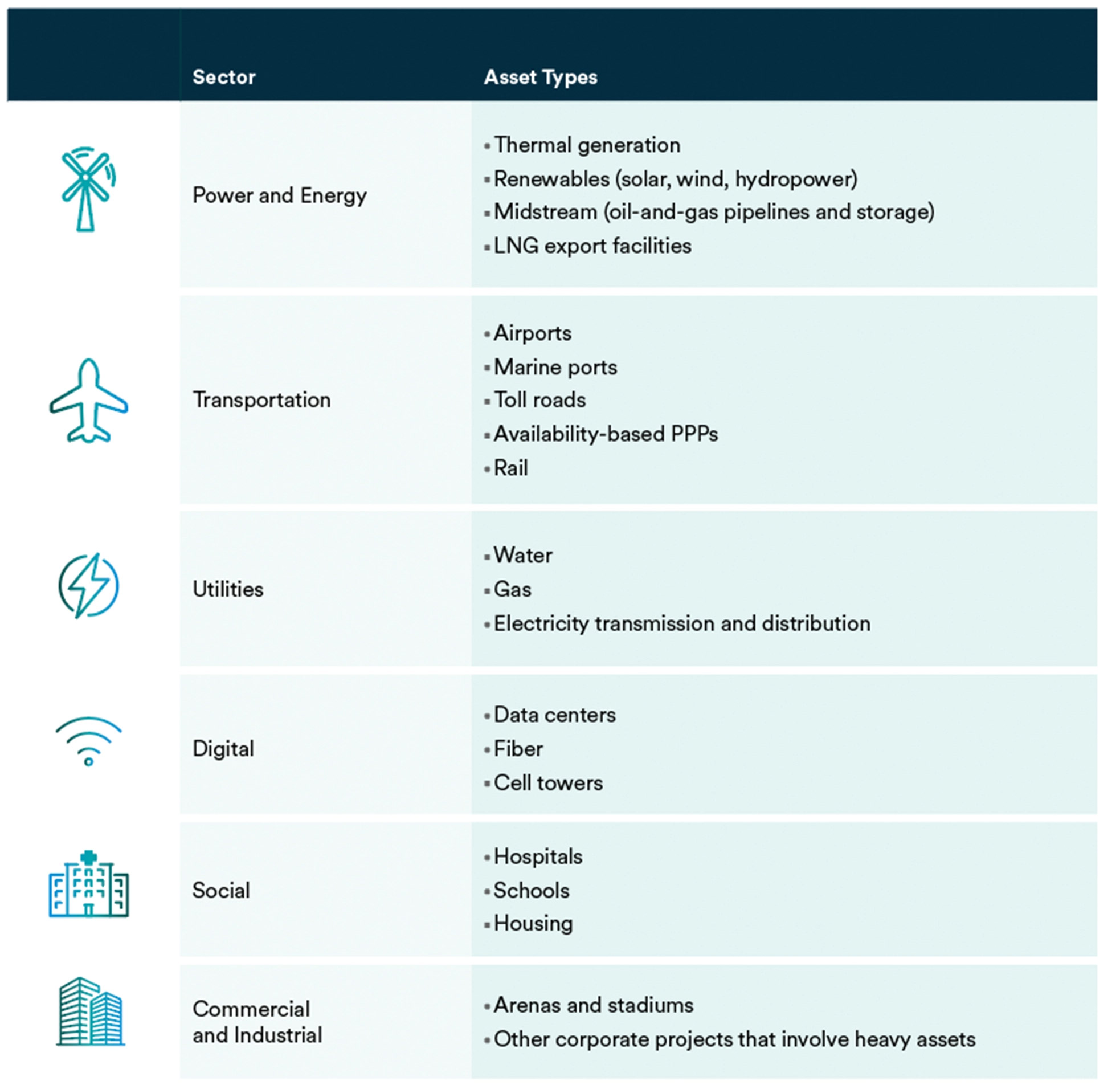
As one of the largest global infrastructure investors, the 20-person Infrastructure Debt team at MIM manages $41.2 billion7 in infrastructure debt across over 500 credits in all major infrastructure sectors. Exhibit 1 shows how we categorize these sectors.
 

Exhibit 1 | Infrastructure Sectors and Asset Types
Image
Table listing infrastructure sectors and asset types

Source: MetLife Investment Management as of April 24, 2026.
 

Our approach to analyzing potential investments centers on the asset’s fundamental risks and the cash flows it is likely to generate.

Infrastructure Strategies and Risk Level

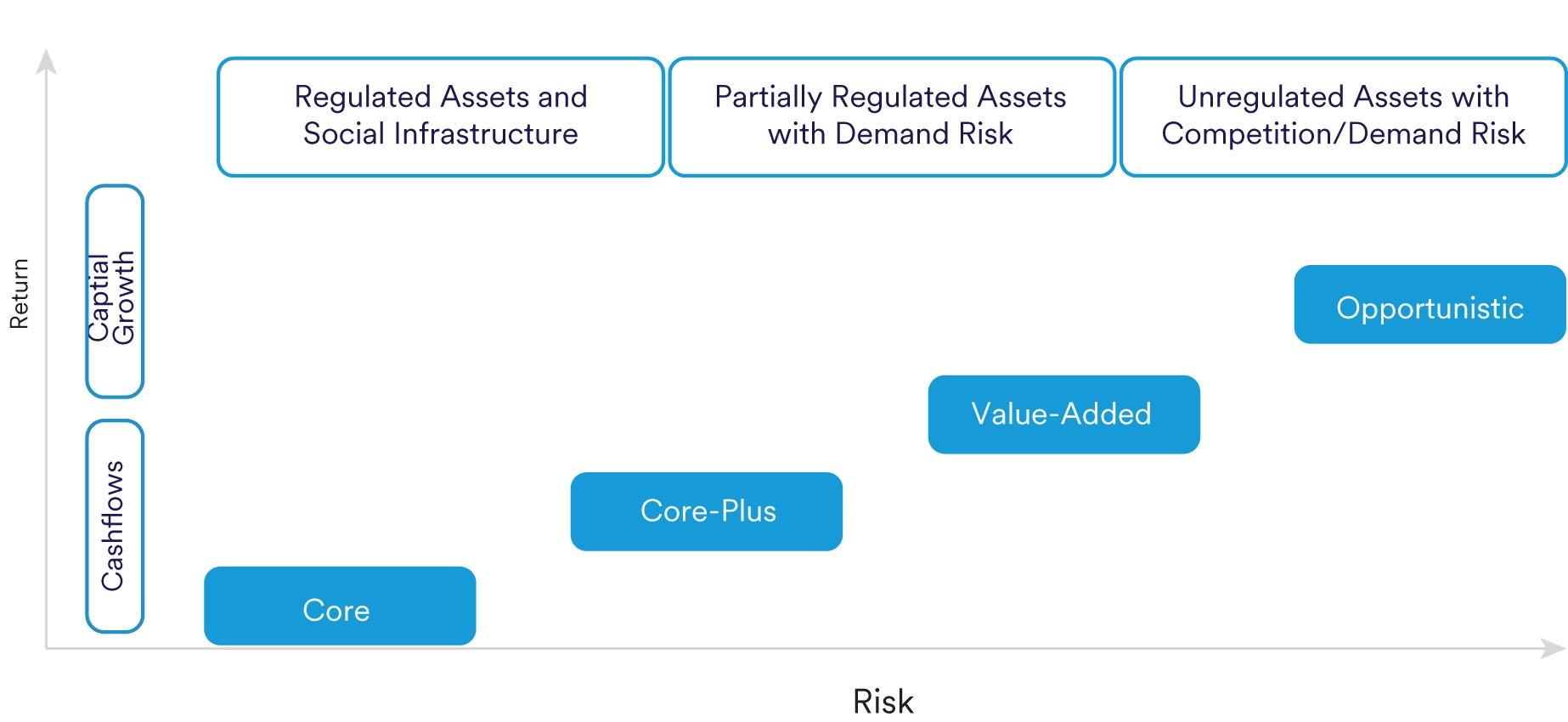
The infrastructure market typically groups investment strategies into four categories. In ascending order of risk and return, these are:

  • Core
  • Core-Plus
  • Value-Added
  • Opportunistic

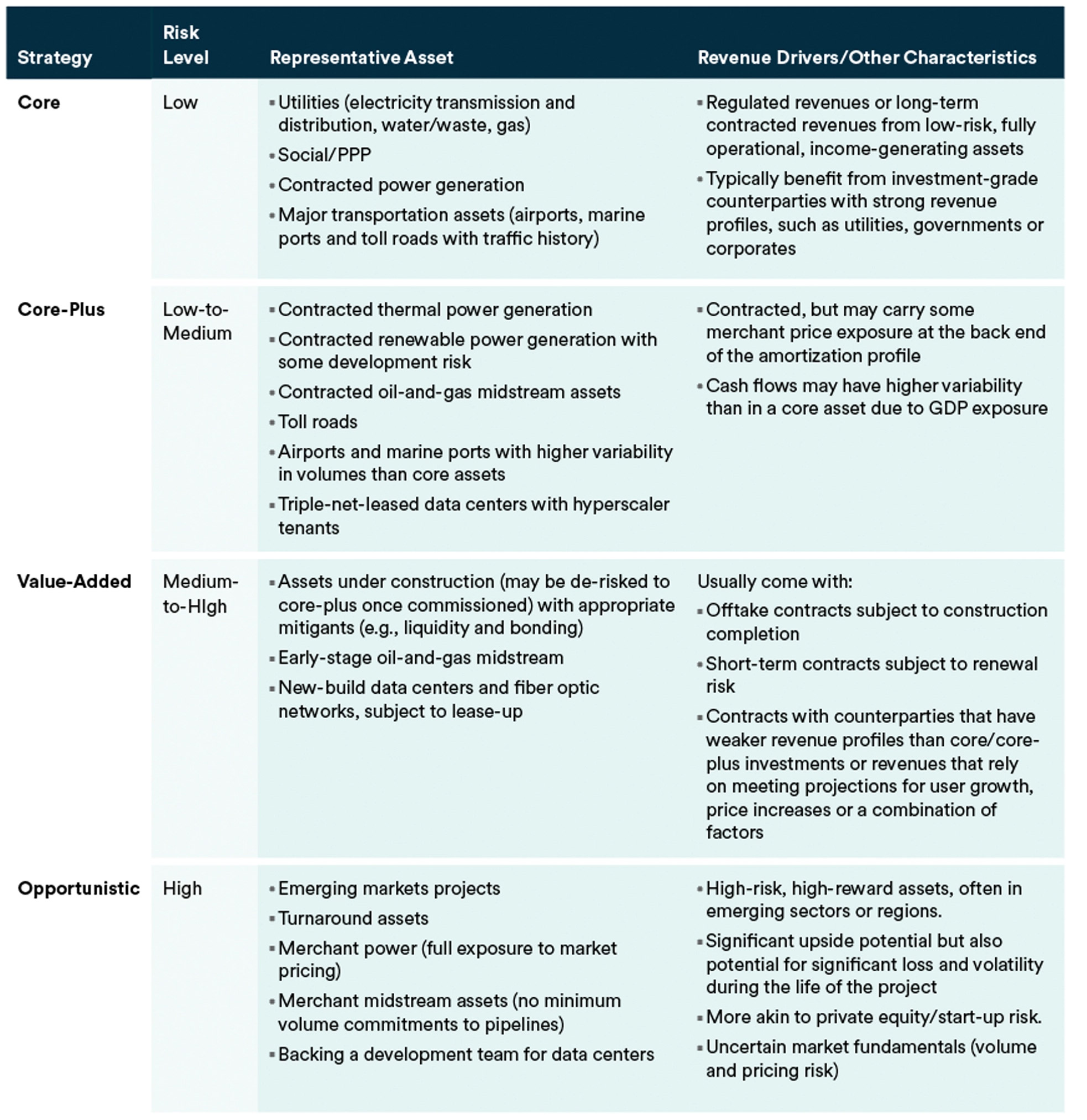
As Exhibit 2 shows, the relative level of risk depends on the degree of certainty that the underlying assets can generate projected cash flows. Core investors typically purchase assets that generate stable, predictable, regulated cash flows and have a low cost of capital that allows them to accept a lower return. At the opposite end of the spectrum, opportunistic investors seek higher returns by backing earlier-stage projects or development teams in hopes of capturing significant upside. Our Infrastructure Debt team focuses primarily on core and core-plus sponsors and value-added sponsors where there is significant risk mitigation due to the unique features of infrastructure debt. Exhibit 3 describes each type of strategy in more detail, along with examples of relevant infrastructure assets and projects.
 

Exhibit 2 | The Spectrum of Infrastructure Debt Investment Strategies
Image
Chart plotting strategies with risk and return

Source: MetLife Investment Management as of April 24, 2026
 

Exhibit 3 | Infrastructure Sectors and Asset Types
Image
Table listing strategies, risk, assets, and revenue drivers

Source: MetLife Investment Management as of April 24, 2026.
 

Key Attributes of Private Infrastructure Debt

Private high-yield infrastructure debt has several attractive features that support its addition to a portfolio, including:

  • A history of enhanced cash returns that have benefited from illiquidity and structural premia versus liquid public high-yield bonds.
  • Lower credit risk than similarly rated corporate debt.
  • Enhanced structural protections.
  • Diversification and lower correlation with typical corporate issuers.

We will consider each of these in turn.

Enhanced Cash Returns

In 2026, private high-yield BB infrastructure credit spreads typically started in the high-200-to-low-300-basis point (bp) range resulting in yields typically starting at approximately 7.0% or higher.8 With the usual caveat that these spreads may not be indicative of future performance, they compared favorably to the BB US High Yield Index option-adjusted spread, which averaged approximately 176 bps for the 12 months through April 2026.9

Higher infrastructure spreads generally reflect the premium investors demand for illiquidity and single-asset risks associated with infrastructure and project finance debt. Private lenders can also target sectors such as digital infrastructure or midstream oil-and-gas assets that have higher expected returns than the over-represented utility credits in the high-yield index.

Lower Credit Risk than Similarly Rated Corporate Debt

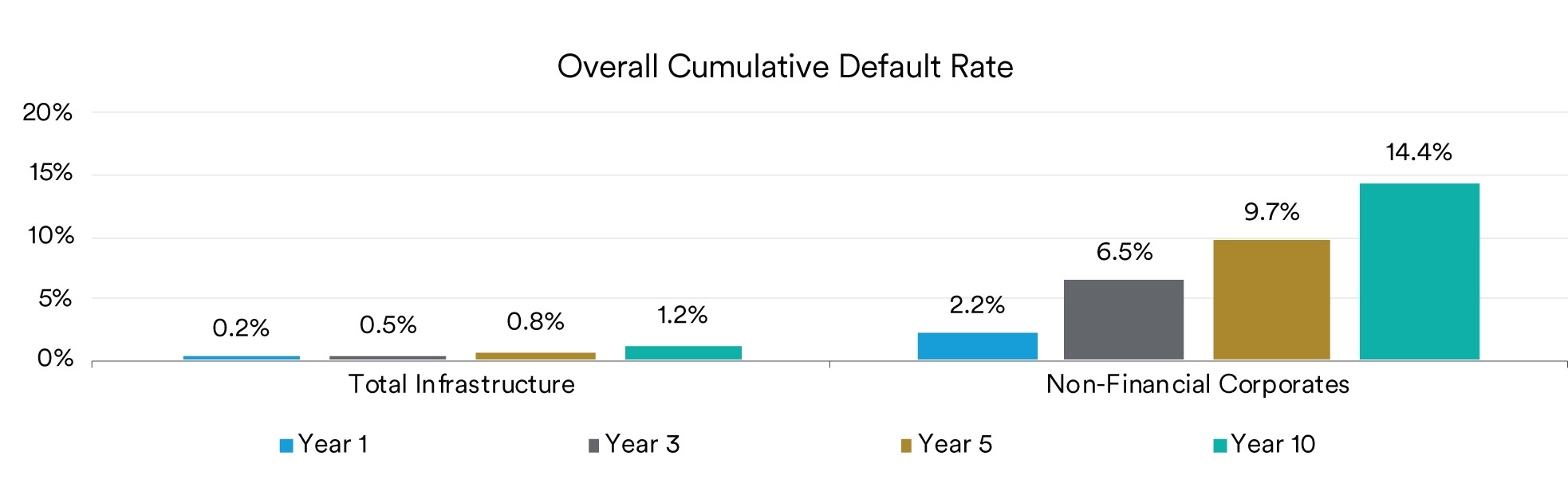
While infrastructure issuers typically pay a higher rate for debt, their track records suggest their credit risk has been lower than that of corporate borrowers. Infrastructure debt has demonstrated resilience through various cycles, with lower default rates and lower loss rates than non-financial corporate debt (Exhibit 4). A recently updated Moody’s study of debt securities from 1983–2024 showed that an average of 0.8% of total infrastructure debt securities defaulted over a five-year horizon during this time period, compared with 9.7% of non-financial corporates. The gap increased over time.10
 

Exhibit 4 | Cumulative Default Rate of Infrastructure Debt vs. Non-Financial Corporate Debt
Image
Graph showing overall cumulative default rate

Source: Moody's as of Sept. 3, 2025
 

Especially relevant for yield-seeking investors is the difference between high-yield (BB) infrastructure debt and high-yield (BB) non-financial corporates with maturities of five years or less, a comparison that reflects the shorter maturities of high-yield debt. Non-financial corporate debt’s cumulative default rates at five years were 71% higher than for infrastructure debts, at 7.9% compared to 4.6%.11

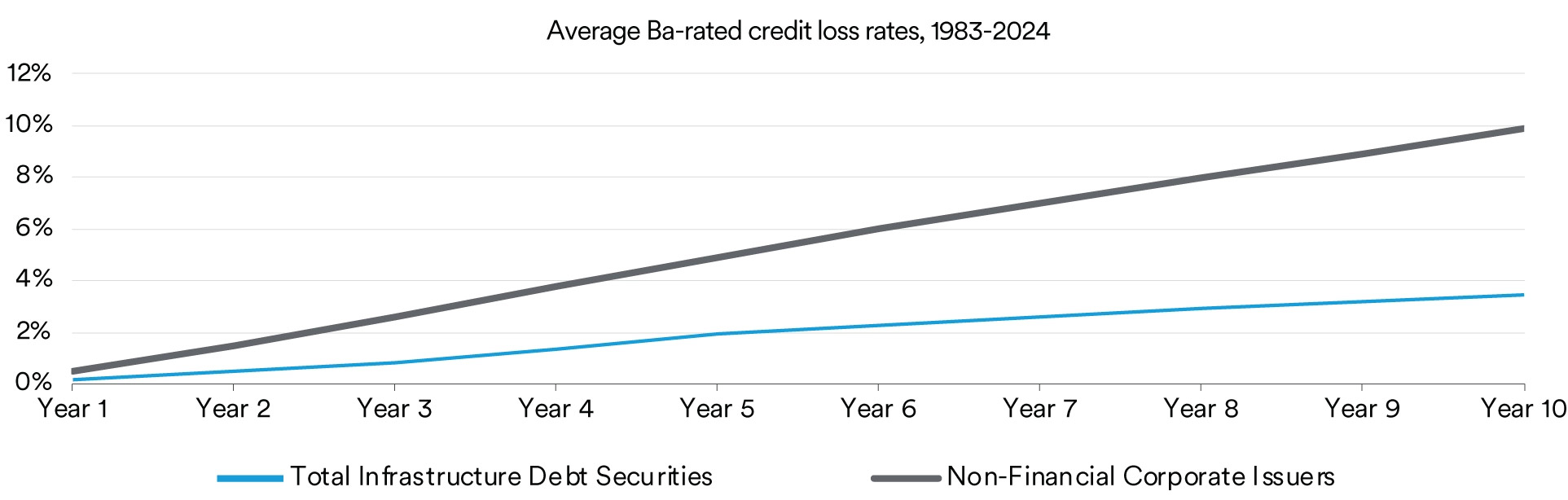
Infrastructure debt also has a history of lower losses than non-financial corporate debt. The average recovery rate for senior secured infrastructure debt, based on trading prices, was 67%12, compared to 56% for non-financial corporate issues and an 18-year average recovery rate of 40% for high-yield bonds and 59% for leveraged loans.13 Furthermore, infrastructure debt demonstrated a loss rate at the five-year horizon that was 60% lower than similarly rated BB-quality, non-financial corporate debt, at 1.95%, compared to 4.91% (Exhibit 5).14
 

Exhibit 5 | Infrastructure Debt Loss Rates vs. Non-Financial Corporates
Image
Graph comparing infrastructure debt loss rates

Source: Moody's as of Sept. 3, 2025
 

Enhanced Structural Protections

Infrastructure debt has structural features that help limit defaults and support higher recovery rates. Compared to other sectors of the capital markets, infrastructure debt is highly structured, with a comprehensive set of covenants that restrict a borrower’s ability to undertake actions adverse to the lender’s interests. Typical restrictions include limitations on additional indebtedness and requirements to maintain debt service coverage ratios and limit leverage ratios, both to avoid a default and before any distributions are made to equity holders. This ensures an alignment of interests with the equity owners. Reserves for debt service as well as major maintenance are often included as part of the debt structure. As with real estate properties, physical infrastructure assets are often pledged as collateral to secure the debt, which helps explain the favorable historical recovery statistics.

Diversification and Lower Correlations with Corporate Issuers

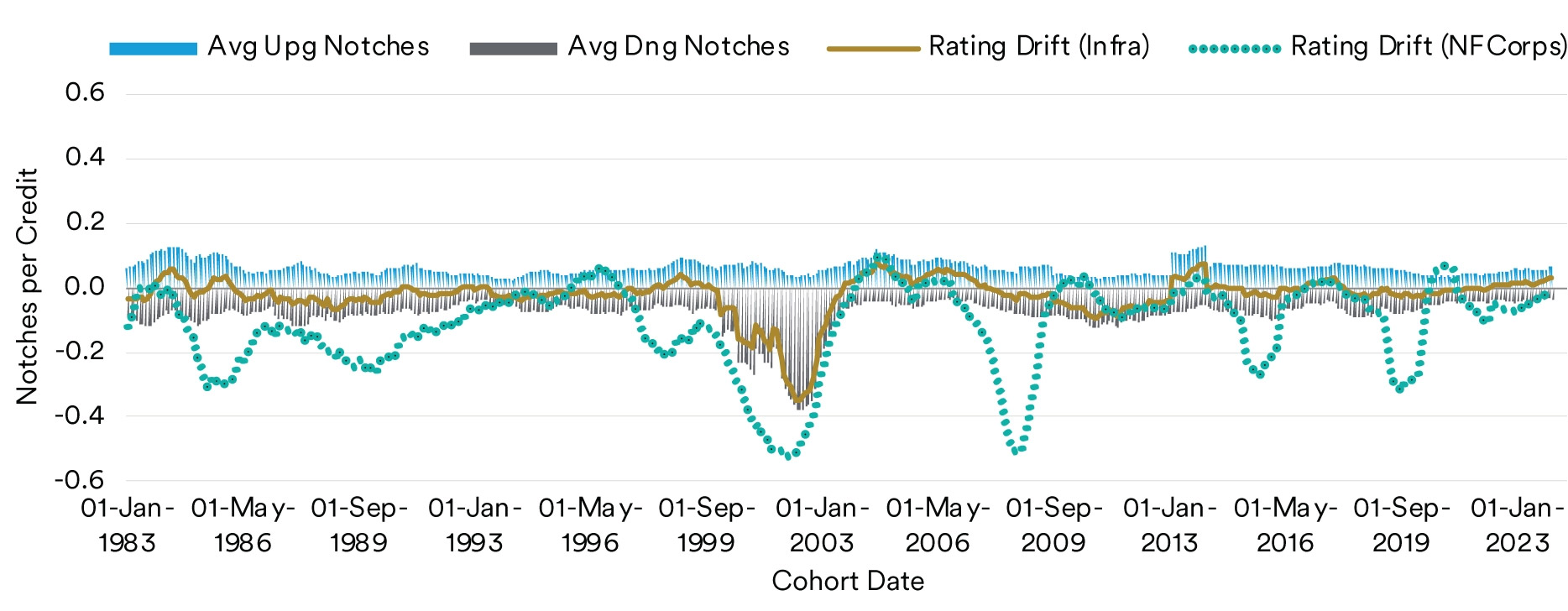
The Moody’s study also showed that ratings volatility for infrastructure debt has been “near zero” for much of the study period, aside from the energy crisis in the early 2000s, as shown in Exhibit 6.15 This was true even during the Global Financial Crisis in 2008–2009, the energy price drop in 2015–2016 and the COVID-19 shutdown in 2020–2021.
 

Exhibit 6 | One-year Average Upgraded and Downgraded Notches Per Issuer and One-year Rating Drift (1983-2024)
Image
Graph comparing one-year average notches per issuer over 40 years

Source: Moody's as of Sept. 3, 2025.
 

Infrastructure assets can withstand economic cycles for several reasons. First, they provide essential services. Second, the debt instruments typically require issuers to hold reserves to preserve liquidity in case of an event or operating issue that interrupts the normal generation of cash flows. Infrastructure assets also often benefit from revenue contracts that are indexed to inflation, so that as costs increase, their revenues step up with the Consumer Price Index or some other form of indexation. Finally, infrastructure revenues are often set by contracts or regulatory regimes that do not typically depend on the performance of the broader economy or consumer spending.

Risks to Consider

Investment in private infrastructure debt offers many potential benefits, but like other investments, there are also risks.

Illiquidity

Private infrastructure debt is an illiquid asset class with no readily tradable market, which means that investments cannot be readily sold. This illiquidity may limit an investor’s ability to redeem their investment. However, the Moody’s recovery study indicated that ultimate recoveries16 (i.e., being able to hold the investment to ultimate resolution) may outperform trading recoveries. Including infrastructure debt as part of a long-term investment strategy, while maintaining adequate levels of liquidity on a portfolio-wide basis, is one way to manage illiquidity risk at the portfolio level.

Legal/Regulatory Risk

Legal and/or regulatory changes that have a negative impact on the cash flows of a project due to increased costs related to remediation, fines or loss of permits or licenses could be implemented or imposed. Failure to comply with laws, statutes and regulations could result in fines or project shutdowns, which could also have a material impact on the project’s cash flows. It is important to assess these risks when analyzing an investment and seek guidance from the appropriate professionals and legal support to understand the critical issues involved.

Operating/Technology Risk

Infrastructure assets are often complex and require maintenance and technical upkeep. Ongoing operations and maintenance by qualified personnel and a sufficient budget to meet operating needs are critical to generating projected cash flows. Assets occasionally have operating issues, and appropriate staffing or response plans for any unforeseen problems are necessary to ensure they continue operating. Ways to mitigate operating issues include staffing projects properly with qualified personnel, maintaining proper insurance, requiring maintenance reserves in the debt structure and assigning risk properly. For example, insuring that technology providers offer a warranty shifts technical risk to the provider, and KPI penalties shift operating risk to the operator.

Blind Pool Risk

Investing in an infrastructure debt strategy where the manager has broad discretion to choose assets that fit within a set of investment criteria means investors are committing to “blind pools.” Investors must commit to fund the pool’s future investments without knowing what they will be. Managers may diverge from what the investors understood the strategy to be. Using stated criteria for inclusion into the pool is a partial mitigant to complete discretion but remains subject to the manager’s ultimate interpretation of the criteria. There is a risk that the manager may construct a portfolio differently than the investor anticipated.

Environmental Risk

Infrastructure investments sometimes involve environmental risks, which can potentially result in fines, regulatory changes and contamination — all of which may negatively affect operating performance. Proper compliance with a sound operating plan and a commitment to follow existing laws and regulations can mitigate potential environmental issues. Any contamination associated with a project could become the financial burden of that project.

How We Approach Investment and Balance Risk in Infrastructure Debt

Credit Discipline and Rigorous Underwriting

At MIM, we invest the capital of our parent company, MetLife, among other clients. Our focus, therefore, is first and foremost on capital preservation and stable, consistent, risk-adjusted cash returns — not short-term paper gains.

We apply fundamental asset analysis to sub-investment grade exposures, including in-depth due diligence, detailed cash-flow modeling, covenant structuring and review with counsel, as well as collateral evaluation. A credit committee consisting of senior members from across the Private Fixed Income group, including the Infrastructure Debt team, reviews the deals that make it through the fundamental analysis.

Integrated ESG Research and Cross-Platform Insights

MIM deploys an integrated approach to sustainable investing, such that investment analysts, asset originators and portfolio managers are responsible for implementing our Sustainable Investment Policy and associated practices. Dedicated sustainability resources throughout our organization support these teams.

As part of our Infrastructure Debt team’s disciplined, bottom-up, research-driven security selection process, we evaluate financially material environmental, social and governance (ESG) considerations alongside other material risks and opportunities to determine fair value at the issuer and security level. We benefit from the input of teams around MIM to better understand individual investment opportunities, including material sustainability risks. Some of these partnerships include:

  • The Private Credit Sustainability Research team is integrated with the Infrastructure Debt team and provides sustainable investing expertise as required.
  • The Corporate Private Placement and Private Asset-Backed Finance teams, part of the unified Private Fixed Income group, can often provide insight into particular issuers and deals.
  • The Real Estate teams also serve as expert resources in digital infrastructure and other areas where infrastructure and real estate overlap, such as logistics.
  • The Sustainability Strategies Group (SSG) supports MIM’s objective to be a leader in sustainable investment solutions by building a strong foundation across sustainability governance, data and client strategy. The SSG works closely with the sustainability research teams across fixed income, equities, private capital and real estate.

Conclusion

Infrastructure debt offers investors a powerful combination of stable cash yields, downside protection, portfolio diversification and exposure to long-term secular growth themes. Its historical record of reduced ratings volatility, lower defaults and higher recoveries relative to traditional corporate credit demonstrates the resilience that a strategy that invests in assets that provide essential services can provide across economic cycles.

As governments increasingly rely on private capital to fund the modernization of energy, digital, transportation and utility systems, the opportunity set for private lenders continues to expand. These trends create durable demand for experienced debt investors capable of navigating complex structures, assessing long-lived physical assets and underwriting projects with disciplined risk management.

Our approach is grounded in credit discipline, sustainable investing principles and a long-standing focus on capital preservation. As both a balance sheet investor for MetLife and a fiduciary for third party clients, MIM’s Infrastructure Debt team combines fundamental asset-level analysis with infrastructure expertise, global reach and an extensive origination network to source, evaluate and structure transactions designed to deliver stable, risk adjusted returns to investors looking to incorporate infrastructure debt into their private credit allocations.


Read More from MetLife Investment Management


Disclaimer

This material is intended solely for Institutional Investors, Qualified Investors and Professional Investors. This analysis is not intended for distribution with Retail Investors.

MetLife Investment Management (MIM), which includes PineBridge Investments, is MetLife Inc.’s institutional investment management business. MIM is a group of international companies that provides investment advice and markets asset management products and services to clients around the world.

This document is solely for informational purposes and does not constitute a recommendation regarding any investments or the provision of any investment advice, or constitute or form part of any advertisement of, offer for sale or subscription of, solicitation or invitation of any offer or recommendation to purchase or subscribe for any securities or investment advisory services. The views expressed herein are solely those of MIM and do not necessarily reflect, nor are they necessarily consistent with, the views held by, or the forecasts utilized by, the entities within the MetLife enterprise that provide insurance products, annuities and employee benefit programs. The information and opinions presented or

contained in this document are provided as of the date it was written. It should be understood that subsequent developments may materially affect the information contained in this document, which none of MIM, its affiliates, advisors or representatives are under an obligation to update, revise or affirm. It is not MIM’s intention to provide, and you may not rely on this document as providing, a recommendation with respect to any particular investment strategy or investment. Affiliates of MIM may perform services for, solicit business from, hold long or short positions in, or otherwise be interested in the investments (including derivatives) of any company mentioned herein. This document may contain forward-looking statements, as well as predictions, projections and forecasts of the economy or economic trends of the markets, which are not necessarily indicative of the future. Any or all forward-looking statements, as well as those included in any other material discussed at the presentation, may turn out to be wrong.

The various global teams referenced in this document, including portfolio managers, research analysts and traders are employed by the various legal entities that comprise MIM.

All investments involve risks including the potential for loss of principle and past performance does not guarantee similar future results.

In the U.S: This document is communicated by MetLife Investment Management, LLC (MIM, LLC), a U.S. Securities and Exchange Commission (SEC) registered investment adviser. Registration with the SEC does not imply a certain level of skill or that the SEC has endorsed the investment adviser.

For investors in the UK: This document is being distributed by MetLife Investment Management Limited (“MIML”), authorised and regulated by the UK Financial Conduct Authority (FCA reference number 623761), registered address One Angel Lane 8th Floor London EC4R 3AB United Kingdom. This document is approved by MIML as a financial promotion for distribution in the UK. This document is only intended for, and may only be distributed to, investors in the UK who qualify as a "professional client" as defined under the Markets in Financial Instruments Directive (2014/65/EU), as per the retained EU law version of the same in the UK.

For investors in the Middle East: This document is directed at and intended for institutional investors (as such term is defined in the various jurisdictions) only. The recipient of this document acknowledges that (1) no regulator or governmental authority in the Gulf Cooperation Council (“GCC”) or the Middle East has reviewed or approved this document or the substance contained within it, (2) this document is not for general circulation in the GCC or the Middle East and is provided on a confidential basis to the addressee only, (3) MetLife Investment Management is not licensed or regulated by any regulatory or governmental authority in the Middle East or the GCC, and (4) this document does not constitute or form part of any investment advice or solicitation of investment products in the GCC or Middle East or in any jurisdiction in which the provision of investment advice or any solicitation would be unlawful under the securities laws of such jurisdiction (and this document is therefore not construed as such).

For investors in Japan: This document is being distributed by MetLife Investment Management Japan, Ltd. (“MIM JAPAN”), a registered Financial Instruments Business Operator (“FIBO”) conducting Investment Advisory Business, Investment Management Business and Type II Financial Instruments Business under the registration entry “Director General of the Kanto Local Finance Bureau (Financial Instruments Business Operator) No. 2414” pursuant to the Financial Instruments and Exchange Act of Japan (“FIEA”), and a regular member of the Investment Management Association of Japan and the Type II Financial Instruments Firms Association of Japan. In its capacity as a discretionary investment manager registered under the FIEA, MIM JAPAN provides investment management services and also sub-delegates a part of its investment management authority to other foreign investment management entities within MIM in accordance with the FIEA. This document is only being provided to investors who are general employees' pension fund based in Japan, business owners who implement defined benefit corporate pension, etc. and Qualified Institutional Investors domiciled in Japan. It is the responsibility of each prospective investor to satisfy themselves as to full compliance with the applicable laws and regulations of any relevant territory, including obtaining any requisite governmental or other consent and observing any other formality presented in such territory. As fees to be borne by investors vary depending upon circumstances such as products, services, investment period and market conditions, the total amount nor the calculation methods cannot be disclosed in advance. All investments involve risks including the potential for loss of principle and past performance does not guarantee similar future results. Investors should obtain and read the prospectus and/or document set forth in Article 37-3 of Financial Instruments and Exchange Act carefully before making the investments.

For Investors in Hong Kong S.A.R.: This document is being distributed by MetLife Investments Asia Limited (“MIAL”), licensed by the Securities and Futures Commission (“SFC”) for Type 1 (dealing in securities), Type 4 (advising on securities) and Type 9 (asset management) regulated activities in Hong Kong S.A.R. This document is intended for professional investors as defined in the Schedule 1 to the SFO and the Securities and Futures (Professional Investor) Rules only. Unless otherwise stated, none of the authors of this article, interviewees or referenced individuals are licensed by the SFC to carry on regulated activities in Hong Kong S.A.R. The information contained in this document is for information purposes only and it has not been reviewed by the Securities and Futures Commission.

For investors in Australia: This information is distributed by MIM LLC and is intended for “wholesale clients” as defined in section 761G of the Corporations Act 2001 (Cth) (the Act). MIM LLC exempt from the requirement to hold an Australian financial services license under the Act in respect of the financial services it provides to Australian clients. MIM LLC is regulated by the SEC under US law, which is different from Australian law.

For investors in the EEA: This document is being distributed by MetLife Investment Management Europe Limited (“MIMEL”), authorised and regulated by the Central Bank of Ireland (registered number: C451684), registered address 20 on Hatch, Lower Hatch Street, Dublin 2, Ireland. This document is approved by MIMEL as marketing communications for the purposes of the EU Directive 2014/65/EU on markets in financial instruments (“MiFID II”). Where MIMEL does not have an applicable cross-border licence, this document is only intended for, and may only be distributed on request to, investors in the EEA who qualify as a “professional client” as defined under MiFID II, as implemented in the relevant EEA jurisdiction. The investment strategies described herein are directly managed by delegate investment manager affiliates of MIMEL. Unless otherwise stated, none of the authors of this article, interviewees or referenced individuals are directly contracted with MIMEL or are regulated in Ireland. Unless otherwise stated, any industry awards referenced herein relate to the awards of affiliates of MIMEL and not to awards of MIMEL.


1 Moody’s, “Infrastructure default & recovery rates, 1983-2024.” Sept. 3, 2025
2 McKinsey & Company, “The Infrastructure Moment: Investing in the expanding foundations of modern society” by Alastair Green, Ishaan Nangia, Nicola Sandri, September 2025
(https://www.mckinsey.com/~/media/mckinsey/industries/infrastructure/our%20insights/the%20infrastructure%20moment/the-infrastructure-moment-investing-in-the-expanding-foundations-of-modern-society.pdf?shouldIndex=false)
3 IJ Global (https://www.ijglobal.com/data/market-analytics)
4 Infrastructure-Debt-–-Understanding-the-Opportunity.pdf
5 IJ Global, Infrastructure and Project Finance League Table Report H1 2025 (Infrastructure and Project Finance Charts) (https://www.ijglobal.com/articles/228086/ijglobal-league-tables-h1-2025-infra-finance-stumbles?home=1)
6 MetLife Investment Management, LLC
7 As of Dec. 31, 2025
8 Spreads to ICE Bank of America BB High Yield Index Option-Adjusted Spread. This is not intended to serve as investment advice, and past performance is not indicative of future performance.
9 Source: Bank of America [BAMLH0A1HYBB] ICE Bank of America BB High Yield Index Option-Adjusted Spread for April 23, 2025–April 23, 2026
10 Moody’s, “Infrastructure default & recovery rates, 1983-2024.” Sept. 3, 2025
11 Moody’s, “Infrastructure default & recovery rates, 1983-2024.” Sept. 3, 2025
12 Moody’s, “Infrastructure default & recovery rates, 1983-2024.” Sept. 3, 2025
13 Cliffwater Report on U.S. Direct Lending (2023 Q3) – Source: JPMorgan Markets, Bloomberg US High Yield Index, Morningstar LSTA Leveraged Loan Index.
14 Moody’s, “Infrastructure default & recovery rates, 1983-2024.” Sept. 3, 2025
15 Moody’s, “Infrastructure default & recovery rates, 1983-2024.” Sept. 3, 2025
16 Moody’s, “Infrastructure default & recovery rates, 1983-2024.” Sept. 3, 2025


MetLife Investment Management ("MIM") is MetLife, Inc.'s institutional investment management business. MIM is a group of international companies that provides investment advice and markets asset management products and services to clients around the world.

MIM offers a variety of products and services intended solely for investors from certain countries or regions. Your country of legal residence will determine the products or services that are available to you. Nothing on this website should be considered a solicitation or offering for sale of any investment product or service to any person in any jurisdiction where such solicitation or offer would be unlawful. This site does not provide financial or investment advice and does not take into account the particular financial circumstances of individual investors. Before investing, investors should seek their own professional advice.

All investments involve risk, including possible loss of principal; no guarantee is made that investments will be profitable. The information provided on this website is for informational purposes only, and does not constitute investment advice, solicitation for or intermediation of investment advice or investment management services, or an offer to buy or sell or solicit the acquisition of any security, financial instrument or service. Securities products are sold by MetLife Investments Securities, LLC, a FINRA member firm and member of SIPC.

All information contained in this website is provided in good faith and believed to be accurate as of the time of compilation. The information in this website is provided "as is" and on an "as available" basis without warranties of any kind. MIM does not warrant that the information on this website will be accurate as of the date it is accessed by any user.

© 2026 MetLife Services and Solutions, LLC, New York, NY 10166 - All Rights Reserved.

04-28 5434731-[MIM Europe, MIAL (HK), MIM Japan, MIML (UK), MIM, LLC (US)]

Share this post

Sign Up Now for Full Access to Articles and Podcasts!

Unlock full access to our vast content library by registering as an institutional investor

Register

Contacts


MetLife Investment Management

MetLife Investment Management and PineBridge Investments now have more to offer as a top-tier global investment platform. With more than 150 years of insurance heritage, we combine the strength of a global, top-tier investment manager with expanded capabilities across multiple capital frameworks. We offer life, property & casualty, reinsurance, and healthcare clients a broad range of total return, income, and yield-enhancing solutions. Backed by $122B in insurance Client AUM1, our expertise spans fixed income, private credit, real estate, equities, and multi-asset strategies. Our proprietary origination and structured deal flow help insurers improve liability alignment, balance-sheet resilience, and capital efficiency, supported by teams across 19 countries.

Madhavi Chugh, CFA
Global Co-Head of Insurance Solutions 
madhavi.chugh@metlife.com
(609) 216-6691 

Jeannine Heal, CFA
Global Co-Head of Insurance Solutions 
jeannine.heal@pinebridge.com
(732) 778-4734

MetLife Investment Management
One MetLife Way
Whippany, New Jersey 07981
 

View the contributor page

Sign Up Now for Full Access to Articles and Podcasts!

Unlock full access to our vast content library by registering as an institutional investor .

Create an account

Already have an account ? Sign in

Ѐ Ё Ђ Ѓ Є Ѕ І Ї Ј Љ Њ Ћ Ќ Ѝ Ў Џ А Б В Г Д Е Ж З И Й К Л М Н О П Р С ΄ ΅ Ά · Έ Ή Ί Ό Ύ Ώ ΐ Α Β Γ Δ Ε Ζ Η Θ Ι Κ Λ Μ Ν Ξ Ο Π Ρ Ё Ђ Ѓ Є Ѕ І Ї Ј Љ Њ Ћ Ќ Ў Џ А Б В Г Д Е Ж З И Й К Л М Н О П Р С Т У Ф Х Ц Ч Ш Ā ā Ă ă Ą ą Ć ć Ĉ ĉ Ċ ċ Č č Ď ď Đ đ Ē ē Ĕ ĕ Ė fi fl œ æ ß