

Invesco -

Insurance Outlook 2026

Urban commuter wearing a bicycle helmet and backpack riding a black city bike past a modern glass office building on a city street during daytime.

We believe 2026 will present insurers with another challenging investment backdrop.  While the global economy held up reasonably well in 2025, there are a number of risks to consider moving forward.  For example, will the Federal Reserve cut rates too quickly and drive inflation higher?  Or will it cut too slowly and be forced to play catch-up in a deteriorating economy?  Will tariffs bring about a new round of inflationary pressure?  Will geopolitical conflicts bring risk assets under pressure?

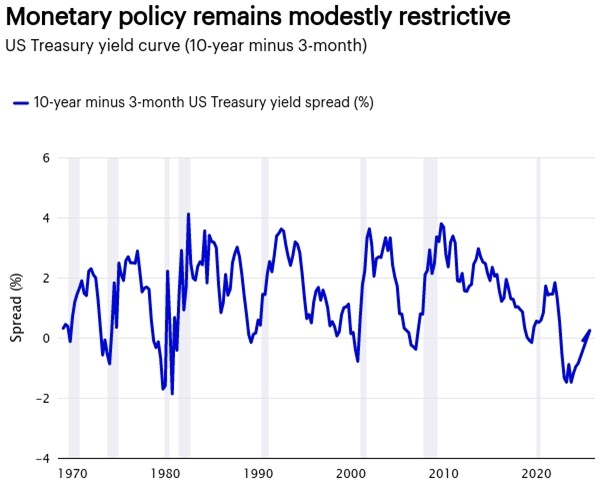
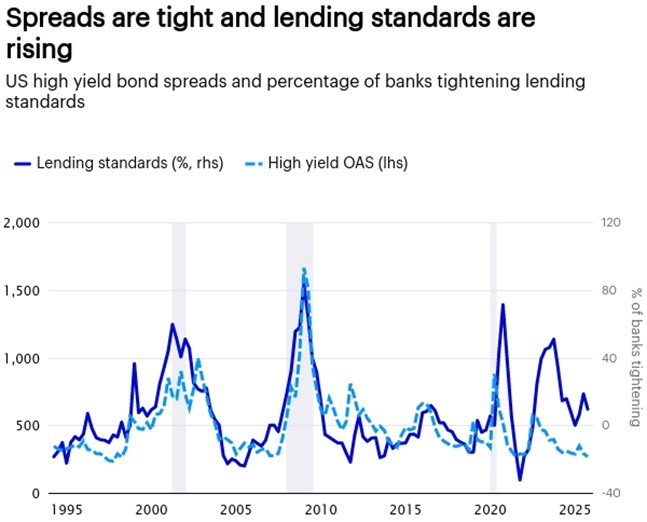
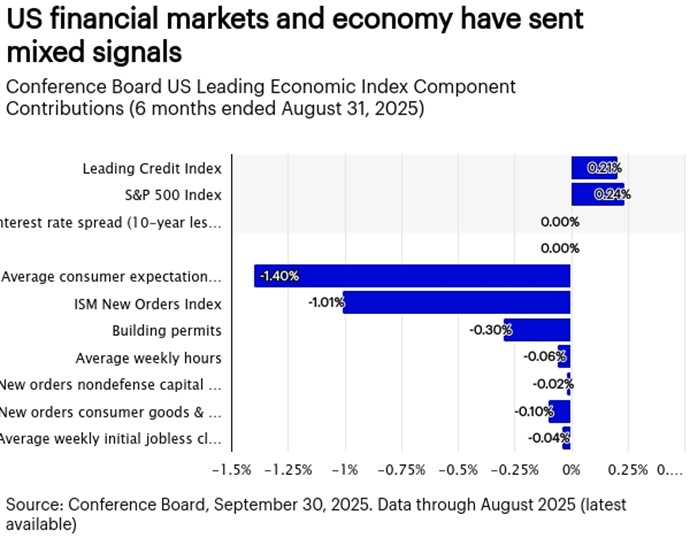
While risk assets continued to perform well as we approached the end of 2025, we do not necessarily see recession as a significant near-term risk. Rather, we are seeing mixed signals which, along with high valuations, warrant caution heading into 2026.

Yield curve, credit spreads, and lending standards don’t point to a recession

Image
Picture3


Image
Picture4


Sources: US Treasury yield curve data from Bloomberg L.P., September 30, 2025. Credit spreads data from Bloomberg L.P., September 30, 2025. Represented by the Bloomberg US High Yield Corporate Bond Index. Option-adjusted spread (OAS) is the measurement of the spread of a fixed-income security rate and the risk-free rate of return, adjusted to account for an embedded option, such as calling back or redeeming the issue early. Lending standards: US Federal Reserve, Q3 2025. Shows the net percent of respondents tightening lending standards for mid and large businesses. Latest data available. Ihs= left hand side, rhs= right hand side.
 

Image
Picture5

Fixed income fundamentals are strong, but spread duration presents a risk

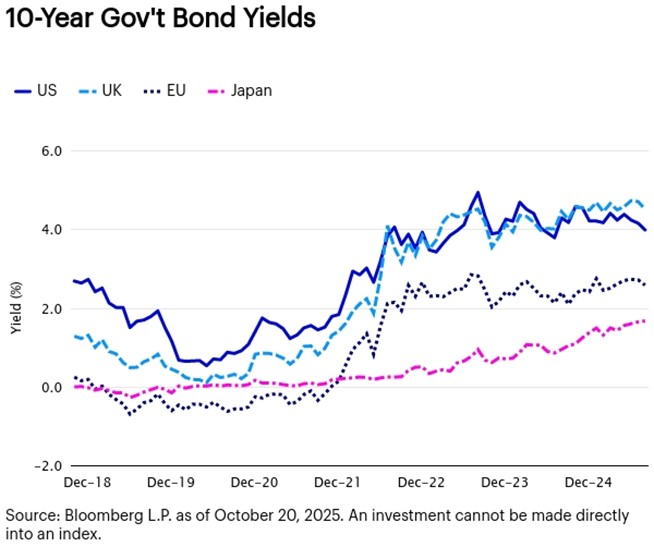
We’ve clearly seen a meaningful shift lower in fixed income yields in 2025 with the 10-year US Treasury yield falling about 80 basis points through mid-October to below 4%.  While major central banks have begun reducing policy rates, investors continue to reassess how far policy rates can fall and how quickly that destination can be reached.  Notably, the US Treasury market is pricing in nearly constant long-term yields over the next two to three years, which are more meaningful to most insurers. 

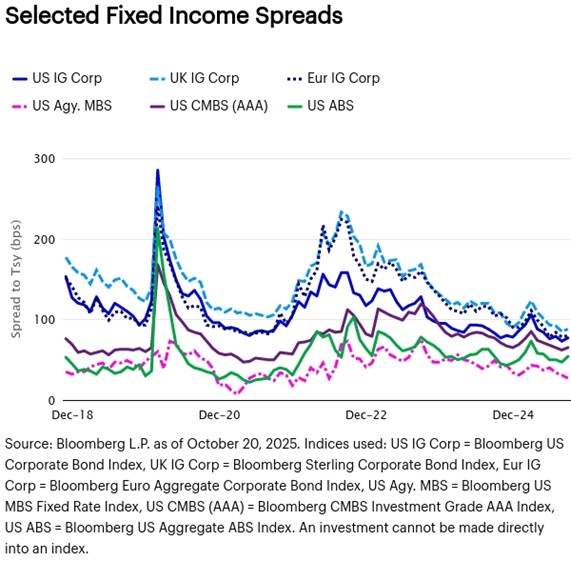
Meanwhile, spreads across many fixed income assets returned roughly to where they started the year after widening significantly in the spring, leaving all-in yields for US investment grade exposure in the mid-4% context, UK yields in the low-5% context, and European yields in the 3% context as of mid-October. While fundamentals are strong, we encourage caution on spread duration as spread risks currently appear to be asymmetrically skewed to the upside.
 

Image
Picture6


Image
Picture7


The case for private markets for insurers

Beyond public fixed income, we believe insurers should continue building out or refining their private market portfolios as well.  Private credit remains an overweight position in Invesco strategies relative to other assets given attractive all-in yields, seniority in the capital structure, and reasonable spreads over liquid credit.  Recently there has been much discussion about credit events in private markets and whether they are signs of broader stress to come or idiosyncratic events; in our view, they are more likely to be idiosyncratic with current spreads still providing reasonable compensation for the risk.  Similarly, while commercial real estate has been under pressure in recent years, the current environment can offer favorable CRE debt yields – we believe this is an opportunity which could enhance capital-adjusted returns for a wide variety of insurers globally.

Within private equity, we continue to encourage caution for our clients.  Substantial dry powder and high valuations make it a difficult environment from a technical standpoint, and with financing levels still higher than the recent past, the return potential from deploying leverage is not as attractive as it was a few years ago.

Regulatory issues to watch

From a regulatory perspective, there are a number of items warranting continued close monitoring going in to 2026.

European and UK insurance portfolios continue to be shaped by Solvency II and Solvency UK reforms, coupled with the macroeconomic backdrop of historically low spreads in the public markets, 2025’s policy induced volatility, and ongoing concerns around inflation.

The EU’s upcoming Solvency II revisions (2026–2027) aim to significantly lower capital charges for high-quality senior securitization tranches and enhance treatment of infrastructure and long-term equity exposures. These changes position senior structured credit — such as asset-based finance, commercial mortgage loans, and senior tranches of collateralized loan structures (CLOs) — as attractive options for insurers seeking capital-efficient yield and portfolio diversification.

In the UK, the Prudential Regulation Authority (PRA)’s proposed updates to the Matching Adjustment (MA) framework are expanding insurers’ access to private markets. The Matching Adjustment Investment Accelerator (MAIA) introduces pre-investment flexibility, enabling faster deployment into eligible illiquid and structured assets. Additionally, 2024 reforms — removing the cap on sub-investment grade (SIG) assets and introducing the highly predictable (HP) asset bucket — have prompted insurers to explore CLO tranches for their blend of enhanced yield and structural resilience. With pension de-risking and bulk annuity volumes reaching record levels of £10 billion annually, the PRA’s MA reforms broaden the range of eligible assets — such as structured credit, broadly syndicated loan and private credit CLOs — and enhance deployment speed into illiquid credit for UK life insurers’ annuity portfolios.

In the US, regulators continue to monitor and consider refinements to the reporting requirements for alternative asset manager-backed insurers. Additionally, insurers in the US continue adapting to recent changes to bond definitions and the associated reporting considerations. One topic getting more attention is the credit ratings process and the prevalence of private ratings in particular; with the NAIC taking a more active role in reviewing and potentially contesting ratings, this is an area that has garnered significant commentary from carriers.

In Asia broadly, introduction of, or updates to, existing, risk-based capital (RBC) regimes – as well as financial reporting standards – have been key considerations for insurers in the region. Private markets exposure has gradually been trending upwards as insurers seek to diversify their portfolios and capture spread; still, according to a recent report, insurers within Asia remain generally under-allocated to private markets compared to their European/UK and US counterparts. Insurers, especially the lifers, remain well-positioned to take advantage of the characteristics of private assets, buoyed by on-going new business inflows as well as in-force blocks. Credit focused strategies (e.g. direct lending, real estate debt as referenced above, and structured credit (especially senior tranches of collateralized loan obligations) tend to be quite appealing with their ability to generate additional sources of risk premium as well as helping diversify existing public fixed income allocation. Of course, this requires a more rigorous approach to due diligence – whether directly at the security level or even assessing asset managers who run such strategies. Under RBC regimes generally, private assets can offer an advantageous risk-reward profile and help make portfolios more efficient – albeit with the potential introduction of other types of risk which insurers need to understand and manage appropriately. We feel a disciplined and nuanced approach to private markets investing would continue to be the focus for insurers in the region.

Ahead of and alongside these reforms, insurers continue to focus on increasing allocations to credit focused strategies that complement public fixed income, notably infrastructure debt, real estate debt, and direct lending.  These assets capture yield uplift and improve portfolio diversification with a key focus on portfolio resilience. As regulatory frameworks evolve, insurers are refining asset-liability management and governance to balance capital efficiency, yield, and portfolio resilience.

Challenges warrant a defensive posture

In summary, we expect 2026 to be another challenging year for insurance investors.  Investment opportunities certainly still exist, but we believe full valuations and mixed signals from the real economy call for a defensive posture.


Read More From Invesco


NA4992662

Investment Risk Warnings

The value of investments and any income will fluctuate (this may partly be the result of exchange rate fluctuations) and investors may not get back the full amount invested.

For Institutional Investor Use Only

Invesco Advisers, Inc. is an investment adviser; it provides investment advisory services to individual and institutional clients and does not sell securities.

Data as of November 7, 2025, unless otherwise stated.

All material presented is compiled from sources believed to be reliable and current, but accuracy cannot be guaranteed.  This is being provided for informational purposes only, is not to be construed as an offer to buy or sell any financial instruments and should not be relied upon as the sole factor in any investment making decision.  This should not be considered a recommendation to purchase any in-vestment product.  As with all investments there are associated inherent risks.  This does not constitute a recommendation of any investment strategy for a particular investor.   Investors should consult a financial professional before making any investment decisions if they are uncertain whether an investment is suitable for them.  Please read all financial material carefully before investing.  Past performance is not indicative of future results.  The opinions expressed herein are based on current market conditions and are subject to change without notice.  These opinions may differ from those of other Invesco investment professionals.

Invesco Advisers, Inc. is an investment adviser; it provides investment advisory services to individual and institutional clients and does not sell securities.
 

Share this post

Sign Up Now for Full Access to Articles and Podcasts!

Unlock full access to our vast content library by registering as an institutional investor

Register

Contacts


Invesco

Invesco is a leading independent global investment management firm, dedicated to helping insurance investors achieve their financial objectives. We understand insurers have unique investment needs, from optimizing capital efficiency and yield, to managing reserves and reporting. That’s why we offer specialized solutions across a broad set of asset classes and vehicles. With $2.2 trillion in total assets under management,[1] and $89 billion on behalf of insurance clients,[2] we strive to understand your distinct capital requirements, accounting tax treatment, and risk factors.

Invesco Advisers, Inc. and Invesco Senior Secured Management, Inc. are investment advisers that provide investment advisory services to Institutional Investors and do not sell securities. Invesco Distributors, Inc. is the distributor for Invesco's retail products. Invesco Advisers, Inc., Invesco Senior Secured Management, Inc. and Invesco Distributors, Inc. are indirect wholly owned subsidiaries of Invesco Ltd.

1 Invesco Ltd. AUM of $2,169.9 billion as of Dec. 31, 2025
2  As of December 31, 2024


1331 Spring Street NW, Suite 2500, Atlanta, GA 30309

 

View the contributor page

Sign Up Now for Full Access to Articles and Podcasts!

Unlock full access to our vast content library by registering as an institutional investor .

Create an account

Already have an account ? Sign in

Ѐ Ё Ђ Ѓ Є Ѕ І Ї Ј Љ Њ Ћ Ќ Ѝ Ў Џ А Б В Г Д Е Ж З И Й К Л М Н О П Р С ΄ ΅ Ά · Έ Ή Ί Ό Ύ Ώ ΐ Α Β Γ Δ Ε Ζ Η Θ Ι Κ Λ Μ Ν Ξ Ο Π Ρ Ё Ђ Ѓ Є Ѕ І Ї Ј Љ Њ Ћ Ќ Ў Џ А Б В Г Д Е Ж З И Й К Л М Н О П Р С Т У Ф Х Ц Ч Ш Ā ā Ă ă Ą ą Ć ć Ĉ ĉ Ċ ċ Č č Ď ď Đ đ Ē ē Ĕ ĕ Ė fi fl œ æ ß