

Alliance Bernstein -

Insurance Outlook 2026: Innovation at the Helm

IAUM Article - 2026-02-24T084340.407

Geoff Cornell, CFA | Chief Investment Officer—Insurance
Gary Zhu, CFA | Deputy Chief Investment Officer—Insurance; Global Head—Insurance Portfolio Management
Deanna Leighton, CFA | Head of Allocation & Strategy—Insurance
Gerry Anderson|  Portfolio Manager—Insurance Allocation and Strategy

Creative solutions and tools will be critical for insurance investors in the year ahead.

The Macro Picture: Short-Term Stability, Long-Term Concerns
The global economy seems to have weathered the tariff storm, with slower but positive growth expected into 2026. But stresses include a growing burden on monetary policy and a “K-shaped” US economy, with the well-off benefiting more than lower earners.

Price pressures have kept Fed policy restrictive while other central banks have shifted to neutral; we expect the Fed to continue easing, monitoring labor disruption. The European Central Bank is on hold, but falling inflation could spur more cuts. UK growth will likely disappoint, with cuts expected into 2026. The Bank of Japan is moving toward normalization, with rate hikes possible to achieve its 2% inflation target.

Financial markets appear increasingly leveraged to the rising tide of artificial intelligence (AI) investment; the boom poses opportunities and vulnerabilities into 2026 and beyond. Investors appear content to bet on AI investment now, but it will need to be become profitable to justify rising valuations.

Liabilities: Business Trends Are Strong, but So Is Competition
North American annuity sales were robust over the first three quarters of 2025, and strong equity returns drove double-digit growth in sales of registered index-linked annuities and traditional variable annuities. Insurers’ tapping of diverse sources to manage capital positions and bolster income should continue in 2026.

Life and property and casualty (P&C) insurers have used the Federal Home Loan Banks system (FHLBanks) for spread-lending opportunities to boost income; the National Association of Insurance Commissioners (NAIC) and rating agencies are closely watching the share of general-account reserves invested in funding agreement-backed notes or spread lending. Underwriting results were strong for US P&C, but social inflation from costlier claims, big natural disaster losses and stiffer competition may dampen growth. The total capital dedicated to reinsurance has risen, driven by alternative sources.

If UK interest rates stay high, they could bolster sales of bulk and individual annuities into 2026. The pension risk transfer (PRT) market seems set for another strong year, as firms seek more financial stability. £40 to £50 billion is expected in 2025, near the 2023 record of £49.1 billion, and insurers are looking to other growing PRT markets.

Competition has intensified among Europe’s P&C firms even with claims inflation (especially in motor repairs) and elevated reinsurance costs, but the sector is expected to stay profitable, with combined ratios under 100%. The European Insurance and Occupational Pensions Authority’s October dashboard notes medium and stable risks. For life insurers, risks are declining as premium growth moderates and underwriting results stabilize.

In Asia, analysis from Global Data shows China and India as major growth drivers. China’s life premiums are forecast to grow at 9.3% annualized from 2025 to 2029. With China’s lower interest-rate environment, insurers have reduced guaranteed returns on policies and will likely seek creative solutions to help combat lower rates.

Equity Trends: More Pursuit of Alternative Capital
Insurers seem likely to continue exploring alternative capital sources in 2026. Sidecar activity has increased to access incremental capital, but investors have been selective, causing some deals to struggle to achieve capital targets. Sidecar investments offer attractive risk-adjusted returns, compelling strategic partnerships and diversification from corporate credit.

Capital is also being funneled to strategic partnerships with asset managers that have differentiated origination capabilities and tailored asset-focused solutions. Liability types and geographic scope are expanding: the first Asia sidecar recently launched, and we expect more. In the UK, the Prudential Regulation Authority is seeking to foster innovation in alternative capital sources.

Asset Trends: Everything’s Tight—Seek Pockets of Relative Value
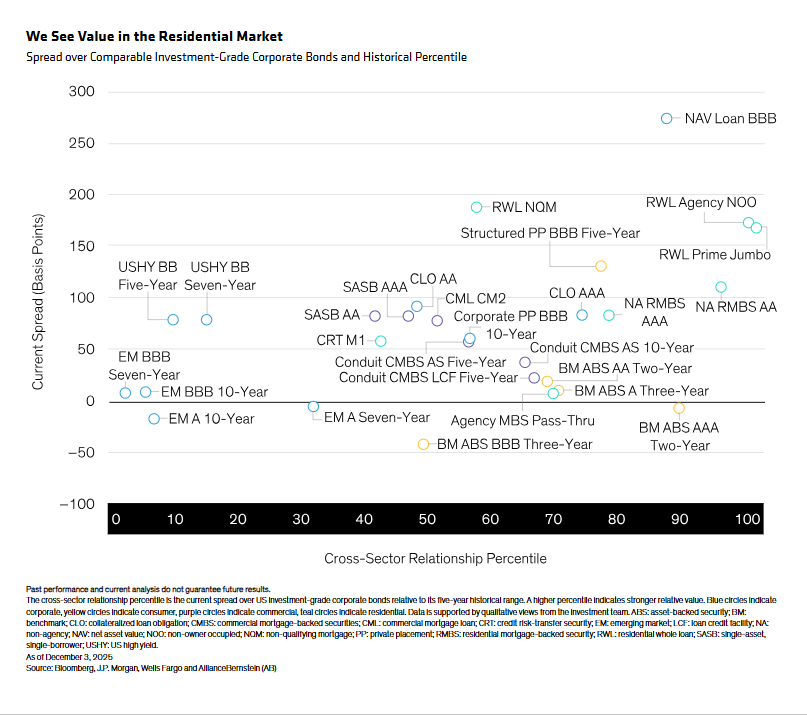
With spreads broadly tight, insurers must be focused to identify pockets of relative value, especially in heavily structured or newer asset classes. We think residential real estate remains one of those areas (Display), for insurers able to withstand cash-flow variability.

Image
Screenshot 2026-02-24 084633

There’s little dispersion in credit spreads, so it seems preferable to accept the incremental risk of cash-flow volatility than to add credit exposure, given default and ratings-migration risks. The US consumer could weaken further in 2026, so investors should rationalize overall exposure and be prudent in allocating to consumer-driven sectors. We still see opportunities, but the focus should be on senior tranches and high-quality issuers with long track records.

Given overlapping public/private credit risks, we prefer a holistic approach spanning both as liquidity in private issuance develops. One area of convergence is the digital infrastructure build-out, where we expect sizable issuance in both spheres. Mega deals from large tech firms have already come to market in late 2025. In assessing opportunities, gauge total issuer and risk exposure across both markets, staying nimble as business models become more capital intensive. Diversification and underwriting are key, too, as is keeping enough liquidity to cushion against market volatility and pay claims promptly.

We think insurers should keep duration close to liabilities, standing ready to adjust in volatile markets. Asset-liability management (ALM) will likely see renewed focus in Asian regimes with insurance capital standards (Japan and Taiwan), given the heavier regulatory focus and stiffer penalties on mismatches.

Segmenting General-Account Asset Risk and Value
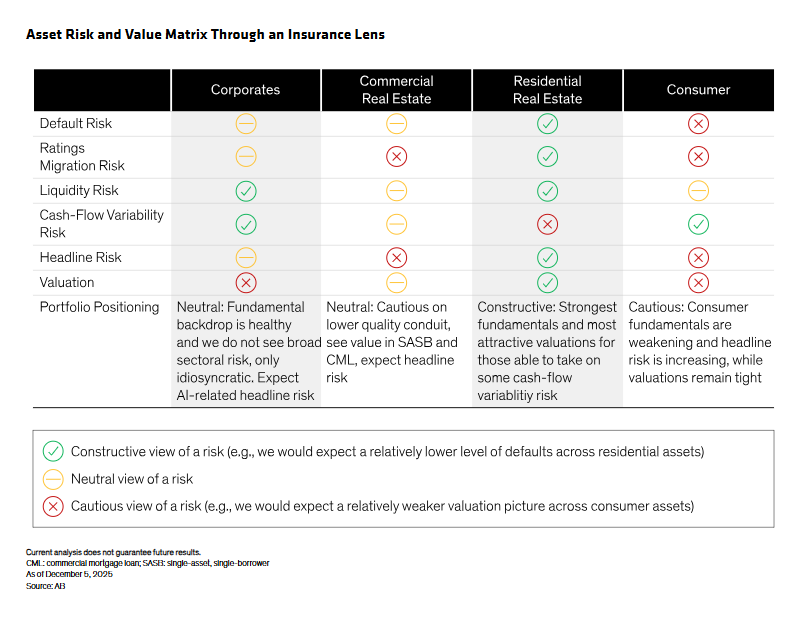
We think insurers should navigate 2026 by focusing on five components of general account risk. We categorize them separately (Display), but they should be managed holistically across the portfolio in what’s likely to be a dynamic market again in 2026. 

Image
Screenshot 2026-02-24 084731

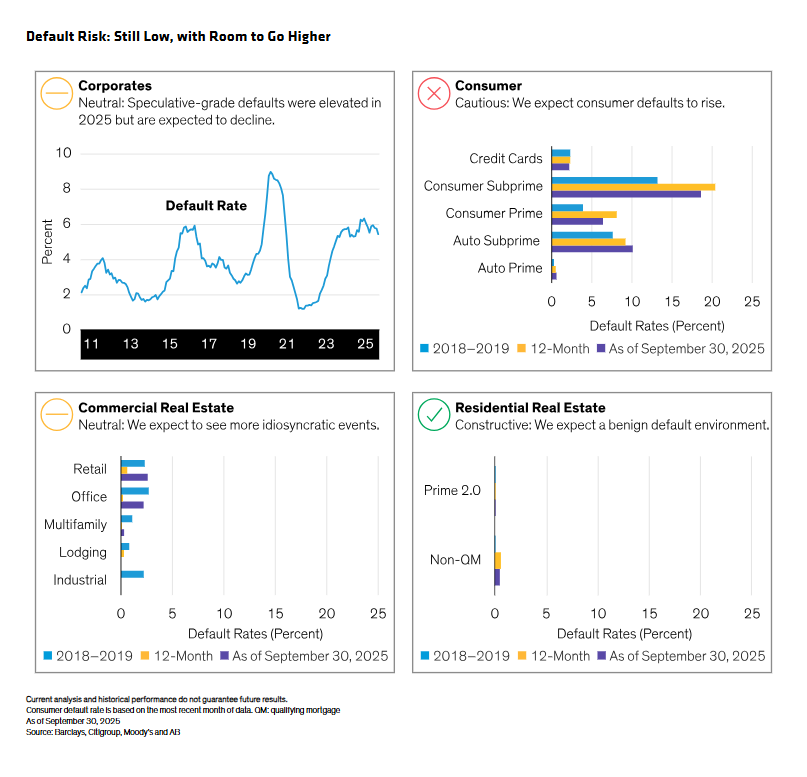
Default risk is the risk of losses from asset defaults—broadly speaking, we see room for this risk to rise (Display). High-yield corporate default rates were elevated in 2025 but are expected to decline. We expect consumer defaults to rise and to see more issuer-specific events in corporates and commercial real estate. In the residential sector, the default environment appears benign. Our view is to stay up in quality and diversify, scaling back our once out-of-consensus view of overweighting consumer exposure.

Image
Screenshot 2026-02-24 084823

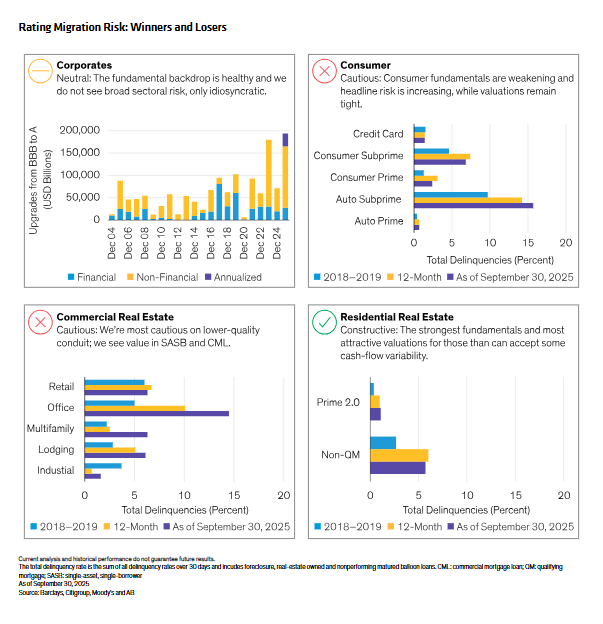
Ratings-migration risk is the potential that downgrades require more capital that could otherwise fund business and investment opportunities (Display). In 2025, US corporate fallen angels outpaced rising stars for the first time since 2020, but investment-grade dynamics seem relatively favorable: upgrades outpaced downgrades, so indices skewed higher quality. We expect downward ratings pressure, largely from issuer-specific events, utilities and tech firms with big AI-related capital needs. Certain firms with excess leverage could see ratings agencies dampen their outlooks—incorporating a forward rating view is key in assessing risk-adjusted relative value. Downgrades will likely rise for commercial real estate conduits, exacerbated by the emergence of the five-year product, with ratings pressure as loans and structures near maturity. Consumer credit could see rising delinquencies and other issuer-specific events; residential real estate fundamentals seem more solid.

Image
Screenshot 2026-02-24 084939

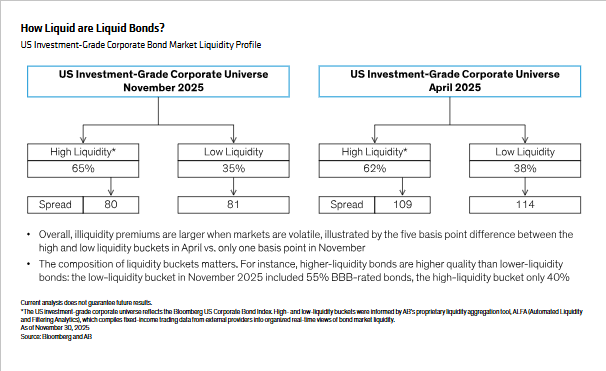
Liquidity risk is the possibility of failing to cover cash and collateral needs. Given macro uncertainty and rising private-credit exposures, a focus on portfolio liquidity needs—and the actual liquidity within liquid allocations—is vital (Display). For insurers with enough liquidity, high-quality, short-term asset-backed securities (ABS) may enhance income, complementing money-market assets in fully liquid allocations. Creative liquidity solutions including FHLBanks, the Federal Agricultural Mortgage Corp., and funding-agreement-backed notes and commercial paper help unlock private asset liquidity.

Image
Screenshot 2026-02-24 085041

We think keeping a short list of sell candidates makes sense, based on tradability, balance-sheet impact and—where possible—contribution to risk reduction or diversification. It also helps to track overall exposure to securities that enable quick responses to emerging liquidity needs. Innovation in asset markets continues, and there’s more industry chatter on making privates public. Investors should constantly calibrate liquidity premiums as market structures evolve, reassessing the appropriate liquidity premium between public and private.

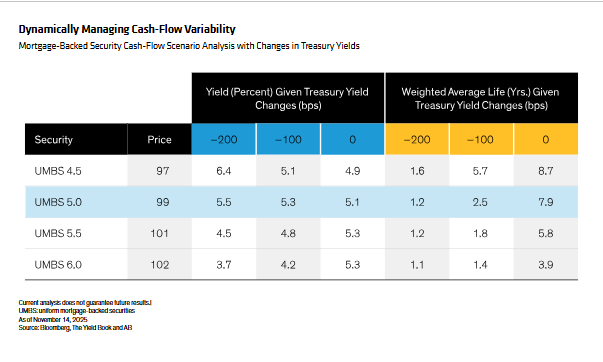
Cash-flow-variability risk is the potential that reinvestment and extension alter asset-liability matches and constraints. Interest rates should remain volatile in 2026, so stress testing is paramount when investing in highly rate-sensitive sectors. Residential real estate is one of those: income and weighted average life vary with the path of rates (Display), and insurers must be comfortable with that volatility.


Image
Screenshot 2026-02-24 085144

Headline risk from major events can be unpredictable. The market reaction to the Tricolor Holdings and First Brands defaults was relatively contained, but they were reminders of headline volatility. We expect headlines around ABS (subprime auto and unsecured consumer), commercial real estate, private credit and AI to spur bouts of volatility. Any dispersion in valuations unrelated to true fundamentals could open opportunities to pursue strong names in affected sectors.

Much Action on the Insurance Regulatory Front
The transition to the Taiwan Insurance Capital Standard is slated for January 2026; some provisions will phase in over a long period but will likely reshape relative value. Higher capital requirements could lead to risk reductions and higher-quality positioning; insurers might also bolster balance sheets with hedging programs and expanded debt-market access. ALM will become more integral to managing interest-rate risk, and investment strategies will need to grow more complex.

The 2025 draft overhaul of Europe’s Solvency II framework should become final in January 2027. It’s intended to help insurers to support the real economy, green and digital transitions, and other priorities while keeping the industry sound and financially stable. One under-the-radar area may be the lighter capital treatment for securitizations—AAA issues may become a viable addition to portfolios.

The UK’s Matching Adjustment Investment Accelerator aims to streamline new investment for annuity providers. Regulators are seeking to facilitate the use of alternative capital sources for life insurers, which could signal expectations that structures like reinsurance sidecars grow more common. This aligns with wider ambitions to support long-term investment, the UK’s growth agenda and insurers’ contributions to productive finance, while protecting policyholders and industry soundness.

The NAIC has focused on improving transparency, accountability and consumer protection. This includes stricter requirements for privately rated securities to be eligible for the filing-exemption process and a principle-based reserving approach for fixed annuities that better reflects risk. We’ve seen more focus on the growth of funding agreements as a percentage of insurers’ liabilities and net reserves. Negative interest-maintenance reserve relief was extended by one year, set to sunset at the end of 2026. Most participants expect another extension in the absence of a permanent solution.

From a big-picture view, 2026 will likely throw some wrinkles at insurance investors. Innovation will be a key partner, whether it’s tapping alternative capital sources, assessing relative value in a tight-spread world or managing portfolio liquidity.

The views expressed herein do not constitute research, investment advice or trade recommendations and do not necessarily represent the views of all AB portfolio-management teams.


READ MORE FROM ALLIANCE BERNSTEIN

Share this post

Sign Up Now for Full Access to Articles and Podcasts!

Unlock full access to our vast content library by registering as an institutional investor

Register

Contacts


AllianceBernstein

At AB, insurance is in our DNA. We understand insurance investors’ biggest challenges because we’ve lived them from the inside out. For more than a half century we’ve managed insurance client assets. Our dedicated vertical, deep resources, distinctive investment capabilities and forward platform are designed with insurers’ needs in mind. With an uncommon approach, a collaborative culture and a commitment to innovation, we drive flexible solutions that unlock potential across balance sheets and the full market spectrum- from fixed income to private markets and equities. We’re built to be long-term partners in the evolution from traditional asset-liability management to the new reality of strategic portfolio construction. AllianceBernstein (AB) is a leading global investment-management firm serving institutional investors, individuals, and private-wealth clients in major world markets. Our diverse, connected, collaborative culture encourages different ways of thinking and differentiated insights. We embrace innovation to address increasingly complex investing challenges. And we pursue responsibility throughout our firm- from how we work and act to the distinctive solutions we design for clients.

https://www.alliancebernstein.com/

AllianceBernstein
501 Commerce Street,
Nashville, TN, 37203

Robert Amberger
Client Advisor – North America
robert.amberger@alliancebernstein.com +1 212-823-2890

Bob Sharma
Global Head of Insurance Client Group
bob.sharma@alliancebernstein.com +44207-170-0688

 

View the contributor page

Sign Up Now for Full Access to Articles and Podcasts!

Unlock full access to our vast content library by registering as an institutional investor .

Create an account

Already have an account ? Sign in

Ѐ Ё Ђ Ѓ Є Ѕ І Ї Ј Љ Њ Ћ Ќ Ѝ Ў Џ А Б В Г Д Е Ж З И Й К Л М Н О П Р С ΄ ΅ Ά · Έ Ή Ί Ό Ύ Ώ ΐ Α Β Γ Δ Ε Ζ Η Θ Ι Κ Λ Μ Ν Ξ Ο Π Ρ Ё Ђ Ѓ Є Ѕ І Ї Ј Љ Њ Ћ Ќ Ў Џ А Б В Г Д Е Ж З И Й К Л М Н О П Р С Т У Ф Х Ц Ч Ш Ā ā Ă ă Ą ą Ć ć Ĉ ĉ Ċ ċ Č č Ď ď Đ đ Ē ē Ĕ ĕ Ė fi fl œ æ ß