

First Eagle Investments -

Lower Middle Market Direct Lending: Same as It Ever Was

IAUM Article - 2026-03-24T142215.157

Investors were first drawn to direct lending due to its rare combination of high current income, limited volatility and strong lender protections.


Key Takeaways

  • We believe the lower middle market continues to offer characteristics that originally drew investors to the asset class including spread, leverage and structure, at deal sizes that facilitate diversification.
  • Larger financing packages have become increasingly covenant-lite as lenders compete with both each other and a syndicated loan market where zero-covenant deals are de rigueur. In contrast, one or more covenants remain common in smaller transactions.*
  • Structural inefficiencies and capital flight upmarket have supported loan spreads in the lower middle market, which is of particular significance in an environment of falling base rates.
  • Despite many lender-friendly characteristics, smaller direct loans have consistently delivered higher risk-adjusted returns than larger ones.**

* Source: PitchBook | LCD; data as of February 28, 2026.

** Source: KBRA DLD; data as of February 11, 2026.


As the asset class grew in popularity and capital flowed in, competition in the space intensified and lending activity increasingly shifted toward larger transactions; with this shift, many of the protections that once differentiated private credit—robust covenants, conservative leverage and lender control—have materially weakened in core and upper middle market deals. In fact, direct lending transactions at the larger end of the market increasingly resemble broadly syndicated loans, but without the benefit of secondary market liquidity. At the same time, the growing popularity of negotiated out-of-court restructurings in larger deals has increased risk and reduced recoveries for minority lenders.1

In contrast, some direct loans to lower middle market companies—typically those with $5–25 million of annual EBITDA—continue to provide the structural risk mitigants and economics that originally defined the asset class and fueled its initial appeal.

We believe the current market environment is unusually favorable for the smaller, more defensively positioned segment of private credit. And as capital continues to crowd into larger transactions and lenders migrate up market with it, the shrinking cohort of specialized lenders that remain dedicated to this space could benefit from a structural capital imbalance.


The Shifting Direct Lending Landscape

Direct lending typically refers to the origination of loans by nonbank lenders—typically asset managers, business-development companies (BDCs) and other institutional investors—to mid-sized companies with financing needs that are generally too bespoke for commercial bank loans but too small to tap the capital markets for their financing needs. Middle market borrowers—broadly defined as companies with annual EBITDA anywhere from $3 million to more than $100 million—typically are privately owned and often have backing from a private equity sponsor. Once dominated by commercial banks, direct lending as we know it today emerged alongside regulatory changes in the aftermath of the global financial crisis that opened the door to nonbank lenders.

Private lending opportunities are available across the debt stack, but senior-secured loans are the most popular, providing lenders first recourse on the borrower’s assets in case of default/restructuring. Typically unrated and without a secondary market, middle market loans offer investors an illiquidity premium, complemented by floating interest rates that mitigate duration risk. These dynamics historically have resulted in a differentiated risk/return profile relative to other fixed income assets, suggesting the potential for portfolio diversification benefits. Providing less leverage than in the core or upper markets—but with slightly more leverage than available from commercial banks— creates a thriving ecosystem for lower middle market direct lenders.


The lower middle market presents a differentiated risk/return profile suggesting potential diversification benefits relative to other fixed income assets.


Dry powder seeking direct lending opportunities has grown significantly in recent years, reaching a record $141 billion in the US at the end of 2025.2 The resulting competition for deals—further exacerbated by the selective return of commercial banks to the fray—has driven a bifurcation within direct lending. Many of the features that made this asset class unique—including robust lender protections, conservative balance sheets and meaningful influence over borrower behavior—have steadily eroded among larger transactions. Today, core and upper middle market deals feature fewer covenants, higher debt levels and greater flexibility for borrowers to defer interest or incur additional debt.3


Lower Middle Market Offers Advantages for Experienced Direct Lenders

While competitive pressures erode lenders’ negotiating power on larger loans, the lower middle market continues to offer private lenders and their investors an attractive combination of stronger covenants, wider spreads and less leverage—at deal sizes that facilitate diversification across borrowers and industries while also discouraging participation by very large lenders. Further, smaller loans tend to facilitate greater access to management teams, promoting more comprehensive due diligence before the loan is written and encouraging a collaborative lender/borrower/sponsor relationship during its life—which are key factors given the lack of a secondary market for these loans. And, at the end of the day, durable exit pathways for lower middle market lenders can reduce exposure to refinancing risk.

Stronger covenants. Financial covenants have long been central to the direct lending investment case. These contractual provisions mitigate the lender’s risk by outlining actions the borrower must take, actions they cannot take and financial thresholds they must meet. Covenants essentially serve as early-warning systems for lenders, alerting them to signs of strain in the borrower’s financial condition and enabling them to engage the borrower on potential remediation—such as an equity infusion from the sponsor or deal restructuring—before they translate into default. They historically have supported higher recoveries and more stable outcomes for investors.

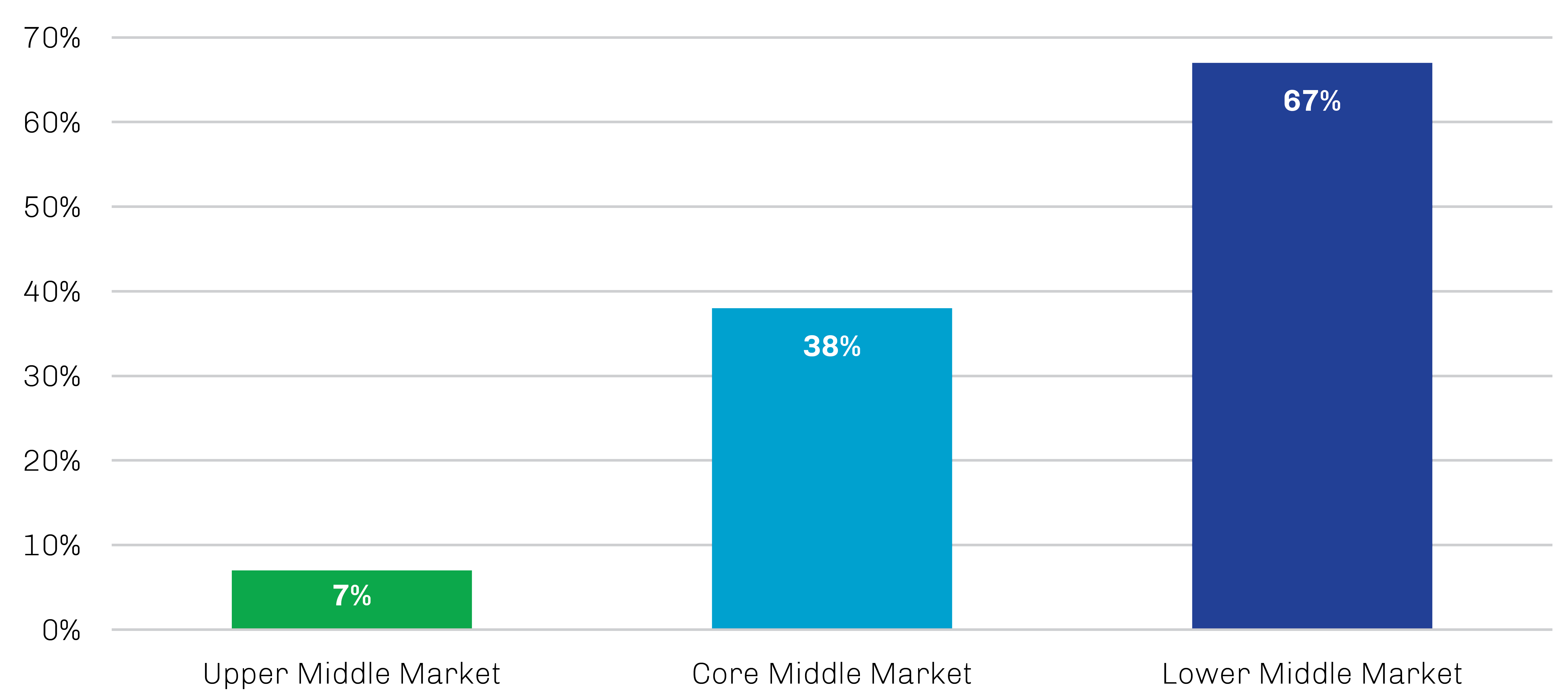
Transactions with core and upper middle market borrowers have become increasingly covenant-lite over the years as lenders compete not only with each other for business but also the syndicated loan market where zero-covenant deals are becoming the norm. As shown in Exhibit 1, covenants remain common in lower middle market transactions.

Exhibit 1. Covenants Remain Common in Smaller Transactions

Loan Population with Covenants by Loan Size

Image
FEI-LMM-DL-Same-As-It-Ever-Was-Exhibits3


Note: Lower Middle Market = loans less than or equal to $250 million. Core Middle Market = loans of $250-$500 million. Upper Middle Market = loans in excess of $500 million.
Source: Moody’s Investors Services; data as of October 2023 (latest available).


Liability Management Exercises Tend to Be Rare in Smaller Loans
The increasing prevalence of coercive liability management exercises (LMEs) in the core and upper middle market direct lending space has been a natural byproduct of the looser structures in larger deals and has accentuated the role covenants play in defending lenders. These out-of-court transactions sidestep the formal Chapter 11 bankruptcy process while enabling borrowers to restructure their debt obligations in negotiation with select creditor groups. The stratification of lenders that often results from this “creditor-on-creditor violence” typically favors larger lenders over smaller ones, providing the former with attractive terms while often subordinating the interests of the latter. Moreover, coercive LMEs have been shown to do little more than delay the inevitable; in one study, only 7% of companies employing these tactics avoided future bankruptcies or defaults within three years. In contrast, pro-rata restructurings— which include the acceptance of payment-in-kind obligations and extensions of the loan’s maturity date—have a much higher success rate.*

LMEs are primarily a large-borrower phenomenon, as the scale, complexity and multiple creditor constituencies required typically are absent in smaller loans. Lower middle market lenders, in contrast, typically maintain unassailable senior positions in the capital stack, clearer enforcement rights and more direct engagement with borrowers when performance deteriorates.

* Source: Mark J. Roe, Vasile Rotaru, “Liability Management’s Limited Runway: Corporate Restructuring Today” (January 2026).


Wider spreads. Despite the preservation of covenants, lower middle market loans continue to command wider spreads than core and upper middle market transactions, as shown in Exhibit 2.

We believe this premium is driven by structural inefficiencies rather than higher underlying credit risk. While lower middle market companies are typically established businesses with stable revenues, experienced management and, often, private equity sponsorship, their smaller size has promoted a fragmented financing market that is less intermediated and more relationship driven. Limited competition from banks and large private credit platforms in this space allow lenders to maintain pricing and structuring discipline. With base rates biased lower since the Federal Reserve began cutting its policy rate in late 2024, spreads have become an increasingly significant component of an investor’s all-in return.4

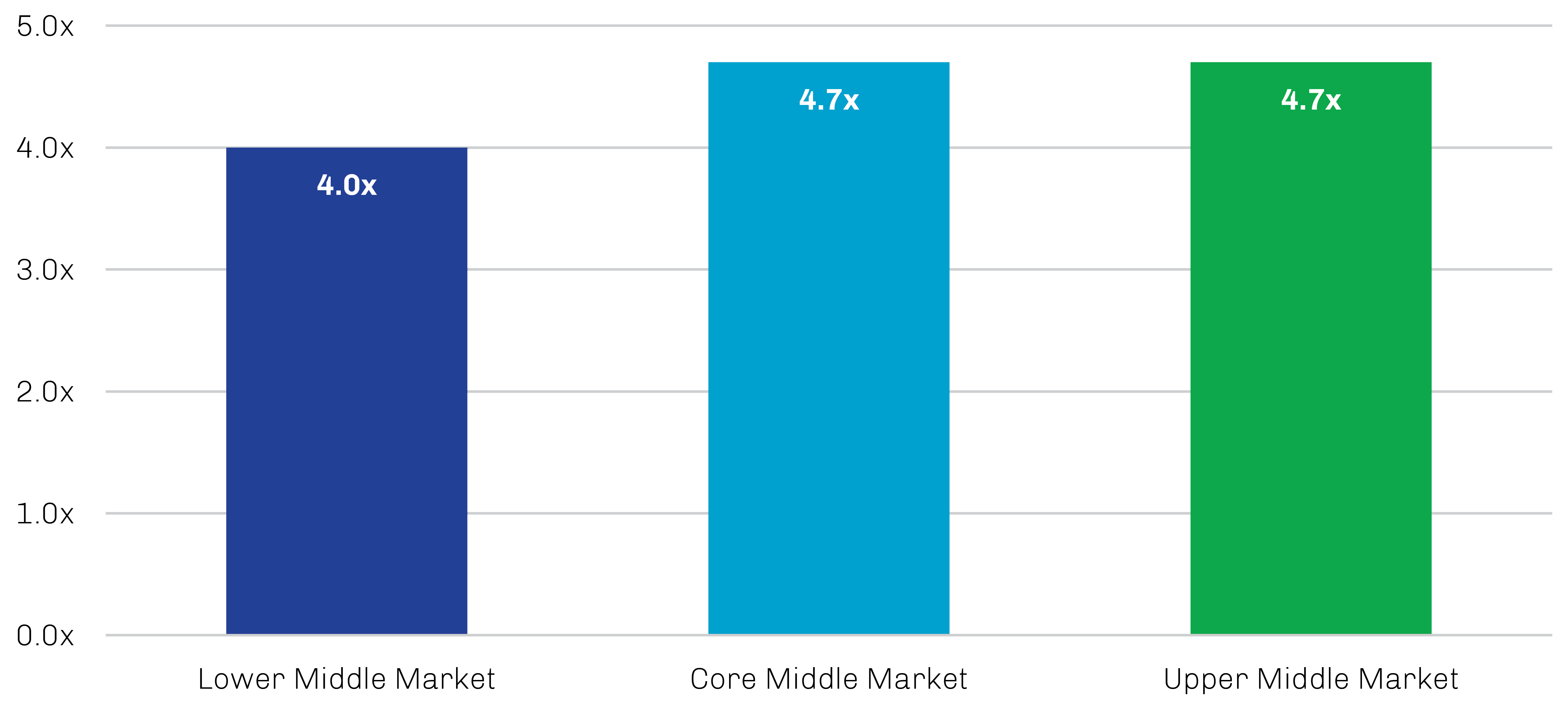
Less leverage. Despite consistently wider spreads, lower middle market transactions are typically structured with materially lower leverage than larger deals, as shown in Exhibit 2. Lower leverage means the company carries less debt relative to its earnings, and the resulting equity buffer can help absorb losses during economic downturns and promote more favorable investment outcomes. Similarly, interest coverage—earnings relative to interest expense—is more conservative in lower middle market deals.5 As these loans typically position lenders at the top of the borrowers’ capital structure, there is considerable junior debt and/or equity beneath to absorb potential losses.

Exhibit 2. Smaller Loans Typically Have Less Leverage Than Larger Loans…

Average Leverage Multiple by Borrower Size

Image
FEI-LMM-DL-Same-As-It-Ever-Was-Exhibits4


 Note: Lower Middle Market = loans less than or equal to $250 million. Core Middle Market = loans of $250–$500 million. Upper Middle Market = loans in excess of $500 million.
Source: Moody’s Investors Services; data as of October 2023 (latest available).

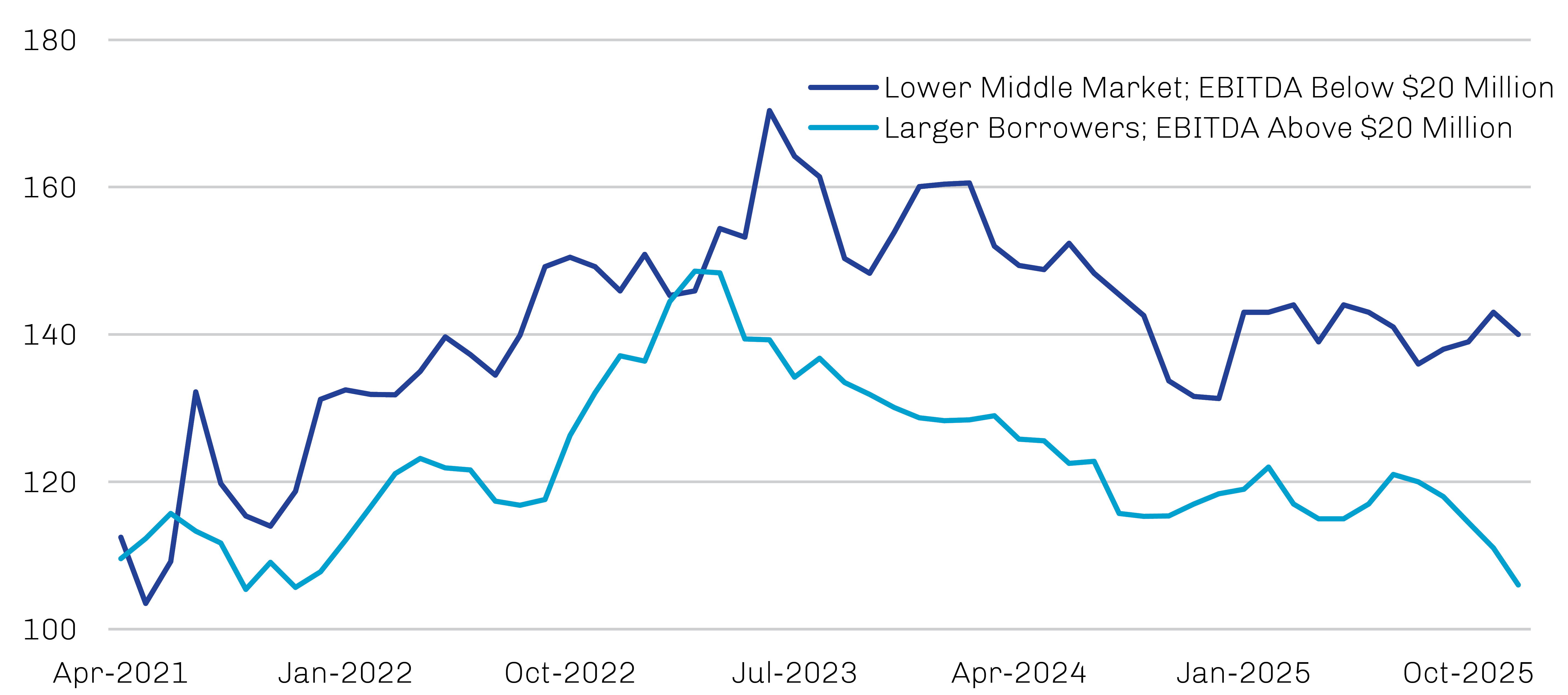
Greater leverage efficiency. Viewed together, the combination of wider spreads and lower leverage is particularly compelling. Lower middle market loans have consistently offered greater spread per turn of leverage compared to larger loans, as shown in Exhibit 3, suggesting the potential for attractive risk-adjusted returns.


Lower middle market loans typically have offered greater spread per turn of leverage compared to larger loans.


Because lower middle market transactions pair higher spreads with lower leverage, lenders have historically earned more income while assuming less financial risk. Larger transactions, by contrast, often pair tighter spreads with higher leverage multiples, resulting in lower compensation per unit of risk.


Exhibit 3. …and Have Historically Delivered Superior Risk-Adjusted Returns

Spread per Unit of Leverage, Three-Month Rolling Average

Image
FEI-LMM-DL-Same-As-It-Ever-Was-Exhibits5


 Source: KBRA DLD; data as of February 11, 2026.

Robust exit dynamics. Smaller businesses tend to be early in their institutional-ownership lifecycle and are often targeted for acquisition as they scale. As a result, realizations of lower middle market loans are often achieved through the sale of the borrower to a strategic buyer or another financial sponsor. In contrast, larger sponsor-backed loans are typically repaid when the borrower is able to refinance at more favorable terms in the broadly syndicated loan market, an activity highly sensitive to capital market conditions.

In our view, a mergers and acquisitions (M&A) driven takeout channel tied to company growth and strategic value creation—rather than the prevailing capital market environment—represents a more durable pathway to repayment for lower middle market lenders and helps mitigate the refinancing risk that characterizes larger, more liquid credit markets.


Lower Middle Market Direct Lending as a Strategic Allocation

The US middle market consists of approximately 200,000 companies, and we believe the 90% that comprise the lower middle market represents the sweet spot of direct lending, offering the most compelling combination of spread, leverage and structure at deal sizes that facilitate diversification.6

Moreover, deal flow in the lower middle market remains deep and resilient—especially M&A activity between sponsors and transactions driven by first-time predicate equity ownership—and steady origination has enabled direct lenders to remain highly selective without sacrificing the structural characteristics that originally drew investors to the asset class. In contrast, the battle over limited deal flow in the core and upper middle markets has led to significant concessions over pricing and deal terms. Since 2021, the number of transactions in the lower middle market has outpaced core and upper market activity by 1,000% as rising interest rates weighed on M&A activity.7

In a private credit market that has evolved rapidly in pursuit of scale, lower middle market lending stands out not because it has changed—it stands out because it has not. We believe lower middle market direct lending should be viewed as a diversifying core component of private credit portfolios for investors seeking durable income, conservative risk positioning and greater consistency through cycles.


READ MORE FROM FIRST EAGLE INVESTMENTS


1. Source: Bloomberg, “Troubled Companies Find a Shortcut to Restructure Their Debts,” December 9, 2025.
2. Source: PitchBook | LCD; data as of December 31, 2025.
3. Source: PitchBook | LCD; data as of February 28, 2026.
4. Source: Federal Reserve; data as of February 13, 2026.
5. Source: KBRA DLD; data as of February 11, 2026.
6. Source: KBRA DLD; data as of December 31, 2025.
7. Source: PitchBook | LCD; data as of February 28, 2026.  

The information contained in this material is provided by First Eagle Investment Management, LLC (“FEIM”) and its global subsidiaries (collectively, “First Eagle”). FEIM is an investment adviser registered with the US Securities and Exchange Commission (SEC). Registration with the SEC does not imply a certain level of skill or training.

This material is for informational purposes only and reflects prevailing conditions and the judgment of the author(s) as of the date of publication, all of which are subject to change. This material should not be relied upon as investment advice; it does not constitute a recommendation to buy or sell a security or other investment; and it is not intended to predict or depict the performance of any investment. This material is not being provided in a fiduciary capacity and is not intended to recommend any investment policy or investment strategy or consider the specific objectives or circumstances of any investor. We consider the information in this material to be accurate, but we do not represent that it is complete or should be relied upon as the sole source of appropriateness for investment.

Prospective investors should inform themselves and consult with an investment, tax or legal professional as to any applicable legal requirements, taxation and exchange control regulations in the countries of their citizenship, residence or domicile that may be relevant prior to investing.

This material does not constitute an offer or solicitation in any jurisdiction where or to any person to whom it would be unauthorized or unlawful to do so.

All investments involve the risk of loss of principal.

Past performance does not guarantee future results, which may vary. The value of investments and the income derived from investments will fluctuate and can go down as well as up. A loss of principal may occur.

Risk Disclosures

All investments involve the risk of loss of principal.

Alternative investments can be speculative and are not suitable for all investors. Investing in alternative investments is only intended for experienced and sophisticated investors who are willing and able to bear the high economic risks associated with such an investment. Investors should carefully review and consider potential risks before investing. Certain of these risks include:

• Loss of all or a substantial portion of the investment;
• Lack of liquidity in that there may be no secondary market or interest in the strategy and none is expected to develop;
• Volatility of returns;
• Interest rate risk;
• Restrictions on transferring interests in a private investment strategy;
• Potential lack of diversification and resulting higher risk due to concentration within one or more sectors, industries, countries or regions;
• Absence of information regarding valuations and pricing;
• Complex tax structures and delays in tax reporting;
• Less regulation and higher fees than mutual funds;
• Use of leverage, which magnifies the potential for gain or loss on amounts invested and is generally considered a speculative investment technique and increases the risks associated with investing in the strategy;
• Carried interest, which may cause the strategy to make more speculative, higher risk investments than would be the case in absence of such arrangements; and
• Below-investment-grade loans, which may default and adversely affect returns.

Definitions

Broadly syndicated loans (BSLs) typically refer to floating-rate commercial loans provided by a group of lenders—the syndicate—to a noninvestment grade borrower.

Direct lending refers to a loan agreement between a borrower and single lender or small group of lenders. Direct lending can also be referred to as “private credit” or “private lending.”

The information presented does not reflect the performance of any fund, strategy or account managed or serviced by First Eagle, and there is no guarantee that investors will experience the type of performance reflected. There is no guarantee that any market forecast set forth in this communication will be realized. There is no guarantee that any historical trend referenced herein will be repeated in the future, and there is no way to predict precisely when such a trend will begin. The mention of specific securities is not a recommendation or solicitation to buy, sell or hold any particular security and should not be relied upon as investment advice.

Availability of the products or services described may be restricted by law in certain jurisdictions. This material may not be distributed, published or used by any person or entity in any jurisdiction or country where such distribution or use would be contrary to local law or regulation.

Middle East: This material is for information purposes only and has not been, and will not be, registered with or reviewed or approved by any regulator located in the Middle East. It does not constitute or form part of any marketing initiative, any offer to issue or sell, or any solicitation of any offer to subscribe to or purchase, any products, strategies or other services, nor shall it, or the fact of its distribution, form the basis of, or be relied on in connection with, any contract resulting therefrom. In the event that the recipient of this material wishes to receive further information regarding any products, strategies or other services, it shall specifically request the same in writing from an authorized financial adviser.

Canada: This material is for information purposes only and has not been, and will not be, registered with or reviewed or approved by any regulator located in the Middle East. It does not constitute or form part of any marketing initiative, any offer to issue or sell, or any solicitation of any offer to subscribe to or purchase, any products, strategies or other services, nor shall it, or the fact of its distribution, form the basis of, or be relied on in connection with, any contract resulting therefrom. In the event that the recipient of this material wishes to receive further information regarding any products, strategies or other services, it shall specifically request the same in writing from an authorized financial adviser.

FEF Distributors, LLC (“FEFD”) (SIPC), a limited purpose broker-dealer, distributes certain First Eagle products. FEFD does not provide services to any investor but rather provides services to its First Eagle affiliates. As such, when FEFD presents a fund, strategy or other product to a prospective investor, FEFD and its representatives do not determine whether an investment in the fund, strategy or other product is in the best interests of, or is otherwise beneficial or suitable for, the investor. No statement by FEFD should be construed as a recommendation. Investors should exercise their own judgment and/or consult with a financial professional to determine whether it is advisable for the investor to invest in any First Eagle fund, strategy or product.

First Eagle Investments is the brand name for First Eagle Investment Management, LLC and its subsidiary investment advisers.

First Eagle Alternative Credit and Napier Park are brand names for the two subsidiary investment advisers engaged in the alternative credit business.

©2026 First Eagle Investment Management, LLC. All rights reserved.

Share this post

Sign Up Now for Full Access to Articles and Podcasts!

Unlock full access to our vast content library by registering as an institutional investor

Register

Contacts


First Eagle Investments

First Eagle Investments is an independent, privately owned investment management firm headquartered in New York with approximately $213 billion in assets under management as of March 31, 2026.* Dedicated to providing prudent stewardship of client assets, the firm focuses on active, fundamental, and benchmark-agnostic investing, with a strong emphasis on downside mitigation. With over 15 years of experience managing assets on behalf of insurers, First Eagle is focused on meeting their unique portfolio and servicing needs through bespoke investment solutions and a dedicated insurance coverage team. The firm’s investment capabilities for the insurance market include alternative credit, fixed income, and global equities.

All figures related to assets under management (AUM) are preliminary figures based on management’s estimates and as such are subject to change.

As of 31-Mar-2026.

*Total AUM shown is pro forma to include the acquisition of Diamond Hill Capital Management, which closed on April 22, 2026. All figures related to assets under management (AUM) are preliminary figures based on management’s estimates and as such are subject to change. Some offerings may not be available in all jurisdictions. * The total AUM listed above represents the combined AUM and assets under advisement of First Eagle Investment Management, LLC, First Eagle Separate Account Management, LLC, Napier Park Global Capital (Napier Park), Regatta Loan Management (RLM, an advisory affiliate of Napier Park), Napier Park CMV (CMV, an advisory affiliate of Napier Park), First Eagle Alternative Credit (FEAC), and Diamond Hill Capital Management, LLC as of 31-Mar-2026. It includes $3.6 billion in committed/non-fee-paying capital from Napier Park, inclusive of assets managed by RLM and CMV, and $0.9 billion in committed/non-fee-paying capital from FEAC. For CLO warehouses, AUM represents maximum commitment (loan par value). As of 5-Sep-2025, Napier Park and FEAC investment activities are unified under Napier Park’s brand and management. First Eagle Alternative Credit, LLC is a distinct registered investment advisor within the Napier Park platform, acting in sub-advisory capacity to a number of First Eagle’s registered funds.

Katie Cowan   
Head of Insurance Client Solutions
katie.cowan@firsteagle.com(310) 893-2440

 

View the contributor page

Sign Up Now for Full Access to Articles and Podcasts!

Unlock full access to our vast content library by registering as an institutional investor .

Create an account

Already have an account ? Sign in

Ѐ Ё Ђ Ѓ Є Ѕ І Ї Ј Љ Њ Ћ Ќ Ѝ Ў Џ А Б В Г Д Е Ж З И Й К Л М Н О П Р С ΄ ΅ Ά · Έ Ή Ί Ό Ύ Ώ ΐ Α Β Γ Δ Ε Ζ Η Θ Ι Κ Λ Μ Ν Ξ Ο Π Ρ Ё Ђ Ѓ Є Ѕ І Ї Ј Љ Њ Ћ Ќ Ў Џ А Б В Г Д Е Ж З И Й К Л М Н О П Р С Т У Ф Х Ц Ч Ш Ā ā Ă ă Ą ą Ć ć Ĉ ĉ Ċ ċ Č č Ď ď Đ đ Ē ē Ĕ ĕ Ė fi fl œ æ ß