
Meet The Institutes’ President & CEO - Pete Miller, CPCU
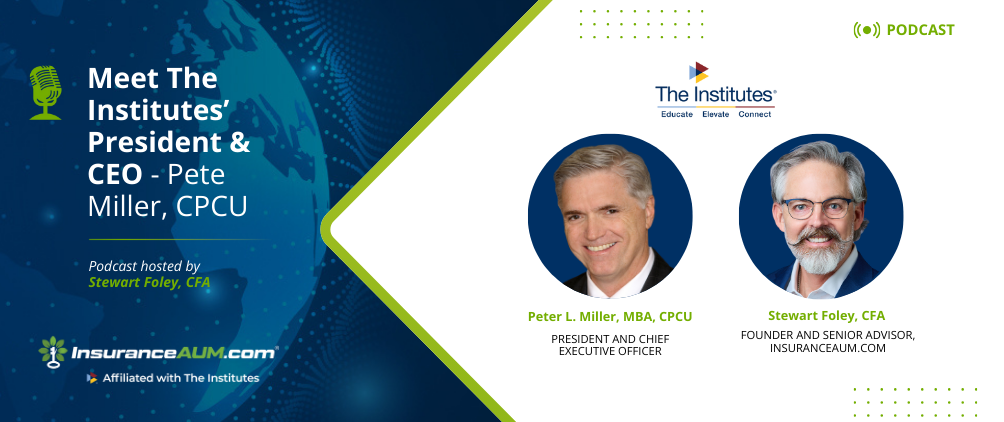
Stewart: Hey, welcome back to the Home of the World's Smartest Money. We're thrilled to have you. This is the InsuranceAUM.com podcast, and we're now proudly affiliated with The Institutes. My name's Stewart Foley. I'm the Founder and Senior Advisor to InsuranceAUM, and we have a very, very special guest on today. We are joined by the leader of an organization that has shaped this entire industry for more than a century. He is the President and CEO of The Institutes, which has recently purchased InsuranceAUM, a tech-forward, educationally driven, mission-focused powerhouse that touches nearly every corner of the insurance ecosystem. Pete Miller is here. We couldn't be happier to have you. Pete, welcome to the show.
Pete: Stewart, thank you so much. I appreciate the opportunity to be here, and I'm just thrilled to be working with InsuranceAUM.
Stewart: Thank you. We're thrilled too. And what's interesting about this is that while everybody pretty much knows what you do in terms of the most notable CPCU designation, but many others, a lot of folks on the investment side of the business aren't familiar with The Institutes, and so this is a great opportunity for us to get to know that side of things but also get to know you, right? So, we want to start this the way we always do. So, you have a very interesting background, one that is very unique. I can't wait to get into it, but if you would kind of indulge me, our icebreaker question is where did you grow up and what job would you want if not this one?
Pete: I actually have dual US-Canadian citizenship. So, I was born in Canada, my parents are American, and my family did what we called ping pong. So we went to Ontario, Quebec, Colorado, and Nevada. My dad ended up being the CEO of a Gold Mining company, and he would go, ‘kids, we got to go where the rocks are.’ So, I lived in many houses, and we moved around a lot, so that was kind of very interesting. All in North America, but it was quite interesting. And what ended up happening, really, Stewart, was I got way into sports because that was kind of an entree, and I had an older brother that I needed to defend myself against. Best older brother ever, he still is my best friend. But he and I would help me out. We were competitive. He would take care of me and stuff like that.
So, I ended up playing a lot of sports. I went to high school, actually, in Toronto, and then came down here to the States to play football. So, I went back and forth, back and forth. I got into the industry basically, like a lot of people, by accident. I got out of school, I had an undergrad degree in business and a bachelor's in system management at the time, computer science. And I was very interested in the intersection between computers and business. And so, I worked for a shipping company. I actually had an opportunity to build a very, very early artificial intelligence system, and that has been a lifelong interest. Then I got into the industry at Cigna P&C, which is kind of the successor to what is now Ace, and I was building systems in their workers' comp area, and then I was an IT consultant, and kind of got to The Institutes. So yeah, it was very fun moving around as I was a kid. I had a great family, I had great parents, and we did a lot of different things. And what I found out when I got to this industry is I love this industry.
Stewart: I do too.
Pete: And yeah, the reason I love it is that it ends up making the world better and safer, and you help people. And that has been very, very satisfying for me. So yeah, I'm quite interested in the industry and continue to be. And fortunately for me, I work with just awesome people.
Stewart: Yeah, it's interesting. We've had nothing but a positive experience with everybody we've talked to at The Institutes, and I think it speaks volumes about your leadership. You've been CEO for over 20 years, and by the way, I'm not letting you off the hook on what job would you want if not this one, but you have a 45, I think 45, CEO board. You manage that board. I suspect that you've read Master of the Senate several times. I don't know how you do it, but you have an interesting background. You are a deep technology person, you are an athlete, computer systems expert, insurance leader, and ultimately CEO. What got you into the industry to begin with?
Pete: So, I think what attracted me to the industry and quite honestly, I didn't know a lot about the industry. I came as an IT consultant, and then I started looking around, and I'm like, ‘wow, this is a mission-driven place.’ And if you think about the fascinating, there are many fascinating things about this industry to me, but one is that this industry needs to understand all sectors of the economy. It needs to underwrite risk. And that is very interesting to me. So, I think I always say there's a job for everybody in this industry, whatever you're interested in. I had one week a number of years ago where I went to an insurance company outside of St. Louis that all they did was underwrite flower shops. Who knew?
And then later that week, I went to an insurance company to underwrite nuclear power plants. And I was like, ‘Okay, well, we're getting everything.’ So that and the fact that it helps people. The Institutes does business internationally: I've been to 50 countries working with The Institutes, and in many countries, and even in developing countries, they know that the work that our folks do in this industry is so key to a developing economy. No single person can take the risk of being an entrepreneur without some sort of financial backstop, and that's what insurance does. So very interesting. Very interesting to me.
Stewart: Yeah, that's really true. I think a lot of times when I was teaching insurance, during the first day of class, I would hold up my iPhone, and I would say to the students, ‘How many people have something that looks like this? And everybody would raise their hands. And then we started talking about the risk transfer involved in producing an iPhone and getting it into their hands. And when you start talking about like, ‘okay, there's a container ship, somebody ensures the hut, somebody ensures the containers, somebody ensures the crane, somebody ensures the person operating the crane.’ Those are all different coverages, just at a very high level. And then you start talking about getting into, at the Apple store, somebody ensures the mall, somebody ensures the people working there, somebody ensures the inventory there, somebody on and on and on.’ And when you start thinking about what the world would be like without insurance, you quickly realize how many facets of life insurance touches. And I wholeheartedly agree with you, it makes people's lives better, no doubt about it. So, let's talk about The Institutes for a second. I mean, the legacy goes all the way back to 1909, based on my notes. The scale of the impact is staggering. You educate a hundred thousand insurance professionals a year on a spectrum of things—data, technology, governance. For the listeners who may not know the full story, can you walk us through how The Institutes began and how it's evolved into the organization today?
Pete: Sure. So, The Institutes did begin in 1909, and it was actually six separate insurance societies from six separate cities, along with some big insurance companies who got together and said, ‘you know what? This is a great industry, but we can't find education now, so why don't we develop educational programs?’ So, when people get into the industry, we have materials so that they can become proficient and perform their jobs more efficiently. The Institutes has been an ongoing thread. You mentioned, we have about a hundred thousand students a year in our designation program. So CPCU, AIC, these are pretty well known. We also then reach people through our other business units as well, and we have about 21 business units. We reach about 1.2 million people in the industry through various means of providing knowledge and education. And we have events: we have 30+ events a year.
And we do publications. We own Risk and Insurance magazine, if you've heard of that. And then we also have consortia and associations. So, our job is to serve the breadth and depth of the industry to serve knowledge needs. You mentioned our board. It's fascinating because there are about 46 people on it right now. And they're mostly CEOs, not all, but mostly CEOs. So, it's a great learning experience for me. And I would say that's been the number one reason for The Institutes’ success—our board. Because they control in P&C roughly 72-73%. So, I always say, Stewart, just for me, ‘go to a board meeting, shut up, and listen’ because our board understands the direction of where the industry's going. And then we try to understand, ‘well, if that's the arc of the business, what do we need to do in order to make sure that folks in the business are well equipped to do not only their current job but the job of the future?’
So that has been sort of the ongoing theme of The Institutes since 1909. Like any organization, we've adapted a lot. And I said earlier, but I feel so privileged to work with who I work with because we have just under 300 people that get up every day and try to figure out how we can serve. And by our service, I think, we make the world better and safer because we provide the knowledge tools to people interested in risk management and insurance, so they can do their job. So, The Institutes has a long tradition. I think some of the former CEOs, particularly Ed Overman, who was just a giant in terms of building the organization. And we're just trying to understand how we can continue to serve folks interested in risk management and insurance.
Stewart: Without going too deep into this. I mean, I think that you have an amazing career in guiding on really important issues in the insurance industry. It's interesting, we met over two years ago, and I'm like, I'm hesitant because I'm afraid to ask this question. That's the truth of it. But given the foundation of the partnership with us, with InsuranceAUM, how did you see that from the vantage point of The Institutes, which has such a rich history, has so much of an educational focus? As most people know, I founded this out of essentially thin air, and what I realized was that no one was talking to this audience, which manages about 30% of the world's invested assets. And I literally started sending out blocks of articles, and it's turned into this. But from your perspective, how do you see value here?
Pete: Stewart, I mean, you've done an amazing job, you and the folks you work with. So, when we looked at it, this was sort of strategic for us. We have all kinds of knowledge products on the operation side, and as we all know, insurance companies make money in two ways, right? Through underwriting activities and through investing. We didn't have anything on investing. And our job is to serve the breadth and depth of the industry. And until now, we didn't have anything, frankly, because we didn't see an organization of the quality of InsuranceAUM.
Stewart: Oh, that's very humbling. Thank you.
Pete: Yeah, no, I would say that if we weren't on this podcast, and we've done probably 15 acquisitions of various types, well, first thing we look at is does the organization's culture match ours? Because that, I think for us, is the most important thing. How do we look at how we treat people? How do we look at our mission? How do we look at how we treat customers? And that's very, very important to us. And insurance AUM, I think, just instantaneously, for us, we were like, well, we share values, and that's a big deal, and that's the number one thing we look at. Then it's like, well, what we started, when we saw what you did, we were like, wow, he's done a great job, and that is a great organization. They do things well that we don't know how to do, so we can learn.
And then I think we do some things that might be able to support you. So, our goal is to support and help extend what is half the business and its knowledge products. So, extend your and your folks' vision on how we can continue to serve, and apply some resources to it. So, I was very excited. It makes sense strategically and organizational culture-wise and it seemed like a really great thing. And so far, that's what we're really excited about. But I'm interested, Stewart. I know you share our passion for education, and it's always been at the core of InsuranceAUM. And I know you were a professor for a time. So how did that shape what you saw when you were sort of building InsuranceAUM?
Stewart: Yeah, it's interesting. I think I would echo some things that you said, which is generally speaking, I get way too much credit for the success of this platform. We have an amazing team led by Lynde O’brien, now the Executive Director. We have a number of folks who are a really small team. We have really big clients. And I mean, I get a lot. I'm somewhat the face, but the other part of it is that we have an executive council that's made up of insurance CIOs and folks who are in comparable positions, maybe they're CIO, or maybe they're direct reports to a CIO, but they're senior investment leaders. And what we try to do is get what they want, what they think are the most important issues on our agenda, at our events. And we have had people, our two co-chairs, John Pattin and TC Wilson, most recently, work tirelessly to make that event in Chicago successful this year.
And we're going on our fifth year. And they are the ones at Swiss Re. There are others that have really helped us. Joe Eppers has helped us a bunch. Aaron Dale has helped us a bunch. There are a bunch of folks that we know in common. They may be CIOs, and their CEO sometimes sits on your board. So, there's some commonality there. And I think the way that I looked at it really is if I'm a CIO of wherever it is, I'm expected to have a command of a wide spectrum of asset classes. In some of these asset classes, people spend a career in and they're complex, and the receivables are complex, or the credit's complex, or the structure's complex. And I couldn't believe that ‘the home of the world's smartest money was available.’ So, we trademarked it. And it's not that insurance investors have a better crystal ball.
They have to navigate so many more facets on the investment side than a typical institutional investor. They've got to consider the regulatory environment, they've got to consider the rating, they've got to consider the state regulations, they've got to consider the operating entity, and the lines of business that they write. They have to consider their capital position, their tax position, their tolerance for risk, their capacity for risk, on and on and on. And it's very complicated. And people who do it well, there aren't that many of them, and there aren't that many people who are our core audience. So, what I was trying to do was allow a CIO to get current on an asset class in a relatively short amount of time. So, the podcasts are really intended to do that. They're intended to educate; they're intended to make folks who are junior or earlier in their careers to make them aware of the opportunity set.
Because one of the challenges I faced with being a first-generation college student was not knowing what the opportunity set was. I didn't know beans about the insurance industry and got in here. I was the treasurer of a city, and literally found out from the bank across the street that there was an insurance company being formed in town. I didn't know that you could form an insurance company. I thought it was dinosaurs and like a MetLife sign. And so, I was trying to reach, and by the way, when we started, insurance wasn't nearly what it is today. It was sleepy. It was nothing like it is today. Today, it's the hottest segment going; insurance companies are doing more interesting ventures into private markets in other ways, so the opportunity set has gotten much greater. But the education piece of it is near and dear to me.
And we approached you originally with the idea of having a professional designation because there's no textbook in this business, period, the end. And so it was really from that impetus that we started talking about the Chartered Insurance Investment Manager program. It's coming out in the first part of 26. We're thrilled with that. We've been able to gather subject matter experts on a wide spectrum of insurance asset management topics. And I know I think that education at the core of both of our organizations really makes it a nice fit. To be candid, it's humbling that something that you started is attractive to a place that has exceptionally high standards for ethics. You can't operate in the insurance industry with 46 CEO sorts of folks without having incredible ethics. The commitment on the education side, you have an incredible amount of credibility in the industry. And so, it's humbling.
And we have a lot to learn from your expertise, your company's expertise in putting curriculum together. And this is innovative. Just for people who don't know, we're interviewing subject matter experts and taking those videos and audio files and creating coursework, curriculum from those. So, we're literally dumping the knowledge out of a bunch of folks' heads and compiling into it because nobody that I know of knows every facet of everything. And so, we're just trying to do that. So, I'm humbled by it. We started off in media, and we started doing podcasts. We kind of got pushed into podcasts: best thing we ever did. And then our innovation, which seems so simple to me, but our innovation on the events side was to ask the investors what topics they wanted to speak on and who they wanted to hear from. So, if that's our secret sauce, I guess it's gotten us here.
And we were at a point where we were not able to provide the resources necessary to advance the ball. There are things that I think we both discussed that we want to do, things that we can get better at. And so that's really kind of what my take was on founding it and why I thought it was important. And by the way, the first 10 years was people telling me, ‘I'm not exactly sure what you're trying to do here or why anybody cares.’ And as an entrepreneur, you hear that you're doing new things and people tell you that, well, that's not what we've been doing. I go, ‘I know, but that's kind of how it came about.’
Pete: Yeah, I agree. We talked about many things, as we were talking about how we could work together and the CIIM. What was your vision for that? I mean, you mentioned it briefly in some of the things, but your background in education, and when you saw it about that, what was your sort of vision behind that?
Stewart: Well, there's a guy named Bill Poutsiaka, who was the CIO of AIG P&C. He was also the CEO of PanAgora. And he was the CEO of FM Global, I believe. And he and I talked about it. And what happens is that I've had countless people say, yeah, that's needed. And I go, ‘You want to help?’ And they're like, ‘Hey, I'm busy right now.’ I go, ‘okay, alright.’ So, it's been a challenge to get people, but at the end of the day, there's a lot to know. And it's hard because, unlike medical school, where you go, and there's tons of documentation about how to become a doctor, there's not a lot of documentation or a lot of best practices on the insurance investment front. It's on-the-job training, and it varies from company to company. Every company is slightly different. And so, the idea behind CIIM was basically to provide a baseline knowledge of what the sort of, I don't know, it's like if I can use a football analogy. It's like I want you to thoroughly understand the rules and all the different aspects of this game.
It doesn't mean that when you get done with this, you're going to be able to be a head coach because it's not. But right now, the way that this is done is that a lot of senior folks spend a lot of time teaching and educating junior folks. I mean, Jack Bishop at Principal runs classes; he teaches there. And what we were trying to do was create a curriculum that was frankly issued by someone who has enough credibility to be taken seriously. Nobody wants the Stew Foley certificate of whatever. And at the end of the day, it needed to be with somebody who really understood how to build a professional designation program. Because there is so much, and I don't think this is a secret, your curriculum team that's working on this with us is the same people who oversee the CPCU, and they're experts in what they do.
And for anybody, and you mentioned I was a professor, it was extremely helpful to know kind of what a student needs to be successful in a class. And they need structure. They need learning objectives. It's not like a podcast where you can come on and talk about whatever it is. You've got to have an outline and structure and testable materials to determine whether or not the person has a decent command of the curriculum that you just covered. And that's what I was thinking originally, spent five years trying to get somebody to care, and then when we started talking, it was a great fit. You educate on everything except investments. And investments are all we do. I mean, we don't know beans about underwriting or claims, or there's a myriad of functionality in an insurance company, that is, we don't have any expertise there. But the combination makes a lot of sense, and that's really what I was hoping we could accomplish with CIIM.
Pete: We're thrilled. I mean, because of your expertise and your experience and your stature, I mean, I've been to your conferences and you're the expert and you're very well regarded and justifiably. So, we're pretty thrilled.
Stewart: I really appreciate that. And it's very kind of you. And I think maybe I'm going to come out with a line of mustache wax, I'm not sure. No, I'm kidding. So, it's interesting that one of the things I think that would surprise people is how technologically advanced The Institutes is. And I say that I think generally speaking, if you just survey random people, you say, ‘is insurance stodgy or progressive?’ Not the company is progressive or innovative. And I think most people would say stodgy. And I think that might've been true at one point, but it's certainly not true today. You are very accomplished in AI. We're using AI to develop the CIIM curriculum. You provide educational support for members of your team and encourage them to become more familiar with AI. You've taught me a lot about AI and how to use it. Can you talk about the development process and where you see the industry heading, given all the innovation and resources that are out there?
Pete: Stewart, I think it's a fascinating time to be in this industry. I think for two seconds, I mentioned, I built my first AI system in the late eighties. At the time, there were two flavors: expert systems and neural nets. If you look at today's technology, the neural net, is really at the heart of the LLMs. So that has been a lifelong interest of mine. I worked on a PhD in AI. I didn't finish the dissertation for a lot of reasons, but mostly because I was doing it in the early two thousands. And at that time, there was not enough computing power, there was not enough data, and there was not enough storage. All those problems have been solved. So, when we look at what The Institutes does internally, yes, this is such a great time and so much opportunity for both. I think for The Institutes and our industry, it's an unknown time, it's a time of change.
And I think that presents great opportunities. So, for us at The Institutes, we've made major investments in Gen AI for sure, with consistent ethical use of it. That's a big deal. I think, as you know, you can't complete one of our designations without taking ethics. And I think what you said earlier about it in this industry is spot on. I mean, that's the basis of this industry: it is built on a promise. So, it would make sense that we would extend that to the use of AI. And yeah, internally, we've done a lot around how we produce more and better content. Certainly, people are at the heart of what we always do. So, we are training. Everybody at our company is given the opportunity to train up on a lot of different things. But right now in particular, AI, so it impacts how we generate content, it impacts how we develop internal systems, and how we do our marketing.
And I'll tell you what, our folks have really taken it to heart. Some of the things we do, we have an AI Lab and the things they're doing. Every couple of weeks, I meet with them, and I'm like, ‘holy smokes, I can't believe you guys can do that now.’ And I think I know that there are a lot of people who know a lot more about AI than I do, but I've been interested in a long time and certainly tried to keep up. So, I think for us internally, you mentioned that's how we're producing the designations now. We produce six or seven newsletters. It's all done by AI. There's a human in the loop for sure, who checks stuff at the end, but it's certainly impacting what we do. It's also impacting the insurance industry quite a bit. And increasingly, and I think it's partially because the ingredients, if you think about the ingredients for AI, sort of at a 10,000-foot level, what do you need?
You need data. And with the advent of Internet of Things and sensors providing real-time access to data, you need more storage. So, you can do cloud, or you can do, in some cases, blockchain. I think would be a good answer. And that's becoming more available. And then the analytical and AI tools, because AI really lives on data, and it needs a lot of it. And then you need a good tool set, and those tool sets are coming along. So, I think it's an opportunity for the insurance industry to provide more and better value to its customers. And the way we look at it is there's a risk management spectrum, and it involves many risk management things and many sorts of risk financing sort of activities. Traditionally, I think insurance has been about detecting and repairing. So, in other words, something bad happens, and then we repair it.
I think the promise for the industry is that we can stop bad things from happening. And now is this is not actually a new concept. Hartford Steam Boiler used in the 1860s to start a company that inspected boilers so they wouldn't blow up. But that was hard to scale across many other sorts of insurance or sorts of risk, which is becoming increasingly impossible. So you can imagine on the operation side, you can do many scenarios and collect data, and then get a predictive ability to say, ‘well, based on these conditions, this house is going to burn down because of an electrical fire in the next 30 days or the next some foreseeable future. How about we do something to stop that?’ You could imagine it on the investment side too, that you could do more and better scenario planning, and you'll have more data in order to build more and better models. So, I think in general, planning is going to change quite a bit. Strategic planning is going to change quite a bit from an annual cycle more to instantaneous, ongoing planning. And in general, in our industry, I think we have afforded a great opportunity to really make people's lives better and safer by avoiding bad things in the first place. And that's what I'm really excited about. I think that's at the core of what we're trying to do.
Stewart: It's so important too, right? Because it's not the value replacement of the house, it's when the house catches on fire, the family loses, oftentimes heirloom pictures, things of emotional value to the family. And so, the ability to prevent that, yes, it's financially beneficial for the insurance company, but that'll result in lower rates, which will benefit everybody. But the idea that you can avoid some of those emotional losses is really cool. I mean, again, it goes back to the insurance industry making people's lives better.
Pete: I hope we do things because it's the right thing to do, right? If we have the ability to stop bad things from happening in and of themselves, I think that's extraordinary value. But also, from a business point of view, imagine the relationship-building sort of impact of being able to go to a homeowner and go, listen, you know what? Your house was going to burn down.’ You're going to lose all your pictures of grandma. And that's not going to happen now because we have this service that helps avoid that and that stickiness and relationship and ongoing relationship and that will lead to financial results, I think.
Stewart: And I mean it's true on the investment side, the alpha in credit is avoiding losses, right? It's like how am I going to, you add Alpha, the way to add Alpha is to avoid losses and being able to do predictive analytics. There, I think, is relatively in its infancy, right? But this is a little bit like, I don't know. I mean, when you think about, okay, from the standpoint of I'm a CIO, The Institutes touches nearly every edge of for sure the property and casualty ecosystem. But I've had people say, ‘Well, does this mean that it's going to be all P&C focused?’ Like, absolutely not. But you have education, data analytics, governance, and you have a community. How does that reach translate into new value or collaboration opportunities for the executives and professionals who frequent InsuranceAUM.com? whether that's the insurance investors or many others who are on our site and listen to our podcast.
Pete: First, just to reiterate, we very much agree it's not just P&C, right? I know that's what we've been doing, but assure everybody, we continue to agree with you, Stewart, that it's Life, P&C, and insurance in general. So that's the goal. I don't think there's any deviation from that in terms of how we can impact InsuranceAUM participants and customers. I think we're very excited about that possibility because I think for either side, if you will, of the equation, either the operations side, the underwriting side, or the investment side, more and better understanding of the other side would be beneficial to both sides. So we seek to understand how we can provide information in a digestible format, for example, to people who are running the operations, the underwriting side, so that they can understand and assist investment, but also to understand how the investment policies and procedures impact what they can do.
So, I can only think, especially in a world where there's going to be much more innovation and much more creativity, that the integration of all parts of the insurance operation is necessary and needed in order for organizations to be successful. And we hope to help facilitate that. So, we can certainly, for folks involved in InsuranceAUM, put them in touch with all sorts of people on the underwriting operation side. As you mentioned, we touch all parts of the industry, and now to include investments and vice versa. So, it's very funny because you mentioned our board. Our board was very supportive of this for that very reason. Makes sense. They control sort of both sides of the equation, and they're like, it'd be really good if we can get some further knowledge of the other.
Stewart: That's good to hear.
Pete: Let me ask you the flip side of that. So, you asked me about legacy and how The Institutes views things. I'm very interested, and because of the impact that InsuranceAUM has had on asset management over the past decade, under your leadership, what do you hope your legacy is as the founder of InsuranceAUM?
Stewart: I really appreciate that question. One of the things that has really been important in my life is that I've made a lot of good friends in this industry, good friends that are CIOs, good friends that are on the asset management side, people I've worked with at different insurance companies. I've been super fortunate to have a lot of friends, and I appreciate their support all the way around. A lot of people were willing to take a chance on us early on, and I'm eternally grateful for that. But for me, what's been most satisfying in my career is to see my former students succeed. I've been super fortunate to have a number of former finance kids that, my former finance students—I feel like they're my kids. And now, believe it or not, I've actually got students having children. So those are my grandstudents, so I'll take them too.
But to see them do well, to see them excel, to see them succeed, buy a home, be able to support their family, have children, have a good, successful life. And for me, that translates into CIIM because this industry needs talent, and we don't need okay talent. We need really good talent. And the investment business on the insurance side is getting more and more complicated. I am fortunate, I work with an incredibly intelligent group of people, our team, the insurance investment community, the asset management community: super, super bright people. And we need more talent like that. And so, my hope is that CIIM will serve as an entry point to others who can have a future, a bright future in this business that offers so many. It's such a wonderful industry filled with such wonderful people, and I couldn't be more honored to be a small part of it. That's my hope is that the work that we're doing on this professional designation helps to grow the next crop of insurance investment professionals.
Pete: Stewart, I've had the privilege of meeting some of your former students and have them talk about grandstudents, and it's pretty clear the positive impact you've had on their lives and how much they appreciate that. So that's outstanding. It's heartening to see.
Stewart: Well, it's funny, we were just at the CFA Society Chicago's Annual Dinner. There were three former students there, Anthony DerManulian, Michelle Greenway, and Charlotte Cosan, formerly Charlotte Austin. And they are three really outstanding people. And I did a podcast about 200, maybe 300 episodes ago, that was called Kids These Days. And I said on the podcast, I said, ‘whenever I hear somebody say kids these days, I stop listening’ because I have been fortunate enough to be affiliated with or associated with or taught such an amazing group of students who do the right thing, show up on time, have a good attitude, willing to help each other, intellectually curious. And not only that, outside the classroom, do the right thing, volunteer on and on. And I've said many times, I would hate to have to compete with those kids when I was in college because I would've paled in comparison.
And so, I'm always enthusiastic about what this next generation is going to come up with. They think differently from how we do. That doesn't make it bad. And I think maybe there are some differences in value systems or whatever, but they've grown up in a different environment than I did, certainly. So, I'm really focused; I really want to focus on access to education. Super important to me. Those students, I thought when I started teaching, I thought, well, I'll just go teach finance and go home, but that doesn't work that way. You end up meeting their parents, you end up meeting their friends, you end up meeting all kinds of people over years, and not to mention a lot of good friends from the faculty too, a great group of people. So, I appreciate you saying that. I mean, it means everything to me that our students are doing well and that they had a good experience.
Pete: And I think that's what I'm excited about, right, Stewart is, especially with CIIM, as you said, is we can help touch the future. That's why I like it. You get to help people advance their careers and that's very exciting to me.
Stewart: So when you think about The Institutes’ scale, educational expertise, and so forth, and really the commitment to advancing the technological capabilities to use the tools available today. And by the way, there are plenty of people, plenty of people, like ‘I ain't doing AI.’ It's like, okay, but I'm telling you, it's the industrial revolution of intelligence, in my mind. What do you see as emerging for insurers and the industry as a whole, bringing our organizations together?
Pete: Well, I just think the industry as a whole has a really bright future. I think it's going to take imagination, and it's going to take effort for sure. But I think the industry as a whole has the capabilities to develop and use a completely different set of tools to operate in a completely different way. In some cases, that will really significantly increase its impact to not only its customers, but society as a whole, for our organizations. I think we can contribute to that. And I think by combining operations, we can more effectively do both our jobs and now, our combined job. It's to serve those folks, to give them the tools to be able to help others, and others are a lot of different things. Primarily for me, they're policyholders, but they're shareholders and people interested. And this is the most charitable industry of all. And there are all those things that the industry does. And I think our combined organizations can really merge what have been, from an education and knowledge point of view, really two separate parts of the industry and bring them together and further understanding and further learning so that the policy holders and customers of the industry can be served more effectively. I think that's pretty exciting to me, and why I am really, really grateful that we're able to combine forces and to work together.
Stewart: Me too. Alright, last one. Who do you most want to have lunch or dinner with? Alive or dead? I always say this is on us, and I can't say that anymore. Let's say dinner. You can have up to three guests, don't have to have, you can have one, two, or three. Who's coming to dinner with you, alive or dead?
Pete: That is a fascinating question. I love history. So, from a historical point of view, my middle name is Lincoln, so I would love to talk to Abraham Lincoln. I would really, really like to talk to that. I have an interest in science, for sure. So, I would really like to talk to Albert Einstein about his Miracle Year. And I'm like, where did that stuff come from? If you look at that, that's just fundamentally amazing. And then I think one of my heroes in life is Nelson Mandela, because he and Dr. King, right? Or folks like that, who are just moral giants. I think I'm attracted to people who have courage and conviction. They have the conviction of their beliefs, they have a moral fiber, and then they have the courage to carry it out. And I had the opportunity, I had to make a speech in South Africa, and I got to go to Robins Island, where Mandela was in prison for 26 years, I believe it was. And he could have come out and done retribution and done all that. And he's like, No, that's not the way we're going to manage this transition. And that is an amazing man to me. And another thing, there's another quote of his I love, which is what I either win or I'd learn, but I never lose.
And that has stuck with me. I'm like, okay, every opportunity is an opportunity for me to understand that. What did I do wrong, and how do I fix it? So, there are many people, Stewart. I mean, that's the three today. But those three people, I think, are the people. I'd really just like to sit down and have a conversation with.
Stewart: The conversation between Lincoln and Mandela. That would be amazing in and of itself. You go, I wonder what they'd say to each other. And coming from two, you're just getting people from two different eras together. I mean, just imagine showing that table on your phone.
Pete: Yeah.
Stewart: Just hand Albert Einstein your phone. It reminds me of a buddy of mine, I think I've mentioned this other podcast, but a buddy of mine has had a grandpa who turned 102, and he said, ‘What's the most amazing thing that you've seen over the course of your 102 years?’ And he said, ‘that you can ask your phone a question and it'll tell you the answer.’ He says, if you're stupid today, it's your own fault, this thing. Right? It's amazing what you can learn. And for me, it's been voracious. But I mean, I love that. That is a cool table. I appreciate you joining us. I appreciate your leadership. I've learned a lot from you. I really have.
Pete: Well, I have learned a lot from you, so I'm grateful.
Stewart: This partnership means a lot to me personally, too, and I know it's going to mean even more to the industry. So, thanks for taking the time. This is a little longer than normal, but we're happy to have you on, and thanks so much.
Pete: And I appreciate the opportunity and everything you've done for the industry, and I'm very excited going forward. So, look forward to it.
Stewart: Good stuff. Thank you. And our listeners, thank you for being part of the Home of the World's Smartest Money for conversations like this and others. Check out the full library at InsuranceAUM.com and The Institutes. If you like what we do, please rate us, review us on Apple Podcasts, Spotify, or wherever you listen to your favorite shows. If you want to see us, you can check us out on our YouTube channel at Insurance AUM Community. My name's Stewart Foley. This is the Home of the World's Smartest Money on the InsuranceAUM.com podcast.
The InsuranceAUM.com podcast is available on




Sign Up Now for Full Access to Articles and Podcasts!
Unlock full access to our vast content library by registering as an institutional investor
Sign Up Now for Full Access to Articles and Podcasts!
Unlock full access to our vast content library by registering as an institutional investor .
Create an accountAlready have an account ? Sign in