
Barings -

Portfolio Finance: What it is and Why it Matters

IAUM Article - 2026-03-10T085013.350

Welcome back to Where Credit is Due, a monthly newsletter by Barings recognizing value across the people and portfolios shaping credit markets today.

Today, we're discussing a $200+ billion annual investment opportunity that's gaining momentum across private markets. Portfolio finance—a lesser-known segment of fund finance—is emerging as a powerful engine helping investors access private markets with more efficiency, diversification and control.

Dadong Yan, Head of Portfolio Finance, helps us break down what portfolio finance is, who's investing in it, and why it's quickly becoming one of the most compelling opportunities in private markets.


📖 The Speed Read:

  • Core portfolio finance delivers financing solutions to diverse portfolios of private assets.
  • It's playing a growing role across private credit, real estate debt, secondaries and GP financing—supporting deployment, liquidity and scale in a more efficient way.
  • Private markets are outgrowing bank balance sheets. As traditional lenders retrench, a funding gap is emerging across private markets—and portfolio finance is stepping in to fill it.
  • Institutional investors are leaning in for investment grade characteristics, diversification potential, structural alpha and efficient deployment into private markets.
  • With market headlines and geopolitical risk drawing increased attention, investors looking to “play it safe” can turn to core portfolio finance for high-quality private market exposure without sacrificing return characteristics.

Let's get into it!


🧠 The Simple Definition – What is Portfolio Finance?

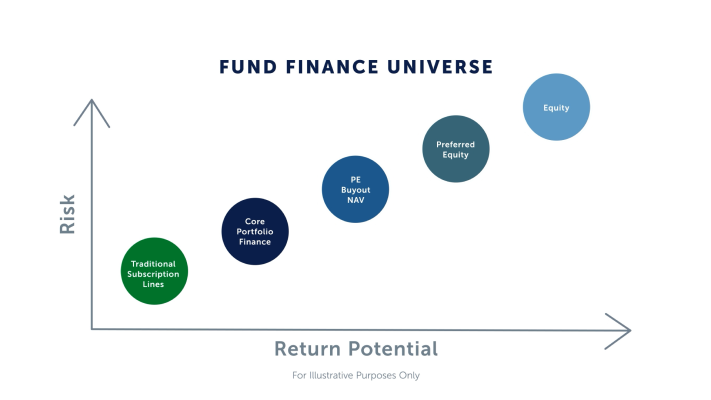
Portfolio finance is an alternative way to fund private market portfolios.

It's part of the broader fund finance universe and sits between traditional subscription line financing and higher-risk preferred or equity-like strategies.

In other words: it's a flexible middle ground for financing private market portfolios at scale.

Image
1772033167099

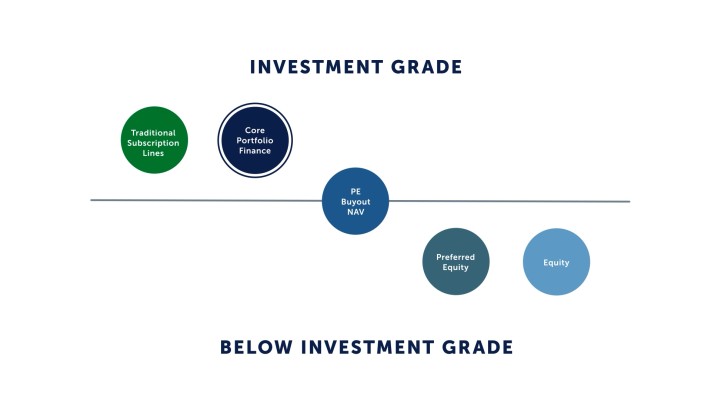
Many investors associate portfolio finance with PE buyout NAV lending, but that represents only one part of the landscape.

Comprised of a broader set of established strategies—core portfolio finance—offers alternative ways to finance private market portfolios and can create high-quality, investment grade private market exposure.

Image
1772033462982

🌐 Breaking Down “Core” Portfolio Finance

Core portfolio finance spans several underlying private market strategies. While it's applied differently across these strategies, the common thread is the same: diversified portfolios seeking financing solutions to support deployment, liquidity and scale.

1. Private Credit & Real Estate Debt
Managers use core portfolio finance to help:

  • Increase buying power
  • Enhance returns
  • Attract new investors seeking customized exposures\

2. Secondaries
A fast-growing segment where portfolio-level financing helps:

  • Fund pools of diversified private equity and private credit portfolios
  • Narrow the bid-ask spread between buyers and sellers of secondary portfolios

3. GP Financing
Provides capital for two key functions:

  • For fund managers to invest in and scale their own businesses, helping promote further alignment with a fund manager's limited partners (LPs)
  • Financing portfolios that include a number of GP stakes strategies

📈 Why It’s Growing

Private markets have expanded rapidly, but banks—historically the main providers of portfolio financings—haven't kept pace due to balance-sheet and regulatory constraints.

This mismatch has created a widening funding gap at the same time managers are seeking more flexible, portfolio-level tools.

Portfolio finance is designed to fill this gap, and the market is scaling quickly.


👥 Who is Investing …and Why?

As banks have been capital constrained from meeting the needs of private market portfolio financings, a much broader set of institutional investors has leaned in—drawn to the combination of investment grade characteristics, diversification and scalable access to private markets.

Today, investors gaining exposure include:

  • Insurance companies
  • Corporate and public pensions
  • Endowments and foundations
  • Sovereign wealth funds
  • Family offices

These allocators share a common goal: strengthen the quality of their private market exposure while maintaining access to scale, stability and steady income.

Portfolio finance sits in this sweet spot—offering a way to “high grade” private credit exposure without taking on equity‑level risk.


⚙️What’s Driving Demand?

✔️ Investment Grade Characteristics
Senior position in the capital structure, strong structural protections and diversified collateral help support investment grade risk profiles.

✔️ Diversification Potential
Exposure backed by broad portfolios of private market assets—often spanning strategies, sectors, vintages or geographies—can complement traditional fixed income.

✔️ Structural Alpha
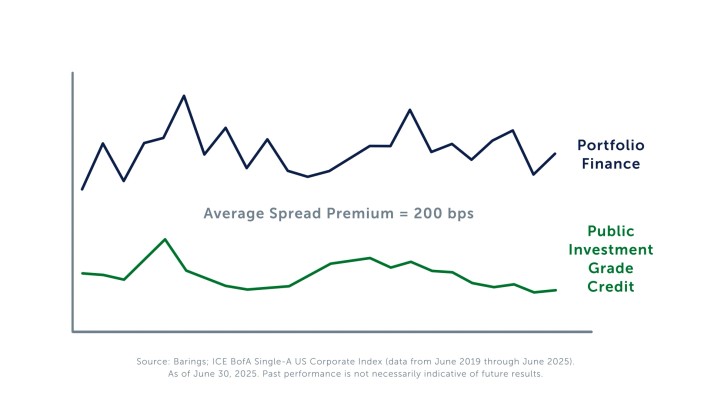
A historical spread pickup over public investment grade corporates, reflecting the structural protections, senior secured position and private market illiquidity premium embedded in portfolio‑level financing.

✔️ Efficient Deployment
Rapid, scalable access to private markets with downside protection built in—supporting deployment pacing, liquidity management, and allocation targets.


Structural Alpha Over Public Investment Grade

Image
1772035878012


✅Playing Safe in Uncertain Times

Recent headlines in private credit and ongoing geopolitical uncertainty have many institutional investors looking for ways to strengthen the quality of their private market allocations, without stepping out of the asset class altogether.

Core portfolio finance offers one potential path.

By moving up in credit quality into directly originated, investment grade exposure, investors can take a more conservative approach while still participating in private markets.

Portfolio finance also tends to exhibit tighter legal documentation, more robust structures, and broader credit controls than many unsecured or below investment grade markets—offering the potential for stability at a time when risk management is top of mind.


💡The Big Picture
Portfolio finance is evolving from a niche tool historically provided only by banks, into a core part of the private market ecosystem accessible to institutional investors.

For managers, it provides a flexible way to manage portfolios at scale.

For investors, it offers an investment grade-quality entry point into private markets with protection built into the structures.

With private markets projected to surpass $20 trillion by 2030,² portfolio finance is poised to play an increasingly important role in how capital moves through—and grows within—the system.


🔎 Go Deeper

Check out our 2-minute animated explainer, where we break down what portfolio finance is, how it works and where it fits in today’s private market landscape:


READ MORE FROM BARINGS


Sources:

1) Barings; Becker Friedman Institute for Economics at University of Chicago (January 2023); Preqin (December 2023); Pitchbook (November 2023).

2) KBRA. As of January 2025.

Barings is a $481+ billion* global asset management firm that partners with institutional, insurance, and intermediary clients, and supports leading businesses with flexible financing solutions. The firm, a subsidiary of MassMutual, seeks to deliver excess returns by leveraging its global scale and capabilities across public and private markets in fixed income, real assets and capital solutions.

*As of December 31, 2025

Compliance Code: 26-5247407

This commentary is for informational purposes only and does not constitute an offer or solicitation to purchase or sell any financial instrument or service in any jurisdiction. It was prepared without consideration of the investment objectives, financial situation, or particular needs of any recipient. This commentary is not, and must not be treated as, investment advice, an investment recommendation, investment research, or a recommendation regarding the suitability or appropriateness of any security, investment, or investment strategy. It must not be construed as a projection or prediction.

Share this post

Sign Up Now for Full Access to Articles and Podcasts!

Unlock full access to our vast content library by registering as an institutional investor

Register

Contacts


Barings

Barings is a $481 billion* global alternative asset manager that partners with institutional, insurance, and wealth clients, and supports leading businesses with flexible financing solutions. The firm, a subsidiary of MassMutual and MS&AD, seeks to deliver excess returns by leveraging its global scale and capabilities across credit, real assets, capital solutions and emerging markets.

*As of March 31, 2026

Ilena Coyle
Head of North American Insurance and Intermediary  
ilena.coyle@barings.com
973-271-2400

www.barings.com
 
300 South Tryon St, Suite 2500,
Charlotte, NC 28202

 

View the contributor page

Sign Up Now for Full Access to Articles and Podcasts!

Unlock full access to our vast content library by registering as an institutional investor .

Create an account

Already have an account ? Sign in

Ѐ Ё Ђ Ѓ Є Ѕ І Ї Ј Љ Њ Ћ Ќ Ѝ Ў Џ А Б В Г Д Е Ж З И Й К Л М Н О П Р С ΄ ΅ Ά · Έ Ή Ί Ό Ύ Ώ ΐ Α Β Γ Δ Ε Ζ Η Θ Ι Κ Λ Μ Ν Ξ Ο Π Ρ Ё Ђ Ѓ Є Ѕ І Ї Ј Љ Њ Ћ Ќ Ў Џ А Б В Г Д Е Ж З И Й К Л М Н О П Р С Т У Ф Х Ц Ч Ш Ā ā Ă ă Ą ą Ć ć Ĉ ĉ Ċ ċ Č č Ď ď Đ đ Ē ē Ĕ ĕ Ė fi fl œ æ ß