

New England Asset Management -

Property Versus Casualty: Investment Trend Comparisons of Shorter-Tail and Longer-Tail Focused U.S. Insurance Carriers

NEAMFeatured

Chris Myers - Enterprise Capital Strategist at NEAM, Inc. 


Executive Summary

Products of property-focused insurers tend to have attritional and catastrophic loss claims that materialize and settle over a relatively short time-period once a loss-event occurs. In contrast, incurred losses related to casualty-focused insurance products may take several years to fully materialize and settle. We focus on commercial property insurers and commercial casualty insurers to see if their respective underwriting focus corresponds to any differences in their respective investment strategies.1 Our findings identified noteworthy characteristics that distinguished the investment portfolios of these carrier types from 2015 to 2024. Property insurers produced strong investment yields, but slower surplus growth relative to their casualty counterparts. Casualty insurers had more conservative asset allocations compared to property insurers. Historically, casualty insurers maintained longer duration portfolios relative to property insurers, but recent data suggests this may no longer be the case. This issue of Perspectives will explore the data behind these findings.

Scope of Analysis

Our analysis considers the 10 years of reported U.S. statutory results for commercial property insurers (PROP) and commercial casualty insurers (CAS) from 2015-2024 (see appendix for more details of which statutory lines are included and classified as PROP and CAS). This includes 215 firms classified as PROP and 281 classified as CAS.

Segment Financial Profile and Characteristics

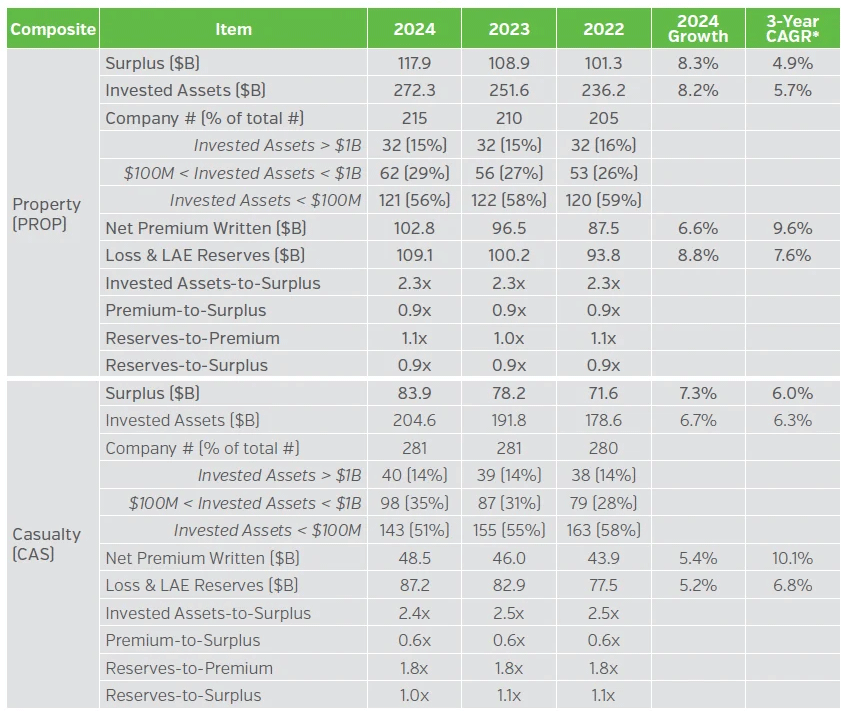
Exhibit 1 provides a summary table showing selected balance sheet and premium data for PROP and CAS insurers for the period, and how these companies are segmented by invested asset size. PROP insurers had higher net premium-to-surplus than CAS insurers. However, CAS insurers generally had higher reserves-to-premium levels, due in part to the longer development and payout periods for most liability claims relative to most property claims. Also, CAS insurers tended to have higher invested assets-to-surplus over the period.
 

Exhibit 1. Table of Surplus, Invested Assets, Net Written Premiums and Reserves for Commercial Property Insurers and Commercial Casualty Insurers Over the Past Three Years.
Image
Table showing table of surplus

*Compound Annual Growth Rate
Source: NEAM, S&P Capital IQ
 

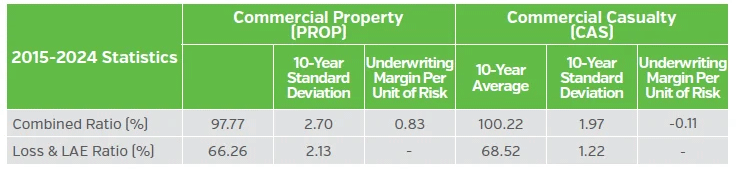
Exhibit 2 shows PROP insurers exhibited stronger underwriting performance relative to CAS per a 10-year average combined ratio from 2015 to 2024. CAS exhibited lower underwriting volatility per a 10-year standard deviation of the combined ratio over the period. However, underwriting margin per unit of risk was still stronger for PROP over the period.
 

Exhibit 2. Combined Ratio and Loss and Loss Adjustment Expense Ratio Data for Commercial Property Insurers and Commercial Casualty Insurers from 2015 to 2024.
Image
Table of combined ratio and loss and loss adjustment expense ratio data

Source: NEAM, S&P Capital IQ
 

Segment Investment Performance and Portfolio Characteristics

High Level Performance

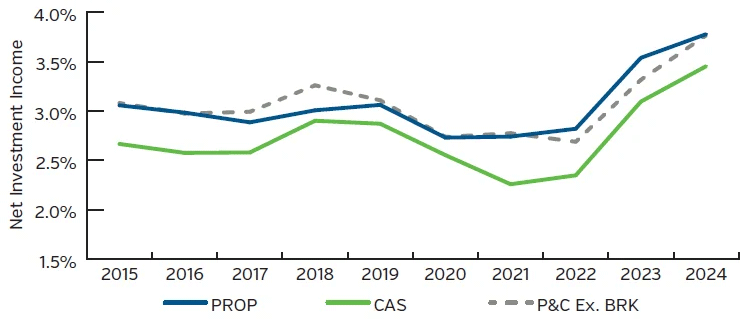
Exhibit 3 shows net investment income for PROP outpaced CAS for the past 10 years through 2024, with the largest gap in 2021 and 2022. CAS also lagged the broader P&C industry over this period.
 

Exhibit 3. Net Investment Income Comparison of Commercial Property Insurers, Commercial Casualty Insurers and the P&C Industry (ex. Berkshire Hathaway) from 2015 to 2024.
Image
Graph showing net investment income comparisons

Source: NEAM, S&P Capital IQ
 

Asset Allocation Comparison

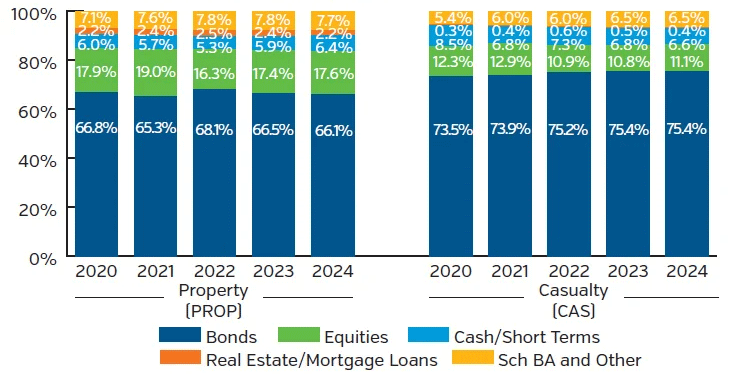
Exhibit 4 shows where property and casualty insurers differed in their asset allocations from 2020 to 2024. The allocations suggest that CAS had a more conservative approach to sector allocation relative to PROP. Over the period, CAS held more bonds than PROP (75.4% versus 66.1% in 2024) and less equities and schedule BA assets relative to PROP (17.6% versus 25.3% in 2024). Also, PROP was more likely to invest in mortgage loans. For 2024, CAS and PROP held similar levels of cash and short-term assets, but for most years CAS held more than PROP.
 

Exhibit 4. Invested Assets Sector Composition
Image
Graph showing invested assets sector composition

Source: NEAM, S&P Capital IQ
 

Risk Assets Relative to Surplus

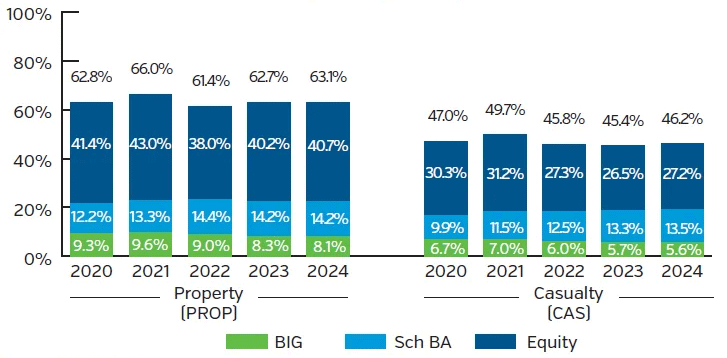
Over each of the five years ending in 2024, PROP held more risk assets as a percentage of surplus compared to CAS. PROP consistently had over 60% of surplus held in risk assets while CAS never surpassed 50%. Exhibit 5 shows how this allocation evolved from 2020 to 2025, with the equity allocation representing the largest difference between the two segments. However, despite the higher allocation to risk assets and stronger net investment income performance from 2020 to 2024, Exhibit 1 shows that growth of surplus and invested assets for PROP trailed CAS over the past three years (see 3-Year CAGR).
 

Exhibit 5. Risk Assets as a Percentage of Surplus Comparison
Image
Graph comparing risk assets

Source: NEAM, S&P Capital IQ
 

Comparing Book Yields

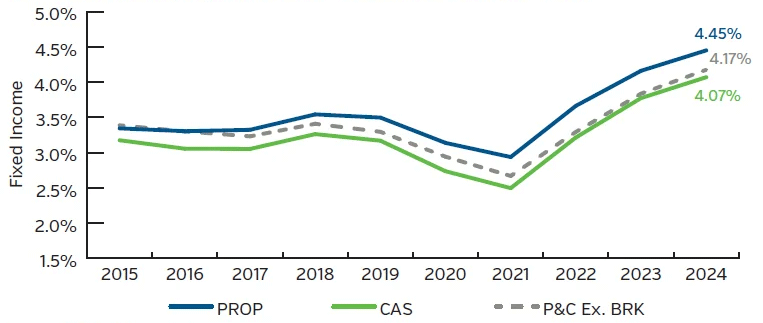
Exhibit 6 shows fixed income book yields for PROP outpaced CAS for the past 10 years through 2024. The yield gap widened each year between 2015 and 2022.
 

Exhibit 6. Fixed Income Book Yields and Net Investment Income from 2015 to 2024 for Commercial Property Insurers and Commercial Casualty Insurers.
Image
Graph comparing fixed income book yields

Source: NEAM, S&P Capital IQ
 

Fixed Income Sector Allocation and Attribution

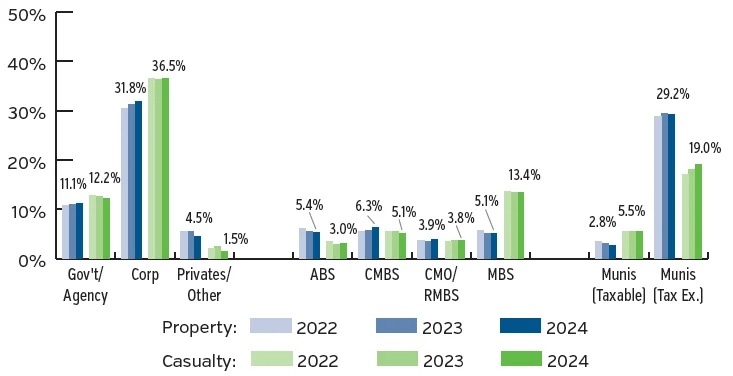
The fixed income allocation levels and differences from 2022 to 2024 are shown in Exhibit 7. PROP insurers had a lower allocation to corporates, privates/other and mortgage-backed securities (MBS) relative to CAS. In contrast, CAS allocated less to tax-exempt municipal bonds and more to taxable municipal bonds.
 

Exhibit 7. Fixed Income Sector Allocations Between 2022 to 2024
Image
Graph showing fixed income sector allocations

Source: NEAM, S&P Capital IQ
 

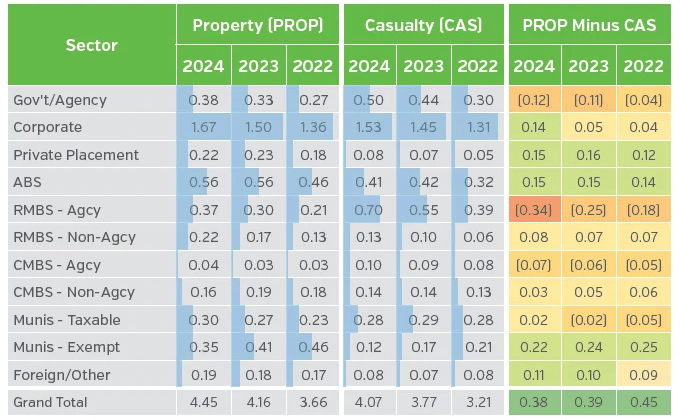
Exhibit 8 shows aggregate book yields for PROP and CAS from 2022 to 2024, and the portion of book yield sourced from each sector. Book yields increased each year for PROP and CAS, with corporates contributing the most across all sectors shown. Asset-backed securities (ABS) were the second leading contributor for PROP book yields while agency residential mortgage-backed securities (RMBS) were the second leading contributor for CAS.
 

Exhibit 8. Comparison of Book Yield Contribution by Fixed Income Sector
Image
Table comparing book yield contributions

Source: NEAM, S&P Capital IQ
 

Fixed Income Quality Distribution

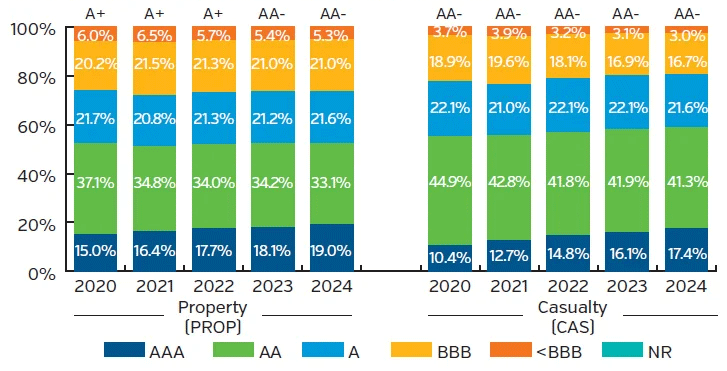
Commercial property and commercial casualty insurer portfolios had noteworthy differences in credit quality. Exhibit 9 shows the quality distribution from 2020 to 2024. Generally, PROP held less “A” and above rated assets and more “BBB” and below rated assets relative to CAS for these years.
 

Exhibit 9. Comparison of Fixed Income Quality Distribution
Image
Graph showing comparison of fixed income quality distribution

Source: NEAM, S&P Capital IQ
 

Fixed Income Duration Comparison

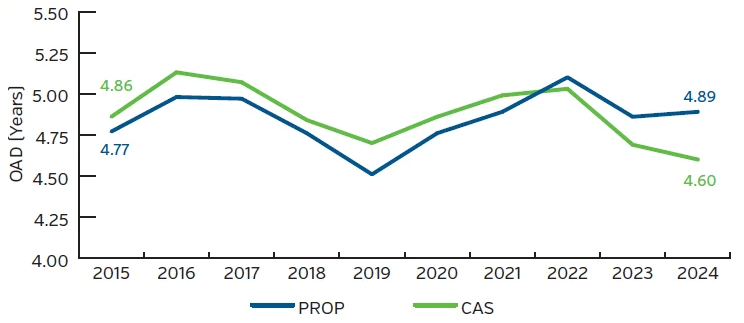
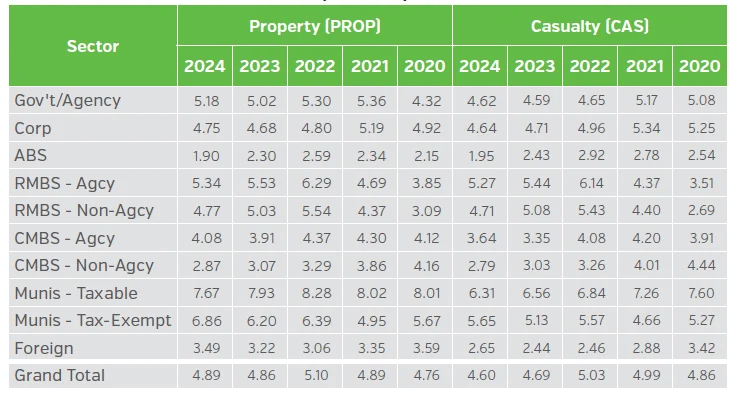
Exhibit 1 above shows that commercial property insurers tend to maintain less reserves relative to their premiums, partly due to shorter loss development periods relative to commercial casualty insurers. However, Exhibit 10 shows that since 2022, the durations of PROP insurer bond portfolios have extended beyond CAS insurers’ portfolios.
 

Exhibit 10. Duration Trend From 2015 to 2024 for Commercial Property Insurers and Commercial Casualty Insurers, and How Duration Compares at the Sector Level Over the Past Five Years.
Image
Graph showing duration trend from 2015 to 2024

Source: NEAM, S&P Capital IQ
 

Exhibit 11. Duration Contribution Comparison by Sector from 2020 to 2024.
Image
Table showing duration contribution comparisons

Source: NEAM, S&P Capital IQ
 

Key Takeaways

U.S. commercial casualty insurers (CAS) and commercial property insurers (PROP) have different insurance risk profiles as reflected in a higher reserve-to-premium ratio for CAS as compared to PROP from 2022 to 2024. PROP exhibited a stronger average combined ratio (C/R) from 2015 to 2024, while CAS exhibited lower C/R volatility over this period. When exploring differences in the investment strategies over the 2015 to 2024 calendar years, key observations include:

  • CAS insurers tended to have higher invested assets-to-surplus versus PROP insurers, along with higher surplus growth and invested asset growth over the period.
  • PROP exhibited higher net investment income relative to CAS over the years observed.
  • Relative to PROP, CAS insurers appear more conservative with their asset allocation, considering a comparatively smaller allocation to risk assets including <BBB rate fixed income and equities.
  • Some of PROP’s investment choices appear to contribute to stronger book yields versus CAS, with the book yields from both segments benefiting mostly from their respective corporate bond allocations.
  • Average credit quality for both CAS and PROP insurers was AA- but PROP had higher allocations to BBB/<BBB rated fixed income.
  • Over most of the observed years, the CAS fixed income duration profile was longer than PROP, but since 2022 this switched with PROP fixed income maintaining longer average duration relative to CAS.

Appendix

We define commercial property and commercial casualty using the S&P Global Capital IQ’s classifications for U.S. property and casualty focused insurers, respectively, as follows:

Commercial Property (PROP): Comprised of 215 insurance groups, including Commercial Auto, Commercial Multi-Peril, Fire and Allied, and Inland and Ocean Marine. Commercial Auto is estimated based on Commercial Auto Liability from the Underwriting and Investment (U&I) exhibit and Commercial Auto Physical Damage from the Insurance Expense Exhibit (IEE).

Commercial Casualty (CAS): Comprised of 281 insurance groups, including Other Liability and General Liability summed for both occurrence and claims made, Workers Compensation and Medical Malpractice.
The above definitions are used to aggregate and track all statutory financial data used in the analysis.

Read More from New England Asset Management


Endnote

1 This article focuses only on selected commercial property and commercial casualty insurers. For a deeper analysis of the broader U.S. property and casualty combined statutory investment results see Perspectives, “2024 P&C Industry Investment Highlights: Momentum Continues, but Slows.” July 2025.


All rights reserved. This publication has been prepared solely for general informational purposes and does not constitute investment advice or a recommendation with respect to any particular security, investment product or strategy. Nothing contained herein constitutes an offer to provide investment or money management services, nor is it an offer to buy or sell any security or financial instrument. NEAM does not offer legal advice and readers should consult their own independent legal advisors before relying on any information herein. The investment views expressed herein constitute judgments as of the date of this material and are subject to change at any time without notice. Future results may differ significantly from those stated in forward-looking statements, depending on factors such as changes in securities or financial markets or general economic conditions. While every effort has been made to ensure the accuracy of the information contained herein, neither New England Asset Management, Inc. (“NEAM, Inc.”) nor New England Asset Management Limited (together, “NEAM”) guarantee the completeness, accuracy or timeliness of this publication and any opinions contained herein are subject to change without notice. This publication may not be reproduced or disseminated in any form without express written permission. NEAM, Inc. is an SEC registered Investment Advisor located in Farmington, CT. This designation does not imply a certain level of skill or training. In the EU this publication is presented by New England Asset Management Limited, a wholly owned subsidiary of NEAM, Inc. with offices located in Dublin, Ireland and London, UK. New England Asset Management Limited is regulated by the Central Bank of Ireland. New England Asset Management Limited is authorised by the Central Bank of Ireland and subject to limited regulation by the Financial Conduct Authority. Details about the extent of our regulation by the Financial Conduct Authority are available from us on request. This is not an offer to conduct business in any jurisdiction in which New England Asset Management, Inc. and New England Asset Management Limited are not registered or authorized to conduct business.


Originally published by NEAM in April 2026. This is not an offer to conduct business in any jurisdiction in which New England Asset Management, Inc. and its subsidiaries are not registered or authorized to conduct business.

© 2026 New England Asset Management, Inc.
 
All rights reserved. This publication has been prepared solely for general informational purposes and does not constitute investment advice or a recommendation with respect to any particular security, investment product or strategy. Nothing contained herein constitutes an offer to provide investment or money management services, nor is it an offer to buy or sell any security or financial instrument. The investment views expressed herein constitute judgments as of the date of this material and are subject to change at any time without notice. Future results may differ significantly from those stated in forward-looking statements, depending on factors such as changes in securities or financial markets or general economic conditions. While every effort has been made to ensure the accuracy of the information contained herein, neither New England Asset Management, Inc. (“NEAM, Inc.”) nor New England Asset Management Limited (together, “NEAM”) guarantee the completeness, accuracy or timeliness of this publication and any opinions contained herein are subject to change without notice. This publication may not be reproduced or disseminated in any form without express written permission. NEAM, Inc. is an SEC registered Investment Advisor located in Farmington, CT. This designation does not imply a certain level of skill or training. In the EU this publication is presented by New England Asset Management Limited, a wholly owned subsidiary of NEAM, Inc. with offices located in Dublin, Ireland and London, UK. New England Asset Management Limited is regulated by the Central Bank of Ireland. New England Asset Management Limited is authorized by the Central Bank of Ireland and subject to limited regulation by the Financial Conduct Authority. Details about the extent of our regulation by the Financial Conduct Authority are available from us on request. This is not an offer to conduct business in any jurisdiction in which New England Asset Management, Inc. and New England Asset Management Limited are not reigistered or authorized to conduct business.

Share this post

Sign Up Now for Full Access to Articles and Podcasts!

Unlock full access to our vast content library by registering as an institutional investor

Register

Contacts


New England Asset Management

New England Asset Management (NEAM) strives to be integral to the success of our insurance industry clients by providing investment management solutions through a team of skilled professionals dedicated to delivering exceptional client service. We aim to build true, enduring relationships with our insurance company clients by combining three core attributes:

Dedicated Teams    
NEAM is staffed with dedicated teams of knowledgeable insurance and capital markets professionals.

Actionable Tools    
Our combination of talent and technology is designed to support all aspects of your investment management.

Tailored Solutions    
We are acutely aware of the unique concerns and challenges insurers face on a daily basis and so these are reflected in our investment process.

Our comprehensive offering includes a wide range of services:

  • Asset Management Services
  • Enterprise Capital Strategy Services
  • Capital & Risk Analytics Platform
  • Investment Accounting & Reporting Services

www.neamgroup.com
74 Batterson Park Road
Farmington, CT 06032

 

View the contributor page

Sign Up Now for Full Access to Articles and Podcasts!

Unlock full access to our vast content library by registering as an institutional investor .

Create an account

Already have an account ? Sign in

Ѐ Ё Ђ Ѓ Є Ѕ І Ї Ј Љ Њ Ћ Ќ Ѝ Ў Џ А Б В Г Д Е Ж З И Й К Л М Н О П Р С ΄ ΅ Ά · Έ Ή Ί Ό Ύ Ώ ΐ Α Β Γ Δ Ε Ζ Η Θ Ι Κ Λ Μ Ν Ξ Ο Π Ρ Ё Ђ Ѓ Є Ѕ І Ї Ј Љ Њ Ћ Ќ Ў Џ А Б В Г Д Е Ж З И Й К Л М Н О П Р С Т У Ф Х Ц Ч Ш Ā ā Ă ă Ą ą Ć ć Ĉ ĉ Ċ ċ Č č Ď ď Đ đ Ē ē Ĕ ĕ Ė fi fl œ æ ß