




GCM Grosvenor-

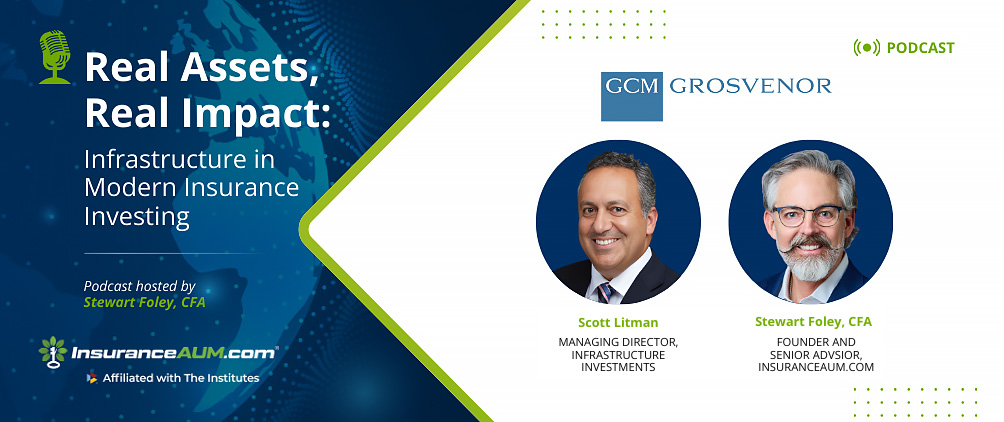
Real Assets, Real Impact: Infrastructure in Modern Insurance Investing

Image
GCMGrosvenorFeatured


Stewart: Welcome to another edition of the InsuranceAUM.com podcast. Commercial real estate investors like to buy everything when it feels really good and sell everything when it feels really bad. So many people were looking for a recession, and that just hasn't happened in the last 18 to 24 months. We've created more data than all of humanity did before. We're coming into 2026 on pretty solid footing. 

Hey, welcome back to the home of the world's smartest money. My name's Stewart Foley, CFA, Founder and Senior Advisor of InsuranceAUM.com. Also the Principal Architect of the upcoming and soon to launch CIIM designation, the Chartered Insurance Investment Manager Designation. More to come on that. We're just kind of teasing that a little bit right now. Today's topic is a good one. It's infrastructure, an asset class that has become increasingly central to modern insurance company portfolios. Infrastructure touches long duration cash flows, inflation linkage, capital efficiency, sustainability, and real economic impact, and all things that insurers care deeply about. The title of today's podcast is Real Assets: Real Impact Infrastructure and Modern Insurance Investing. And our guest today is Scott Littman, Managing Director of Infrastructure Investments at GCM Grosvenor.

Scott brings a rare blend of legal, operational, and investment experience. Prior to GCM Grosvenor, he held a senior leadership position at High Star Capital and at Oaktree Infrastructure. Also, earlier in his career, worked at AIG Global Investment Group. He has served on executive and investment committees and boards spanning airports, midstream power and transportation assets. Scott, there's an intro that no one's ever going to live up to. Welcome to the party. Please make yourself at home.

Scott: Thanks very much, Stewart. And yeah, thank you for the very kind introduction. It's great to spend some time with you here today.

Stewart: Thanks. And we've got a lot to cover and a lot to learn today. But first off, we always start in kind of the same way. We have a new icebreaker question, but we always ask, where did you grow up? What was your high school mascot? And what job would you want if you weren't doing this one?

Scott: I grew up out on the east end of Long Island in a town called Setauket, which many people think is Secaucus, New Jersey, but it's Setauket, New York. Approximate the Stony Brook and the Stony Brook University. I went to Ward Melville High School, home of the Patriots when I was there, the top lacrosse school in New York State. It was exciting. And if I was not doing what I'm doing today, I will hearken back to my college days when I was actually a radio announcer for the University of Pennsylvania's basketball and football team. So maybe a little role with ESPN or something like that.

Stewart: Wow, that's super cool. We had a guy, I was a professor at a small liberal arts school outside Chicago, and we had a guy that did the play-by-play for the football program, and he was so good that he actually got a ride. And it's a tough road. I mean, ESPN, there's seven people who work at ESPN that's on air, and everybody else is hoping to get there. But it's a super cool ... Colin Coward, honestly, Colin Coward used to be at ESPN and now at Fox, he belonged to my gym. I used to live out there, and that was super interesting to talk to him. I'm not a deep sports guy. And he used to say to me, he's like, "My job is to make my show interesting to you, " which is super cool. So infrastructure covers a broad array of assets, transportation, energy, utilities, digital infrastructure, and more.

How do you define infrastructure today, and how has that definition evolved over the last 5 or 10 years?

Scott: When we think of infrastructure, the starting point fundamentally is that we think of assets and they have to be essential. That's the key to thinking about what differentiates infrastructure from other real assets or from elements of private equity. And so when you think about assets that are essential, what are they? They're assets that are critical to society functioning, roads, bridges, airports, power plants, pipelines, transmission of electricity, all of these different things. Interestingly, just to answer the second part of your question, so what I didn't say was data centers or towers or fiber, because when I got started in the infrastructure space way back in the early 2000s with AIG, as you mentioned, we didn't think of digital infrastructure as infrastructure at all. It was really private equity. What changed? The proliferation of the internet, of cell phone usage, and of how people communicated and also moved data, which made all of these elements of the digital infrastructure space truly essential. So we can see the definition of infrastructure evolve over time, but we want to be really disciplined in how we get there.

Stewart: Yeah. It's interesting the central component. I was a treasurer of a city, and that was sort of like electric, water, sewer, trash. This is not stuff that you go, "Oh, things aren't going too good. I think I'm just going to cut my trash service." Yeah, that's right. I'm not going to turn the lights on anymore. And it's like, what? So it's interesting. So you touched on this, but the core characteristics of infrastructure, and talk a little bit about the additive roles that infrastructure can play within an insurance portfolio. And you mentioned your time at AIG. And I've talked about this on podcasts before. I used to be a CIO too, and at the end of the day, insurance companies have these liabilities that are exposed to inflation. And due to the regulatory structure, a lot of their portfolio is in fixed income, which hates inflation. So talk about what the additive roles here are and how it fits for insurers.

Scott: Yeah. So a couple of great things to unpack. So as you very correctly note, these are assets that you can't stop using, that you don't want to stop using, and that's what makes them so valuable. That's what also reduces the level of volatility in the performance of the asset. No matter what's going on in the economy, these are assets that are going to get used. What else protects infrastructure assets return profile? High barriers to entry, long-term contracts. Very often, as you know, with the municipality. So we're not always contracting directly with the underlying company, or excuse me, the underlying customer. We're very often contracting with the municipality to provide that service because we own the landfill or we own the waste to energy plant, or we own the power generation facility. And all of that is what kind of creates this very steady set of cash flows.

So early days of infrastructure, the general belief was that this was a very interesting and exciting fixed income replacement. And the reason that it was so attractive for so many was because infrastructure generally did a better job of managing inflation because in an inflationary environment, prices typically went up because people couldn't stop using the service. So, this wasn't something you could simply shut off. Now, that's not perfect because there are assets that do have less correlation to inflation, but by and large across the asset class, and if you're well diversified across the different sub-sectors of infrastructure, you're going to get a lot of inflation protection, and that makes it really interesting. In an insurance company portfolio, again, what you have is you very often have longer dated liabilities and you're looking for something to match those liabilities. You're thinking about things like capital charges and how are you going to invest your equity?

And having grown up in the infrastructure space inside of AIG, we've seen this be a really interesting asset class early on for insurers to participate in because they can do some liability matching, because they can actually get lower capital charges against an equity investment, and those features are really attractive, and we're seeing that grow. Interestingly, there's still a lot of room for more insurers to come and join us in the infrastructure investing space. It's still quite new across the landscape generally.

Stewart: Yeah, it's interesting. I have heard some staggering numbers that of the amount of investment needed for infrastructure. And I used to live in Chicago. I love Chicago, great city, but like many large cities in the US, literally crumbling infrastructure. And that stuff is not cheap. I mean, a railroad trestle where you've got city streets going underneath it and there's chunks of concrete falling off, it seems like there's a very significant demand. You mentioned the early days of investing in this. How have insurers, how are they approaching infrastructure differently than they were even five years ago?

Scott: Yeah. Well, I think a lot of the answer to that question comes from the proliferation of the asset class more generally. So it wasn't just insurers that really weren't focused on infrastructure, it was almost all of the investor landscape. And the reason was because up until, I don't know, 10, 15 years ago, so much of infrastructure was really the province of government, of municipal governments, of state governments, of federal governments. And they were funding so much of this with bonds or with tax revenues. And so what's changed over time? It's become highly politicized. The ability to raise tax revenue for infrastructure, much more difficult. The ability to go and issue more bonds almost impossible at this point. And so they've had to reach out to the private markets to fill that gap, and that's what's opened up the opportunity. That's what's become so exciting. That is a very recent event.

So if you look at just the age of infrastructure as an asset class and as an opportunity, it's so much younger than private equity or real estate. And so that's the starting point. And then you think about who's taking advantage of the opportunity, and the insurers sometimes are a little bit slower moving in their approach, a little bit more deliberate. They want to make sure they know what they're investing in. They want to learn it. Maybe they've got a smaller staff unpacking this. And so we're just starting to see this uplift. Having said that, there are probably a few different approaches. Infrastructure debt, that's a really popular area for the insurers. Again, returns are going to be lower, but quite interesting. Default rates, very, very low among the lowest in any sort of debt scenario and attractive capital charges against that space for so many.

Two, you're going to see this fixed income replacement product on the equity side, which again, the nomenclature will be familiar to anyone that invests in real estate, but we're looking at core plus. And now what you're seeing is with the addition of more dollars of more ways to play the space, you're seeing core plus value add opportunistic infrastructure, and it's become kind of a private equity replacement or a diversifier. And I like to say when I talk about it as a private equity sort of diversifier, I think of it a little bit as private equity with a seatbelt. So depending on what you want the outcome to be, there's a lot of opportunity in the space.

Stewart: Yeah, I'll put on my former CIO hat. And if I want to start designing or expanding an infrastructure allocation, what challenges am I going to typically encounter as an insurer? It's just a practical question for those who may be considering maybe just starting to investigate the asset class, give them some best practices.

Scott: Yeah. So starting point is understanding where you really want infrastructure to fit in the portfolio from a return perspective. And today, the options in infrastructure are so much broader than they've been that really you can start with something kind of as secure.. So as I think about different entry points in infrastructure, the starting point is going to be there's now a broad range of open-ended funds that tend to focus on core.. It's going to be the type of thing that if you need liquidity, you've got quarterly redemption options, you put yourself in a queue and you can get yourself out over time, so no lockup, semi-liquid.

Then you go into the closed-end space. In the closed-end space, you're going to think about the province of the mega funds. So these are the guys that now in infrastructure are raising 15 plus billion dollars a fund. Global infrastructure partners now a part of BlackRock, KKR, Stonepeak, iSquared, EQT, Brookfield, those are kind of the preeminent players in this space. And so you're getting, I don't know, 200, 250 basis points of premium for being less liquid. Then as you kind of think about moving up from there into this more private equity style, you're either going to be focused on one, greenfield opportunities, new build, permitting, kind of shovels in the ground, longer dated sort of stuff, or two, you're going to be looking at co-investment, and this is a brand new area of infrastructure.

And I say it's brand new largely because the space wasn't big enough to present these opportunities, but now that's part of the evolution that we've seen. You said it early on and you were absolutely right, each one of these opportunities is large, is chunky. Building a power plant is expensive. Fixing a bridge or maintaining a toll road is expensive. And so the capital need from the fund and its partners is massive. You're underwriting anything from a billion dollar enterprise value asset to $15 or $20 billion. And so the capital's coming from all over. Those co-investment opportunities are often really interesting to produce some very exciting alpha in this space, and that is a growing area where we're seeing a whole lot of interest.

Stewart: One of the kind of stock and trade sort of things is insurance companies have constraints. What constraints or considerations are you hearing specifically from insurance companies?

Scott: Yeah, I think a lot of it is what we started to talk a little bit about, and we can go into some more detail. It's thinking about what the efficient uses of capital are. It's thinking about capital charges and how to make sure that you're getting enough return to think about moving from private equity or some other bucket and also getting something stable so that it is a diversifier. And so what's interesting is if you start to look, we've done some interesting work with insurers from Bermuda, insurers from Europe, insurers from all over, and there are regulatory kind of features of these different jurisdictions that allow certain aspects of infrastructure to receive a lower capital charge, and that's really attractive. So we're building programs, we're collaborating with the accounting firms to get opinions on whether or not the infrastructure would qualify under Bermuda's regs, under Solvency II.

And in Europe, each jurisdiction has its own sort of approach, but being able to satisfy that makes infrastructure really attractive to insurers and is a real enticement because of that kind of attractive capital charge.

Stewart: Yeah. I mean, I think at the end of the day, it's return on statutory capital or on risk-adjusted capital based on whatever your regulatory regime is, it is absolutely a consideration for insurance companies because the capital charges can be radically different and not necessarily reflect the risk underneath to your point. 

Scott: That's right.

Stewart: Let's talk about the macro environment. I've got a specific question for you that came out of a ... We have a call with a pretty good size group of CIOs that ... And one of the things that I want to talk about the current backdrop for infrastructure right now and where you see opportunities and where are you more cautious. And then as part of that, there was some discussion yesterday of the concept of there being a bubble in data centers. And the question, I guess I have a couple questions. One is, do you invest in them at all? And two, what do you think that the state of play is there as part of your answer on the current macro backdrop and what you like and where you're cautious?

Scott: I can hit the data center question right up front and I think it'll lead into the more macro discussion because I think some of the themes are going to be similar. We've been investing in data centers for the better part of 10 years, so they absolutely are a part of our portfolio. Data centers are also going to be a part of real estate portfolios. They also may be a part of private equity portfolios. So a lot of folks are focusing on data centers. How you play the space often kind of dictates which portfolio a particular opportunity fits best in. What do I mean? Well, there's some funds out there that are going to focus first on buying the land. That's generally more of a real estate approach. They don't know exactly who the customer's going to be, but they know that if they're in a good industrial area, even if they don't get the data center built to the features that they were hoping for, they can pivot and use that land differently for industrial uses and still make a good return.

We wouldn't actually invest in that way as an infrastructure investor, there's too much risk there. The other way is there's folks looking at it from kind of, okay, what's AI penetration going to look like? How are we thinking about this? And maybe again, we're looking at a co-location facility, we're looking at a retail sort of facility, higher risk, higher churn, a hotel, if you will, for information that may be more of a private equity sort of play. Where do we like to be? We really like contracts. We really like stable investment grade counterparties, and that's the fundamental starting point for so much of what we're doing in this space. So everybody's going to play this a little differently.. That's what we think infrastructure is supposed to do in the portfolio and then still produce a return. How do we think about what's going on today and this notion of a bubble?

It worries me a lot. So that's a very honest opinion. I think everybody is focused on data centers right now and there is a lot of very, very smart capital in the data center space, but there's also a lot of capital that's less familiar with the data center space that's just trying to kind of ... It's the dog that caught the bus and they just, we got to be invested in data centers, but it's not an area of expertise. We are laser focused when we're investing in the space to be investing with people with very strong track records, with very strong relationship, with the ability to operate and build data centers consistently to price them consistently. And that's how we also look to mitigate downside risk. I'm not super excited, if I'm being honest, about the data center that's being built in the desert somewhere in the middle of Arizona, nowhere near a city, because there's some sort of an AI need and they wind up with a five or a seven year or even a 10-year contract.

And if that AI no longer needs that data center, it's going to be vacant. That's a scary sort of consideration for me. So I think how you play this space today matters a lot. Who you play it with matters a lot. And with all investing, entry point is really, really important. Price matters all the time.

Stewart: Yeah, that's great. So one of the things I should have done at the top of the show is give you the opportunity to talk a little bit about GCM Grosvenor more broadly. It is a very well-known firm with a very good reputation, but perhaps not the same level of household recognition as others. So if you could give us a little bit of a high level view of GCM Grosvenor and then talk to us about how you are working in infrastructure today and how you approach portfolio construction.

Scott: Yeah. So we are really quite unique in the sector, and that's what gets me excited. So you mentioned some of the other household names. They're terrific. We talked about the mega funds. We talked about the BlackRocks and the Blackstones and the KKRs of the world. They're all terrific in the space. What's interesting about us is we'll work with all of them. So Grosvenor, in terms of its overall pedigree, is about a $87 billion asset manager, so not small. We've been around for more than 50 years dating back to 1971. The heritage of the business is we grew up on the hedge fund side. We added alternatives in the 2000s, and now what we're seeing is alternatives probably comprise the vast majority, not the vast majority, but let's say two-thirds, 70% of all of our capital. So we've really seen some tremendous growth. Infrastructure is leading that growth.

So I joined the firm in 2019. We were four billion of AUM in infrastructure. Today, we are $18 billion in infrastructure. It is the fastest growing asset class inside of GCM, and that's really a function of a couple things, a very unique approach and a solid track record. It's, I think, almost as simple in quotes as that. So what do we do that's different and how do we do it and why are we gaining that kind of traction? As I said, the other guys in the space that are household names, what they do is they source all of their own deal flow. What we do is a little bit different. We're effectively curating portfolios of other people's deal flow, and that's a very unique thing to do. In that way, where we go is we'll say to KKR, "Can we invest with you in this deal?" Or more likely, they'll say to us, "Can you invest with us?" And it's that opportunity that we get really excited about because we get to piggyback all of their information, all of their diligence, and we make a decision based on that.

That allows us to build some of the most highly diversified portfolios. We don't have a whole lot of asset concentration, and not only are we diversified by sector and geography, but we're also uniquely diversified by sponsor. And so as a result, what you get in a GCM portfolio is what I like to call the greatest hits of infrastructure. Rather than having to pick a single manager to count on them outperforming the entire sector you're getting from us, two or three investments from each of the top managers.

Stewart: Yeah, that's well said. That's interesting. Thank you. Great education on infrastructure today. So a couple of fun ones for you on the way out the door. The first one is intended to really get at the culture of GCM Grosvenor, and it goes like this. What characteristics, and you've been at a couple of different places and you've been in this business a minute, so what characteristics do you think are important when you're adding to members of your team? And here's why I ask, right? I used to teach a lot of students out there, I'm actually, believe it or not, having grand students. When you said 50 years ago and you said 1971, I remember when 50 years ago had a 1940s handle on it. So I mean, I'm not getting any younger here, but at the end of the day, I do think it's important for people to realize that it's not always hard skills and where you got your degree. There are other things that really matter. What are they at GCM and in your experience?

Scott: Yeah, it's a really, really wonderful question. And I actually think it's a highlight of how we build our team here. So first and foremost, you do have to have those hard skills. We want people that grew up investing in assets that know how to unpack an Excel model and figure out if something is actually going to make money or not, figure out if somebody's being too aggressive in their assumptions or not. So that's a starting point, that's kind of table stakes. But beyond that, because we are looking to source from so many different parts of the infrastructure community, I joke and I say this, we've got to be everybody's best friend. That's the way that we're not competing with anybody. We're building something unique and at the end of the day, we hope to be complimentary and we hope to be a solutions provider not only for our clients, but also for the sponsors that we work with.

And so what are the softer characteristics that are really meaningful? The ability to listen and not judge, the ability to unpack something offline, the ability to quickly assess if something is real or not real, the ability to be creative about entry point. Are we comfortable? What's interesting is everyone will tell you that in alternatives, you got to have control to make money. Most of the time we invest, we don't have control. How is that possible? Well, I harken it back a little bit to the public equity space. When you're investing in public equities, you are buying into companies that are managed by somebody else, you're not taking control and yet you still look for outperformance. You still look to understand, is that management team any good? Can they deliver on their business plan, et cetera? We're doing the exact same thing at infrastructure.

And so it's the ability to connect with people, the ability to have people want to work with you, the ability to be the first person to call back. All of those softer features are really important to making sure that we are the first person that each of these sponsors call because that's what gets us in the loop of the best deal flow.

Stewart: Yeah, it's really true. I used to say that I wanted my clients to call me. I don't care what the question is. What's a good barbecue restaurant in Memphis? Call me. I'll figure it out. I'll call you right back. That's exactly right. We're never saying no. That's exactly right. So last one. This was a fun one. So dinner's on us, first of all. You can have dinner with up to three guests, one, two, or three. Who would you most like to have dinner with alive or dead?

Scott: Oh, wow. I'll give you a couple different angles. So I love the idea of having dinner with a preeminent name in the infrastructure space, a Robert Moses or somebody like that that has some really good connectivity to New York and to how so much of New York was built to think about the evolution of the infrastructure in the state. In my mind is really interesting. The power broker's a terrific read. I think that's super interesting and I'd enjoy that conversation from the infrastructure perspective. So that's one dinner. A second dinner, if I'm having dinner and it's on you guys, I want, let's go have dinner with one of the preeminent chefs in the world. I don't know if it's Nobu Matsuhisa or a Tom Kalicchio or something like that, but I'd love to sit down and really enjoy understanding the nuances of how the meal's prepared, how the wines are paired, all of that great stuff and bring that experience to the next level.

And then third, just for fun, I think Bruce Springsteen's going to be on the list just because he's the boss and that's who's better than that.

Stewart: I love that I answer. I'm a Springsteen guy too. I used to run a lot of cross country on motorcycles and I only listened to three artists. I listen to Billy Joel. I listen to Elton John, and listen to Bruce Springsteen for hours on end, but I still don't have all the lyrics right. There are many lyrics where I think he's saying something and I look at it and I go, "Oh, that's not what he's saying at all. " So hey, listen, thanks for being on. I really appreciate it. It's a great education. We've been joined today by Scott Littman, Managing Director of Infrastructure Investments at GCM Grosvenor. Scott, thanks for taking the time with us.

Scott: Thanks so much for having me, and I look forward to sharing music collections with you. It sounds like we're going to have a lot of fun.

Stewart: Absolutely. Thanks for joining us. If you like what we're doing, please rate us, review us on Apple Podcast, Spotify, or wherever you'll listen to your favorite shows. If you want to see what we're doing, have a look at our YouTube channel at InsuranceAUM Community. If you have ideas for podcasts, please shoot us a note at podcast@insuranceaum.com. My name's Stewart Foley. I've been your host. This is the home of the world's smartest money at the InsuranceAUM.com podcast.

Share this post

Sign Up Now for Full Access to Articles and Podcasts!

Unlock full access to our vast content library by registering as an institutional investor

Register

Contacts


GCM Grosvenor

GCM Grosvenor (Nasdaq: GCMG) is a global alternative asset management solutions provider with approximately $91 billion in assets under management across private equity, infrastructure, real estate, credit, and absolute return investment strategies. The firm has specialized in alternatives for more than 50 years and is dedicated to delivering value for clients by leveraging its cross-asset class and flexible investment platform.  

GCM Grosvenor’s experienced team of over 550 professionals serves a global client base of institutional and high net worth investors. The firm is headquartered in Chicago, with offices in New York, Toronto, London, Frankfurt, Tokyo, Hong Kong, Seoul, and Sydney.  

For more information, visit: gcmgrosvenor.com

Tom Hobson 
Managing Director 
thobson@gcmlp.com 
(484) 800-5073

900 N. Michigan Ave, Suite 1100,
Chicago, IL 60611

 

View the contributor Page

Sign Up Now for Full Access to Articles and Podcasts!

Unlock full access to our vast content library by registering as an institutional investor .

Create an account

Already have an account ? Sign in

Ѐ Ё Ђ Ѓ Є Ѕ І Ї Ј Љ Њ Ћ Ќ Ѝ Ў Џ А Б В Г Д Е Ж З И Й К Л М Н О П Р С ΄ ΅ Ά · Έ Ή Ί Ό Ύ Ώ ΐ Α Β Γ Δ Ε Ζ Η Θ Ι Κ Λ Μ Ν Ξ Ο Π Ρ Ё Ђ Ѓ Є Ѕ І Ї Ј Љ Њ Ћ Ќ Ў Џ А Б В Г Д Е Ж З И Й К Л М Н О П Р С Т У Ф Х Ц Ч Ш Ā ā Ă ă Ą ą Ć ć Ĉ ĉ Ċ ċ Č č Ď ď Đ đ Ē ē Ĕ ĕ Ė fi fl œ æ ß