




Voya Investment Management-

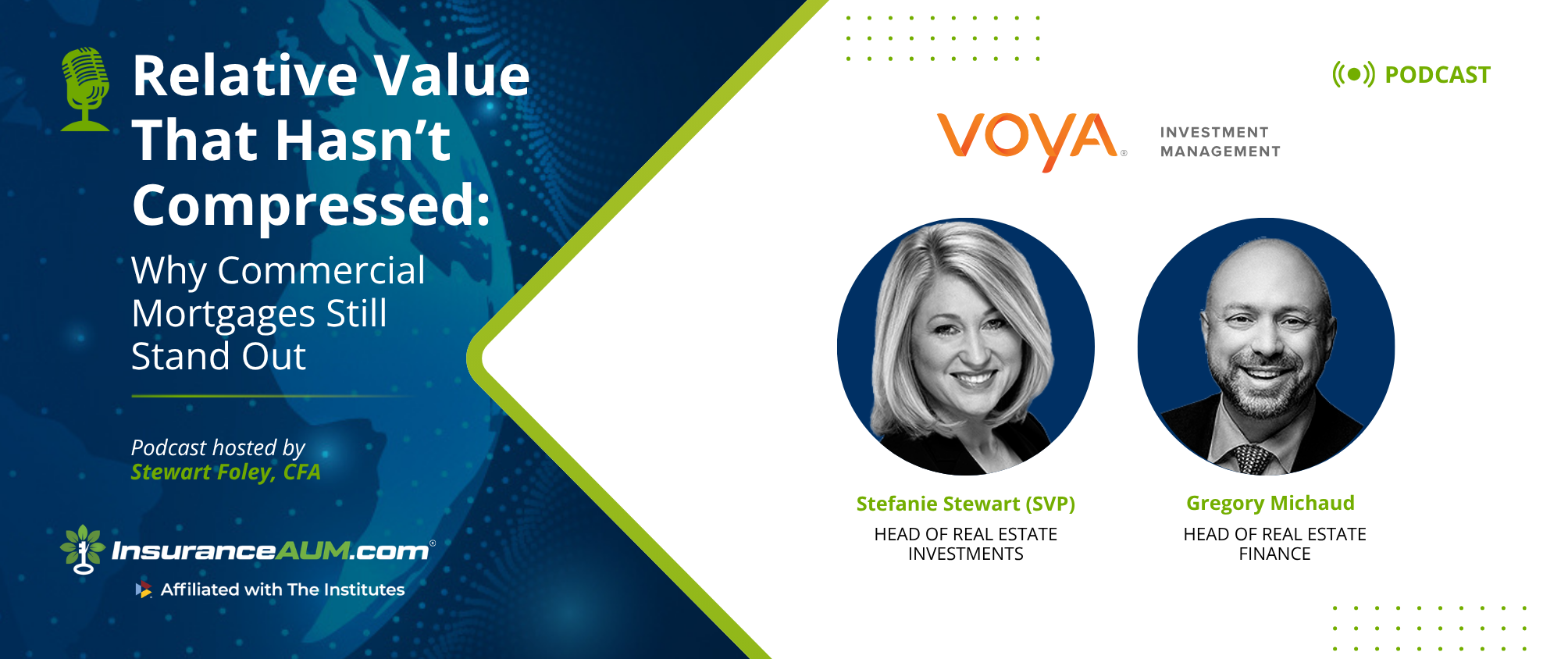
Relative Value That Hasn’t Compressed: Why Commercial Mortgages Still Stand Out

Image
05.19.26 Voya_Web

Stewart: My name's Stewart Foley, CFA, and I'm your host, and we're thrilled to have you with us today. We've got a great podcast. I want to thank our team again for all of the work that they do in making this an award-winning podcast. As I've mentioned on the last couple podcasts, I get way too much credit for this. We have a really strong team that puts this all together, and we're grateful for The Institutes support as well in helping us with our distribution. And so we're very happy here to talk today about fixed income, and that is the meat and potatoes of insurance asset management. And in fixed income, relative value tends to get arbitraged away pretty quickly, but every once in a while, you get an asset class where spreads haven't fully compressed and underwriting discipline actually improves at the same time.

The title of today's podcast is Relative Value That Hasn't Compressed Why Commercial Mortgages Still Stand Out. And I'm joined today by Greg Michaud, Head of Real Estate Finance, and Stefanie Stewart, Head of Real Estate Investments at Voya Investment Management. Greg oversees sourcing, underwriting, and portfolio management across Voya's commercial real estate lending platform and serves on multiple credit and leadership committees. He brings decades of experience across appraisal, underwriting, and credit. Stefanie leads Voya's real estate organization platform and oversees a team producing approximately four billion in commercial mortgages across the US, spanning core, bridge, and construction lending. Greg and Stefanie, welcome to the show.

Stefanie: Thank you. Thanks for having us. Good to be here.

Stewart: We're very happy to have you here, both of you. This is going to be a good podcast because it's a very interesting asset class. It's center of the fairway for the insurance community, and I want to get after it here. But before we go there, we always start the same way, which is a little bit of background on you both. So I'll start with you, Stefanie. Where did you grow up? And if you weren't doing this job today, what job would you most like to have instead? And what job would you be terrible at?

Stefanie: So I grew up in a small town in South Alabama near Gulf Shores, right at the Florida Alabama line. And I would like to think I would be doing something in real estate because I fell in love in real estate in college when I was managing student housing. However, I do think I'd like to teach, and I wouldn't have always said that to be true and preferably college, not the younger, but a job I would be terrible at. I would not be a good waitress. You do not want to take in your order.

Stewart: You know what? I can relate to that. I was a college prof for seven years, and it is incredibly rewarding. I've had a number of people say to me, "Yeah, I'm thinking about doing that when I retire." I said, "Well, I'll tell you what, you'll be working harder then than you are now because if you do that right, that's a really tough job." But passion for it makes all the difference.

Stefanie: I enjoy the opportunities we get to be guest speakers, and so it is rewarding.

Stewart: Absolutely. All right, Greg, we're going to you. How about this? Where'd you grow up? And what job would you most like to have, if not this one, and what would you be terrible at?

Greg: Sure. I grew up in Jacksonville, Florida, and my family had come from the Northeast, so it was a little bit of a shock to move there in the 1970s, but it was definitely an interesting experience coming from Connecticut. What job I'd like to have? When I got into real estate, I initially was doing urban regional planning. I was a draftsman, and I really liked that aspect of real estate. And I think helping plan cities properly and things like that would be really interesting to me. And I'll go with Stefanie. I definitely love to teach a little bit. Both of her and I went to Florida State and were very active going down there lecturing, and we always enjoy doing that. And the job you wouldn't want me doing, a job where I had to actually sit in front of a computer for five days a week where I had to read stuff. So that's why I love real estate. You're not in the office and you're out in the field quite often.

Stewart: I love that. That's awesome. So let's start with framing the current market. To kick things off, how do you frame the current market environment for insurance investors? And why do you describe this as one of the stronger underwriting vintages in recent years?

Stefanie: I'll kick it off. I think it's a good time to invest. I mean, property values are still down 15 to 20% from the peak. Cashflows are improving. We've seen some relief on expenses. We have seen some relief on interest rates. And to your point in the cycle where we sit today, I do think it's one of the strongest underwriting vintages. I think part of that is both lenders and borrowers. We just came out of some pretty significant stress. We came at a time where interest rates increased rather rapidly at the same time that we saw expenses increasing and rent growth was subduing or even going negative in some areas. And so that's a really bad combination. And I think that's still fresh on both borrowers and lenders' minds. When my team receives a debt package to underwrite today, the pro formas from borrowers are a little bit more realistic and take into account some of that.

And I think the underwriting from lenders are holding firm. So for example, there's not a multifamily deal that comes across my desk that doesn't underwrite some concessions in bad debt today. That wasn't always a thing. We are seeing some stress on cap rates and underwriting and some more realistic expectations from borrowers on cap rates and where that trades. And the other thing I'll hit on is structure. Structural erodes in a market where times are really good and things are hot and heavy, we're seeing structure really hang in there. And specifically on bridge loans, cash management's still there with triggers that are acceptable. We're getting reserves at closing. We're getting replenishment guarantees on those reserves and guarantees for shortfall, for debt service and for OpEx. So structure is still very strong. And if you're a lender, you expect it, and if you're a borrower, you anticipate it.

Stewart: That's really helpful. I do think it's interesting that even though we're all supposed to be institutional investors and smart and not dumb money and whatever else, when things are priced to perfection, we tend to like them better than when they come off 20%. And you go, well, if you loved it at 50, you ought to really love it at 35 or 40, but sometimes we have trouble getting over that hump. And I think you're making some great points here. And this is kind of on the back of it, which is why does this moment represent a compelling entry point versus waiting? And the question's a little odd to me because insurance companies don't have the luxury of waiting. You call up an insurance company, you go, "I want to buy auto insurance." Nobody says, "Hey, it's not a good time right now. We're going to wait till rates move and then we're going to write more auto insurance." They don't do it that way. And so this concept of timing is odd to me. But can you talk a little bit about what makes this a compelling entry point in addition to the things that you just discussed?

Greg: Yeah, I'll start off on that. And I think Stefanie hit it, the valuations are still down off some peaks and you always want to get into there. Now, we're not market timers, meaning, “hey, we're coming in when we think rates are ...” We're always constantly in the market. We have through the underwriting real estate. So we're constantly in the market. We just think now is a good opportunity. And we think definitely from a relative value perspective, that is very compelling. And we've seen the other asset classes. I sit on the investment committees at Voya and you've seen the spreads tighten on these investment classes and you've seen a little bit of tightening. And Stefanie, I'm sure could talk about how she's seen that over the last, call it 36 months. However, on a relative value basis, we're still 100, 120 basis points over a comparable bond where you've seen the other asset classes tighten.

And that's been very consistent throughout the last several years. And so we think that's a very compelling point where the other asset, when you're comparing on a relative value basis to other asset classes, this is a good entry point right now. So from the valuation perspective, but also from a relative value perspective.

Stewart: Yeah, it's interesting. And relative value is kind of my next point here, which is relative value is clearly a key theme. And it's not for commercial mortgages, it's for everything in the investment portfolio of an insurance company. And I think that it's an interesting Rubik's Cube. And honestly, I'm going to show you this. We have Rubik's Cubes, by the way. We had them done for insurance asset management. It has all these different complexities on there, right? But commercial mortgages, why do they still stand out versus comparable bonds and alternatives? As I mentioned at the top of the show, it seems like that would get arbed away. So how do you evaluate that without chasing headlines?

Greg: Steph, I'll let you add on to this, but I think we're still at a good point in the cycle for real estate. And I think it was a very challenged market in the fact that there wasn't a lot of liquidity in the space, meaning nothing was selling. And you still have this, you still have a lot of redemption queues, cues in the ODCE funds, and those are the big holders of institutional real estate where we do a lot of our core lending, and that's starting to loosen up. And so you're starting to see sellers capitulate, developers capitulate. A lot of these developers or owners of real estate, they don't make money just holding onto the real estate. They make money on promotes and things like that. So at some point they have to capitulate, and that's what you're seeing now. You're seeing that liquidity. So it was a great story.

I think our spreads were great a couple years ago. However, there's no liquidity in the market. There's nothing selling, so therefore there's nothing to finance. Well, now you're getting to that point where there's good relative value, there's liquidity in the market, redemption cues are starting to loosen up, and so there's good deals to finance. So I think you've got those two things combining to make this a really good point in the market to lend.

Stewart: So let me unpack a couple of things there that I don't really know what they mean. I think you're saying redemption queues. Is that right?

Greg: Yes, that's correct.

Stewart: Can you tell me what ... I think I know what that means, but for our audience, can you unpack what that means?

Greg: Sure. So you have the ODCE Fund Index is the big index that tracks the equity funds that hold real estate. And when we got into rising rate environments and we saw some stress in the real estate market several years ago, a lot of the investors came in saying, "I want to redeem." Well, most of these funds, it's real estate, so it's not very liquid. And in order to protect yields and to protect the other investors in the fund, they had redemption queues come up, which means we're not going to go sell into a bad market right now. And that's primarily because a fair amount of these funds had office and office is an asset class, still challenged, but it's starting to loosen up right now. And so now they're able to go in and go ahead and sell real estate, not at the bottom, but at a point where they think it's not harmful to the fund or the investors in the fund.

So that's what you had going on. So when you have a lot of these funds that not going to go sell anything, obviously that impacts the debt markets because there's nothing to finance.

Stewart: Okay. So let's talk about this rates and underwriting discipline. So interest rates remain top of mind. And we talked about, I did a podcast yesterday, we talked about this. So interest rates are not being impacted only by macroeconomic factors, but there's also macro geopolitical factors as well. And today's rate environment is different than 2022, a lot different. So where do higher rates create challenges? And with that, talk a little bit about underwriting discipline.

Stefanie: In 2022, it was a very different environment. We saw LIBOR, I believe, at 10 basis points in January shot to over 4% in December and peaked in the mid-fives, the floating rate index in 2023. So it was a lot of disruption in a very short amount of time. And you saw similar with the fixed rate business with Treasury. The market just needs less volatility. And I'll use the 10-year fixed rate for an example. I think today it's hovering around 4.30, 4.40. A 4% or a four and a quarter 10-year fixed rate treasury is not a bad rate. And if you look back historically, that works. It's not that deals will not pencil at that level, but when you have the rapid increase, when you have the volatility ... In 2023, we had swings that treasury corporate bonds were moving pretty violently over two or three-day period.

It's really hard for lenders and borrowers to pencil deals when it's so volatile. And so I think the market really just needs consistency in rates for us to get that increase in volume. And we saw that in fourth quarter of last year and even the beginning of this year. Our pipeline was the strongest it's been in years, fourth quarter last year. And it's because we had actually seen probably a six-month period of rate stability. Borrowers may not have liked exactly where rates were, but the fact that they were stable provided a lot of confidence in the market.

Stewart: Okay. So I got to ask you to unpack some stuff. What does it mean when you say a deal pencils?

Stefanie: So if you're a borrower trying to make an acquisition and you're underwriting that based on the cost of debt at a 3% treasury, and in a matter of 30 days, that increases by a hundred basis points. That's going to impact the cost of your debt and the value of your property immediately. So by the time you line up your debt provider and your equity provider and the numbers move on you that quickly, everybody's got to scrap it and start over again. And that's a lot of what we saw and a lot of, I think, the reason the market just really froze.

Stewart: I want to go a little farther here. So when you say pencil, it's slang for the cash flows and modeling of the deal don't work.

Stefanie: Absolutely.

Stewart: Giving your underwriting discipline and your return hurdles and your risk return discipline, that's really what we're talking about there, is that when rates are higher, it makes a deal harder because when rates go up, real estate values, all things being equal go down. Absolutely. Is that fair?

Stefanie: And when the cost of your capital goes up, it increases your cashflow. And so if a lender is underwriting to a 1.25 debt service coverage ratio, we'll throw that out there. For example, your loan proceeds just got cut when your rate moved a hundred basis points.

Stewart: Yeah. So the debt service coverage ratio, would it make sense to just talk just with general terms of what that metric measures?

Stefanie: Sure. It's just your NOI, your net operating income divided by your annual debt service payment.

Stewart: Right. So it basically tells you how comfortably you can cover your debt. Is that fair?

Stefanie: Absolutely.

Stewart: Yeah. Okay. All right. Platform and sector opportunities is the next item up for bid here. And the question is, how does Voya's lending platform differ? It differentiate itself across core bridge and construction, which I need some help with definitions there. And how does that breadth allow you to navigate today's market? And I think tacked in here someplaces, where do you see the opportunity? What's more compelling across there?

Stefanie: Yeah, I can start with the program and then Greg, let you hit on some opportunities, but our platform really covers the spectrum. So about 50% of the capital my team will deploy annually is going to be on stabilized core product. And so when I say core product, think that is a stabilized asset with no real business plan and typically lower leverage. Maybe it's 55% loan to value, maybe 60%. We can do that on fixed rate. We can do that on floating rate, which provides ultimate prepay opportunities for borrowers. We have short-term money, which became very popular after the rate hike in 2022, and then we have long-term money. The other 50% of the capital that my team will deploy, we refer to as the transitional bridge product. That may be an asset with a business plan. So it might be a vacant building that needs capital for lease-up.

It may be a property that knows that it has a large tenant rolling. You need some sort of business plan and capital to stabilize that asset. We also do a little bit of opportunistic. We'll do some construction. We'll do some mezz. We like to think we've got a lot of products that are on the shelf that we can pull off when the market timing and the opportunities right. But I think what makes us unique about our program is the large menu that my team has to offer when you cover all of those debt products, that keeps us active in the market. I think I heard Greg say, we play all four quarters. We're always in the market, but that helps us stay relevant through cycle. So I'll give an example recently. When rates spiked in 2022, the insurance core business borrowers went from being 10-year fixed rate lenders to five years or shorter, it felt like overnight.

No one wanted to lock in those interest rates for long-term debt. So we did see a lot of our competitors have to slow down of the capital they could deploy or pull out of the market because they weren't able to pivot to the shorter term debt. That kept us in the market through that cycle and we were able to get some pretty good spread premiums as a result. Also, it gives us a unique opportunity to capture business. So we've taken the core stabilized loan that was maturing on our books that maybe had a capital event, a tenant that was rolling. We were able to refinance that on the bridge side and help them through that business plan and then vice versa. We've had really successful transitional loans that have completed their business plan that I could capture that business on the refinance on the core side.

Stewart: So I want to make sure I understand that. So when you say core and it doesn't have a business plan, that says to me that I think what you're saying there is this is sort of a established business. It's a going concern. You can forecast the cashflow easily, it's dull, it's reliable, right up, whatever. And then when you talk about bridge is you're really talking about when you say it has a business plan, it's like the thing is not working right now, but the idea is that we can deploy capital and we can turn this into a business. And when you say you have a large tenant rolling, that means that you have a large tenant who's been paying you rent for this building for however long, and they're going to go someplace else creating a vacancy in that property. I just want to make sure that everybody knows what we're doing here.

Stefanie: Absolutely.

Stewart: And that's super helpful. I mean, some of our listeners are really steeped in the tee and others of our listeners aren't as steeped in the tea in various sectors. So I just try to unpack that. And I get some nice comments saying, "Hey, I like it when you do that. " I'm like, "Yeah, I know. " Because I was like, "I want to make sure I know what she's saying." So Greg, when you look across that spectrum, and I think it's a great point that when you've got more arrows in your quiver, you can stay in a market as it evolves, but what are you seeing right now, Greg, as far as the most compelling opportunities across there?

Greg: Great question. So in January, I actually had some good meetings in New York with insurance companies. Quite frankly, they didn't really exist in the last five years. These are all new insurance companies that are getting into the business. And we all know in the insurance business that you've had a lot of these private equity firms create these insurance companies. And when you talk to several of these companies, they recognize that, and Stefanie can opine to this, that you've got a little bit of a food fight in part of the relative value market where quite frankly, I don't know if there's good relative value. And they're like, we could go after these transitional apartment bridge deals and the market's very flooded. Everybody's chasing those deals. The CRA, CLO guys are in that space and it's hard to compete with them because they're going off putting three times leverage on these deals.

And so when Stefanie wants to go chase that business and go put it on book without a lot of leverage, it's hard to win that business. I can't price perfection when someone's at three times leverage, just the relative value doesn't shake out. So they've challenged us with, well, where do you think there's some good relative value? And I think when we look at other areas outside of apartments, we've done some C-PACE deals. We think that's been a good relative market, value market. It's you're super senior to anything in the stack and

Stewart: Your area- Hang on, hang on, hang on. What's a C-PACE deal?

Greg: Sure, sure, sure. Yeah, I sure start off with that. So C-PACE deals are lending programs run by municipalities. Now the state approves it and it's really meant to bring up the efficiency of the building. So it could be energy efficiency typically. So if you go into hotels are big prime users of this space, so they'll go in, put new HVAC systems in, new windows, anything that improves the energy efficiencies of these buildings, that's what that loan is being used for. So if a hotel's a great example. So hotels in a five to 10-year period, the flag's going to come to a hotel owner saying, "You need to upgrade the hotel. You need to put in new soft goods, things like that. " And that's the opportunity for them to come in there and upgrade the operations of the hotel. So if you can help save on electricity or for a operating business like a hotel that's got a lot of fixed costs, if you could reduce those fixed costs by putting in energy efficiency, it's great for the property.

So these programs are administered through the municipality. And so you have lenders out there that go in lend for these improvements and it's paid through the taxes on the property. So we think that's a very good area of the market. You can get maybe a little bit longer term on those deals. It's super senior, it's a niche market, but I think it's a growing market. Other areas that we like, we love the construction loan area and the triple net lease space. That is a very liquid market due to the 1031 exchange market. And so the 1031 exchange market is where owners of real estate can sell their real estate, roll it into another piece of real estate without paying the taxes on it. So you have this very liquid market and they tend to like these triple net lease deals. So it's a lot of smaller developers or smaller owners of real estate that think that market's good.

So we like that construction loans or mez in that space because it's a very liquid market. So really anything outside of multifamily where we think there is good relative value is what we're looking at.

Stewart: And a triple net lease, I think I know what that means, but is that where the tenant is paying the real estate taxes and so forth?

Greg: They pay for everything and there's various definitions of triple net, but for the most part, the tenant's paying all the expenses. So really as the owner of ... So you may have a group that goes in and buys a bunch of out parcel restaurants. And so all they're really doing is collecting the rent check. And that's why it's very attractive to a lot of real estate investors, especially small ones, because it's a coupon, what I would call a coupon clipper. You're just getting that check every month, you're not dealing with the expenses and everything. And the other thing that really, Stefanie hit on this earlier, when you saw a lot of expenses hit the market, insurance increases really pummeled the multifamily market. Well, multifamily marks to market every year on an annual basis, so it's really hard to get those expense increases pass through to tenants.

Well, on triple net, the moment expense increase hits, the tenant's paying for it directly. So we've saw those actual asset classes that have that triple net lease in place. Industrial is a prime example. It didn't see the same stress as you saw in multifamily.

Stewart: Somewhere back back when the earth was cooling and I was in my twenties, I think that Walgreens uses that. I mean, when you see a Walgreens, you assume that they own that building, but they don't. Somebody else owns that building and it's a triple net lease so that Walgreens doesn't have to use their capital to build that building. It's somebody else's capital and they're essentially renting that infrastructure.

Greg: Yeah. And you've seen Home Depots, Targets. I mean, it's that retail sector, but we really think that's a good sector, especially on construction loans or mez construction in that space because there's a very liquid market for that takeout. When that property gets built, so your risk is the construction of the property, when it's built, there's a ready market out there, these 1031 exchange groups out there that want to buy that stuff.

Stewart: Yeah, that makes good sense. So let's talk about how do we define good risk? And selectivity has come up a few times. And I just want to go and talk about how do you define good risk today versus things that just simply aren't worth taking on?

Stefanie: So when we are identifying good risk, we do have a proprietary rating model that my team uses. And what that does basically is that's going to take a real estate loan and spit out a corporate bond equivalent credit rating. It takes a lot of different factors into account. So it'll take into account loan to value, it'll take into account cashflow. We stress the debt service coverage ratio, we'll stress a refinance test. How much cashflow do we have in order if rates go up a hundred basis points, 50 basis points, how much cushion do we have? It'll take into account borrower strength, market strength. So if that spits out an A minus rating, then I can go figure out if the market is pricing that accordingly. And as Greg referenced earlier, we've been able to get about a hundred basis points over a comparable A minus bond, which we think is really good relative value.

On the risk spectrum, we're chasing that space is really on the bridge side and transitional. And so when we look at some of that space, what's good risk versus what's bad risk? It really comes down to how much leverage am I taking? What kind of structure can I get and what's that overall relative value? What does that spread to ... Typically you see a bridge deal, we'll rate a corporate bond equivalent, that credit risk rating is typically BBB, maybe a BBB minus. And are you getting paid enough to take that risk?

Stewart: And this question is an interesting one. I've been asking it recently. When insurers are looking at commercial mortgage loans, CMLs, and you talked to a bunch of different insurers, is there any consistency about misperceptions out there? Do you get the same question with some frequency where you go, you need to explain an aspect of this asset class that folks don't necessarily understand or they don't or that they haven't considered? I do think, and part of the reason I ask this question is that you talked a lot about how this market's changed in the last three years, and even there's legacy asset, there's asset classes that I have an outdated view of. I'm not current on the market today. So can you talk about, are there things that folks where they're missing part of it or don't understand the asset class or misunderstand parts of it?

Greg: Yeah, I think we talked to different insurance companies. So you have P&C, you have workers' comp insurance, you have life insurance, and there's obviously different capital regimes. And so your question that you get may vary based on if you get a question from a P&C or a life company, because it's different capital charges, shockingly enough, to this day, I'm not sure why, but the P&Cs have more punitive risk-based capital charges. And so they're going to ask a lot more questions about risk because they're going to want more risk or they're looking at risking your deals. And then even when you get in that space, the insurance companies, the life insurance companies are going to tend to want long duration where the P&C or the other insurance companies are more comfortable with the shorter stuff. And I think the perception right now that has changed and Stefanie hit on it, before rates, it was a 10-year market.That's kind of where this market was.

In my 30-some-odd years of doing real estate, 25 of it, I could count on the majority of our loan production being 10 years, and that's really changed. And I think that perception is still a 10-year market. So when you go talk to a life insurance like, "Oh, I can't wait to get all these 10-year deals." And we're like, "Well, how do you like five?" Because that's really where the market is right now. Now, I do think that as rates stabilize out, you'll start seeing that kind of push out, but that right now is the perception right now. People still look at it like it was five years ago before rates moved that it's a 10-year market. And I'll add, it does add a varying degree of risk that you always have to consider because instead of a loan being a 10-year deal where you might have some amortization, and Stefanie talked about it, we look at the refinance test that really goes into our ratings model.

Well, 10 years with amortization is going to give you a different risk profile than five years of IO. And so I think that's the conversation you got to have. And I'll finally add, the only person that it's really working for that moved everything are the mortgage bankers because these are the guys that would go out and finance deals. They get paid a fee once every 10 years. Now they got their fee twice in a 10-year period. And what the borrowers kind of misunderstood on that whole thing was they assumed rates were going to come down, so they'd be able to refinance, but the friction cost to do a commercial mortgage loan is pretty substantial. So the only guy, it's not working for the borrowers. I don't think it's working for a lot of lenders that want duration, but the mortgage bankers really love it because they really doubled their fees.

Stewart: That's interesting. And just to unpack a term there, when you said IO, that means interest only. So in the five-year deals, you're not paying principal, which means you're not amortizing the loan.

Greg: That's correct.

Stewart: Yeah. So to close, what should insurers be reevaluating right now as they think about portfolio construction and long-term partners? I think that you've got a long, long history here in this asset class, which I think is valuable to insurers. I mean, insurers make long-dated promises and they appreciate longevity and they appreciate consistency. I think part of what you're experiencing right now with this 10 to five movement is that uncertainty is hard to price. It's hard to price what you don't know, particularly with the geopolitical volatility. So can you talk a little bit about looking forward, how should insurers be evaluating this right now?

Greg: Sure. As you said, we've been in the market for a long time. I've been here for 30 years. The program has been here for well over 80. And so one of the things we talk to our insurance company clients, we emphasize the fact that we're an insurance company. We do strategic asset allocation work. We look at it on a relative value basis, and we like to say we eat our own cooking. So we go do a $30 million loan, a piece of that Voya keeps, and then the other insurance companies get. And so we're able to say with a straight face, we think there's a good relative value, we think this is a good fit for our SAA work, and we think it's good in that model. And so we're able to emphasize that. The other thing that I think that is interesting that we're seeing, you have a lot of non-insurance company investors in the space, and some of them are great and some of them are, it's interesting.

They create these funds that kind of have its quote, I'm going to use my air quotes, look through treatment to a CM2, so favorable capital treatment. But now we're seeing, we were with an investor this week, another insurance company, and he's bemoaning the fact that now he's seeing these funds have residential mortgage servicing rights in these funds that, hey, this is a CM2. And so my point of that whole thing is you got to be very careful as we get people's trains stretch for a yield, they stretch for risk. Are they doing the right thing or are they doing the smart thing? And so for us, we look at things from an eye of an insurance company and we never want to do anything that's going to jeopardize that risk-based capital charges because we know that's very important for insurance companies. So you're starting to see some players come in that are making some questionable choices.

After all, if you have a commercial mortgage loan fund and now all of a sudden you have residential mortgage servicing rights in it, I'm not sure that's in the spirit of where we should be investing.

Stewart: Yeah. I mean, I think that style discipline matters, right? Yes. And one of the things that's different between retail and institutional is you hear people who go, "Yeah, I bought this stock and it went up and ... " And it's like they don't understand that institutional investors have investment policy guidelines. And when you hire a manager, you want them to do what you hired them to do. And so that makes total sense to me. One of the things I want to just touch on, and it is in the back of minds of people who make allocation decisions when there's an insurance company owner and an asset manager, there are people who say, "Oh yeah, they're cherry picking the best loans for the mothership and I'm getting what's left." And I know for a fact, having worked in the asset management industry and being owned by an insurance company, that that allocation process is highly regulated and it has to be fair. Can you kind of back me up on that a little bit?

Greg: Yeah. Yeah. Well, first off, the majority of the insurance companies we invest for Voya invests alongside. So there is not that cherry picking. Now, there are some insurance companies who are like, "Hey, we want to have our own whole loan." They want to go to the Federal Home Loan Bank with it. There's a variety of reasons why they may want their own whole loan. And you have to be hypervigilant if that's the case. And we have some clients that do that, that want that, that you have to have a good rotation policy in place. And so I think the way we do it, so Stefanie could tell you, she'll bring a deal in. We go through our credit reprocess. We have no idea where that deal's going to go. She's trying to find the best deals out there. Then once we approve it and underwrite it, then it goes into the rotation and then we'll figure out who gets it.

So there's not that cherry picking going on. We're making sure whatever deals coming in is high quality and could fit for whatever investor we have, whether they're getting a whole loan or they're getting a co-investment with Voya. So irrespective, we're making sure that funnel that's coming in is getting the best deals. But the way we have our policy set up is we want to make sure that that rotation, Stefanie's not sitting there going, "Hey, we're going to try and give this deal to this one investor." We just don't know until the underwriting's done. And it is a SEC regulated policy. We have compliance coming in and checking on it. So we take that very seriously because we want to be good stewards of people of insurance companies' money, and this is one of the key aspects of how you do that.

Stewart: Yeah, it's super helpful. It's been a phenomenal education on commercial mortgage lending today. I really appreciate you both being on. We've got a couple of fun ones for you on the way out the door, and I want to go to Stefanie for this. The question is really intended to get at the culture of Voya and you've had a long and successful career in this industry and you've hired people on your team. What characteristics do you look for when you're adding to members of your team?

Stefanie: Great question. We're growing the team now. Look, we're collaborative. Everything we do, and I say team and I mean that because there's no deal one makes it through investment committee without collaboration and teamwork. So I want a team player and I want someone who is inquisitive and curious. A lot of our job is solving problems. We're trying to solve a problem and provide a solution for the borrower with the right structure and leverage and pricing for our investors. So I'll say a team player, collaborative and inquisitive and curious.

Stewart: Yeah, I love that. That's awesome. All right, last one. You can have dinner. When we have two guests, you each get one choice. It's dinner for four. Dinner's on us. I haven't gotten that approved yet, but I think it is. Who would you most like to have dinner with alive or dead? Stefanie, what do you think there? By the way, hang on just to make sure you know, it's you and Greg and you get a guest and Greg's going to get a guest. So just with that as a backdrop.

Stefanie: Okay. Well then I'm going to go, if I'm having dinner with Greg and I'm going to stay on the team mentality, look, I run a team and a competitive business. I am always amazed at coaches who go get a team from various backgrounds and that they bring them together, they lead them, they inspire them, they motivate them, and they get the buy-in to be successful. So I'm going to go coach Bobby Bowden from Florida State because that is near and dear to our heart. And I think that'd be a great dinner guest with Greg.

Stewart: All right, Greg, it's up to you. It's you, Stefanie, and Bobby Bowden. Who's coming with you?

Greg: I was going to go with a history person, but I may have to adjust that. So if we're going to go with the sports themed, I don't know. Irrespective of the problems he had, you have to throw Joe Paterno in there with Bobby Bowden and just really talk about how college football evolved because they were the two individuals that evolved college football. Bobby Bowden went out and was like, "Look, I'll play anybody anywhere in the country and I'm going to have speed." And Paterno was more of the Big 10, the big guys on the lines, but he eventually evolved to compete with the Bobby Bowdens of the world. So I think having those two coaches there to talk about how they evolved the sport would be the best dinner.

Stewart: I really appreciate it. Thanks so much, Stefanie and Greg for sharing your wisdom with us today, and I really appreciate your time. Thank you.

Greg: Thanks for having us.

Stewart: We've been joined today by Greg Michaud, Head of Real Estate Finance and Stefanie Stewart, Head of Real Estate Investments at Voya Investment Management. If you like what we're doing, please rate us to like us and review us on Apple Podcasts, Spotify, or wherever you listen to your favorite shows. You can also watch this podcast on YouTube, on our YouTube channel at InsuranceAUM Community. My name's Stewart Foley. I've been your host. This is the home of the world's smartest money at the InsuranceAUM.com podcast.

Share this post

Sign Up Now for Full Access to Articles and Podcasts!

Unlock full access to our vast content library by registering as an institutional investor

Register

Contacts


Voya Investment Management

Voya Investment Management is a leading authority in insurance asset management, bringing the capabilities of a large institutional investment manager with proprietary insurance balance sheets to small and medium sized insurance companies and key strategic partnerships. As the manager of a large and complex proprietary life insurance balance sheet, we extend every resource committed to that undertaking to our third-party clients. Our deep insurance resources and expertise, investment process and infrastructure built especially for regulated balance sheets, and our high touch client engagement model are all key differentiators versus our competitors.

Voya Investment Management is the asset management business of Voya Financial (NYSE: VOYA), overseeing $333 billion in assets for institutions, financial intermediaries and individual investors as of 06/30/24. Voya Investment Management assets are calculated on a market value basis and include proprietary insurance general account assets of $31 billion.

Michael Alvarez, CFA

Managing Director, Head of Insurance Solutions
Michael.Alvarez@voya.com     
770-690-6709

 

View the contributor page
 

Sign Up Now for Full Access to Articles and Podcasts!

Unlock full access to our vast content library by registering as an institutional investor .

Create an account

Already have an account ? Sign in

Ѐ Ё Ђ Ѓ Є Ѕ І Ї Ј Љ Њ Ћ Ќ Ѝ Ў Џ А Б В Г Д Е Ж З И Й К Л М Н О П Р С ΄ ΅ Ά · Έ Ή Ί Ό Ύ Ώ ΐ Α Β Γ Δ Ε Ζ Η Θ Ι Κ Λ Μ Ν Ξ Ο Π Ρ Ё Ђ Ѓ Є Ѕ І Ї Ј Љ Њ Ћ Ќ Ў Џ А Б В Г Д Е Ж З И Й К Л М Н О П Р С Т У Ф Х Ц Ч Ш Ā ā Ă ă Ą ą Ć ć Ĉ ĉ Ċ ċ Č č Ď ď Đ đ Ē ē Ĕ ĕ Ė fi fl œ æ ß