

T. Rowe Price -

Why the AI Capex Cycle is Built to Persist

TRPFeatured

David Eiswert - Portfolio Manager, Global Focused Growth Equity Strategy


Key Insights

  • The scale of AI‑related capital expenditure (capex) represents one of the largest and most consequential investment cycles in modern corporate history. It is better understood as a competitive necessity than a discretionary boom.
  • Hyperscaler investment decisions and future returns on investment are likely to arrive unevenly and with a lag. However, the option value of staying in the race combined with supply bottlenecks helps explain why spending can persist even when near‑term economics are debated.
  • The key question is whether the forces sustaining the game‑theoretic equilibrium remain intact, namely competitive incentives, structural supply constraints, disciplined capacity allocation, the persistence of scaling laws, and measurable progress in monetization.

The rapid acceleration of artificial intelligence (AI) has pushed capital allocation into uncharted territory. Annual investment in AI infrastructure by hyperscalers is expected to exceed USD 600 billion1 in 2027. For investors, the natural question is whether this surge represents rational, value‑added investment or the early stages of overcapacity and potential capital destruction. 

We believe the AI capex cycle is poorly framed through a traditional boom/bust lens. Instead, it resembles a structurally enforced equilibrium, shaped by competitive dynamics, physical supply constraints, and the persistent economics of scale. Understanding these forces is essential for identifying where long‑term opportunities may emerge as the cycle evolves. Drawing on Nash equilibrium2 dynamics, kinked demand and inelastic supply, internal capacity trade‑offs, durable scaling laws, and the gap between value creation and capture, our analysis suggests that this cycle can continue for another two to three years before facing its first true test. The greater risk lies in monetization lagging investment, creating volatility in sentiment despite the persistence of the strategic rationale. 

A competitive equilibrium, not a spending frenzy

Hyperscalers face a binary choice: invest aggressively in AI infrastructure or risk falling behind. Crucially, aggressive investment remains the dominant strategy regardless of competitor behavior. Pulling back while rivals accelerate risks ceding monopoly‑like economics, forfeiting strategic control over the platform’s trajectory, and missing the next platform shift—costs that compound materially in tail scenarios where capabilities scale toward more agentic systems. This dynamic creates a Nash equilibrium, in which sustained capital expenditure is rational even if near‑term project‑level returns compress. 

Importantly, the large hyperscalers possess the financial capacity to sustain this equilibrium. Hyperscalers are cash‑generative businesses on a scale we rarely see, with net cash balance sheets and, in most cases, high margins in their core franchises. In this context, capital discipline is less about absolute spending levels and more about maintaining strategic relevance in a rapidly scaling ecosystem. The implication for investors is clear: Persistence of capital expenditures is the base case, so the key is to find who can translate spend into defensible economics.

“...our analysis suggests that this cycle can continue for another two to three years before facing its first true test.”

Why supply expansion has not collapsed prices

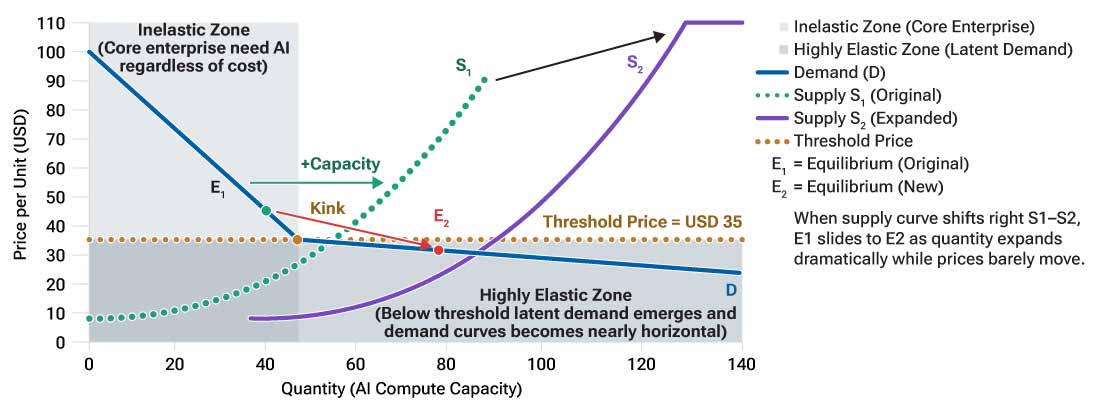
AI compute pricing has been more resilient than many expected despite massive capacity expansion. A kinked demand structure3 helps explain why (Figure 1). Above a threshold price (in this example, USD 35), demand is relatively inelastic because enterprise and strategic users treat AI as mission critical regardless of cost. Below that threshold, latent demand emerges rapidly, as experimentation, new use cases, and internal model training workloads become more economically feasible.

On the supply side, constraints remain acute. Power infrastructure lead times currently stretch three to five years. Advanced semiconductor fabrication requires multibillion‑dollar investments and extended construction timelines. Meanwhile, memory, networking, land availability, and permitting further restrict how quickly capacity can scale. In this setting, incremental supply often raises volume more than it lowers price, a modern Jevons Paradox.4 The kinked demand curve explains why the Jevons Paradox operates so powerfully in AI compute. Once price falls below the threshold (USD 35), the nearly horizontal demand curve (D marked in blue) means any supply increase is immediately absorbed by latent demand. Consumption expands to meet capacity with minimal price impact. For investors, this dynamic suggests that fears of an immediate price collapse may be overstated. The binding constraint is not demand, but the physical and logistical limits of expanding supply.
 

Why the AI thesis can be maintained as long as equilibrium remains elastic
(Fig. 1) The kinked demand curve explains why the Jevons Paradox operates so powerfully in AI compute (illustrative)
Image
Graph detailing usage of AI

Source: T. Rowe Price analysis. Actual outcomes may vary.
 

Capacity allocation: The internal trade‑off

Scarcity introduces a second‑order decision: how to allocate limited compute across competing priorities. Broadly, capacity is divided among three uses: revenue‑generating services, internal product enhancement, and long‑term research and development (R&D). The mix changes by phase, but R&D remains a competitive floor rather than a discretionary choice. The trade‑off is brutal because there is little slack. Every graphics processing unit (GPU) hour allocated to external revenue generation defers capability development, while every GPU hour devoted to model training defers near‑term revenue. Leaning toward R&D can deepen the long‑term competitive moat at the expense of near‑term margins. Those who choose to prioritize revenue may improve short‑term economics, but risk ceding long‑term leadership if R&D investment falls below the competitive floor. 

This “Red Queen” dynamic,5 running simply to stay in place, helps explain why capital discipline is difficult to enforce across the industry. From an investment perspective, it also highlights why differentiation among winners and losers will increasingly hinge on execution, efficiency, and regulatory positioning rather than on headline spending levels alone.

Scaling laws and the case for persistence

The economic rationale for AI capital expenditure ultimately rests on scaling laws. Empirical evidence from leading research institutions shows that model capabilities have improved in a predictable manner as compute has increased. As long as incremental compute continues to deliver materially better models, the incentive to invest remains intact. Historically, each order‑of‑magnitude increase in training compute has produced meaningful gains in capability.

Three broad scenarios lie ahead:

  • If scaling laws continue to hold, the current investment cycle could extend several more years, with expanding enterprise value justifying infrastructure costs.
  • If returns diminish sharply, whether from data constraints or algorithmic efficiency gains that reduce compute needs, rationalization could arrive sooner and some infrastructure could be underutilized.
  • A third possibility, a change in basic assumptions in architectures, may render some assets less economically viable, while preserving advantages for early investors with scale and ecosystem depth. 

Monitoring these pathways will be crucial as durability of scaling relationships is likely to be the single most important determinant of long‑term value creation in the AI ecosystem.

Hidden economics of AI adoption

A defining feature of early technology markets is the gap between value created and value captured. AI may be creating enormous economic benefits that currently flow to users rather than producers, suggesting that the true market opportunity for producers exceeds current and estimated revenue. For example, enterprise pilots currently report 20%–40% efficiency gains in coding, content creation, and analysis tasks, which far exceed current subscription costs, while willingness‑to‑pay surveys indicate substantial latent pricing power. 

These benefits are not accidental. Competitive pricing accelerates adoption, helps build ecosystems, and increases switching costs. Over time, however, as markets mature and differentiation deepens, a greater share of these benefits will likely accrue to producers. For investors, this implies that current revenue metrics may materially understate the true economic opportunity embedded in AI platforms.

“As with past periods of profound technological change, uncertainty is elevated, but so too is the opportunity set for those investors willing to look beyond near-term volatility and focus on the long-term fundamentals.”

Investing for the next phase

The AI capital expenditure cycle is neither irrational exuberance nor a guaranteed path to economic success. It is a competitive equilibrium sustained by supply constraints and the belief that scaling drives value creation. In our view, the market remains in the scale race phase, where proof points on monetization are rising but the capability race still sets the spending floor. In such an environment, active investment discipline will matter, and we are focused on the important signposts, such as changes in capital access, evidence that supply constraints are easing, shifts in capacity allocation toward harvest mode, validation or weakening of scaling returns, and early proof that producers are improving surplus capture. 

As with past periods of profound technological change, uncertainty is elevated, but so too is the opportunity set for those investors willing to look beyond near‑term volatility and focus on the long‑term fundamentals. Discipline is less about calling the top in the capex cycle and more about underwriting durability, efficiency, and credible pathways from infrastructure advantage to monetizable outcomes.


Read More from T. Rowe Price


1 Source: T. Rowe Price estimates. See Additional Disclosures for more information on estimates.
2 Nash equilibrium is a game theory concept where no player can increase their payoff by unilaterally changing their strategy, assuming all other players keep their strategies unchanged.
3 A kinked demand curve is an economic model for oligopolies (markets with few firms) that explains price stability, showing that demand is elastic (responsive) to price increases but inelastic (less responsive) to price decreases, creating a “kink” at the current price where firms have little incentive to change it, leading to “price stickiness.”
4 Jevons Paradox is an economic, ecological, and technological phenomenon where increased efficiency in using a resource leads to an increase—rather than a decrease—in the total consumption of that resource.
5 The Red Queen hypothesis suggests that species must constantly evolve and adapt to survive against competing, coevolving organisms (like predators, prey, parasites) in an “evolutionary arms race,” meaning they must run hard just to stay in the same place relative to their enemies.


Additional Disclosures
For U.S. investors, visit troweprice.com/glossary for definitions of financial terms. 
T. Rowe Price cautions that economic estimates and forward-looking statements are subject to numerous assumptions, risks, and uncertainties, which change over time. Actual outcomes could differ materially from those anticipated in estimates and forward‑looking statements, and future results could differ materially from historical performance. The information presented herein is shown for illustrative, informational purposes only. Any historical data used as a basis for analysis are based on information gathered by T. Rowe Price and from third-party sources and have not been verified. Forecasts are based on subjective estimates about market environments that may never occur. Any forward-looking statements speak only as of the date they are made. T. Rowe Price assumes no duty to, and does not undertake to, update forward-looking statements.

Important Information
This material is being furnished for general informational and/or marketing purposes only. The material does not constitute or undertake to give advice of any nature, including fiduciary investment advice. Prospective investors are recommended to seek independent legal, financial and tax advice before making any investment decision. T. Rowe Price group of companies including T. Rowe Price Associates, Inc. and/or its affiliates receive revenue from T. Rowe Price investment products and services. Past performance is not a guarantee or a reliable indicator of future results. The value of an investment and any income from it can go down as well as up. Investors may get back less than the amount invested.
The material does not constitute a distribution, an offer, an invitation, a personal or general recommendation or solicitation to sell or buy any securities in any jurisdiction or to conduct any particular investment activity. The material has not been reviewed by any regulatory authority in any jurisdiction.
Information and opinions presented have been obtained or derived from sources believed to be reliable and current; however, we cannot guarantee the sources’ accuracy or completeness. There is no guarantee that any forecasts made will come to pass.
The views contained herein are as of January 2026 and are subject to change without notice; these views may differ from those of other T. Rowe Price group companies and/or associates. Under no circumstances should the material, in whole or in part, be copied or redistributed without consent from T. Rowe Price.
The material is not intended for use by persons in jurisdictions which prohibit or restrict the distribution of the material and in certain countries the material is provided upon specific request. It is not intended for distribution to retail investors in any jurisdiction.
NSW 2000, Australia. For Wholesale Clients only.
Brunei—This material can only be delivered to certain specific institutional investors for informational purpose only. Any strategy and/or any products associated with the strategy discussed herein has not been authorised for distribution in Brunei. No distribution of this material to any member of the public in Brunei is permitted.
Canada—Issued in Canada by T. Rowe Price (Canada), Inc. T. Rowe Price (Canada), Inc.’s investment management services are only available to non‑individual Accredited Investors and non‑individual Permitted Clients as defined under National Instrument 45‑106 and National Instrument 31‑103, respectively. T. Rowe Price (Canada), Inc. enters into written delegation agreements with affiliates to provide investment management services.
Colombia, Chile, Mexico, Perù, Uruguay—This material is prepared by T. Rowe Price International Ltd ‑ Warwick Court, 5 Paternoster Square, London, EC4M 7DX which is authorised and regulated by the UK Financial Conduct Authority ‑ and issued and distributed by locally authorized distributors only. For professional investors only.
DIFC—Issued in the Dubai International Financial Centre by T. Rowe Price International Ltd which is regulated by the Dubai Financial Services Authority as a Representative Office. For Professional Clients only.
EEA—Unless indicated otherwise this material is issued and approved by T. Rowe Price (Luxembourg) Management S.à r.l. 35 Boulevard du Prince Henri L‑1724 Luxembourg which is authorised and regulated by the Luxembourg Commission de Surveillance du Secteur Financier. For Professional Clients only.
Hong Kong—Issued in Hong Kong by T. Rowe Price Hong Kong Limited, 6/F, Chater House, 8 Connaught Road Central, Hong Kong. T. Rowe Price Hong Kong Limited is licensed and regulated by the Securities & Futures Commission. For Professional Investors only.
Indonesia—This material is intended to be used only by the designated recipient to whom T. Rowe Price delivered; it is for institutional use only. Under no circumstances should the material, in whole or in part, be copied, redistributed or shared, in any medium, without prior written consent from T. Rowe Price. No distribution of this material to members of the public in any jurisdiction is permitted.
South Korea—This material is intended only to Qualified Professional Investors. Not for further distribution.
Mainland China—This material is provided to qualified investors only. No invitation to offer, or offer for, or sale of, the shares will be made in the mainland of the People’s Republic of China (“Mainland China”, not including the Hong Kong or Macau Special Administrative Regions or Taiwan) or by any means that would be deemed public under the laws of the Mainland China. The information relating to the strategy contained in this material has not been submitted to or approved by the China Securities Regulatory Commission or any other relevant governmental authority in the Mainland China. The strategy and/or any product associated with the strategy may only be offered or sold to investors in the Mainland China that are expressly authorized under the laws and regulations of the Mainland China to buy and sell securities denominated in a currency other than the Renminbi (or RMB), which is the official currency of the Mainland China. Potential investors who are resident in the Mainland China are responsible for obtaining the required approvals from all relevant government authorities in the Mainland China, including, but not limited to, the State Administration of Foreign Exchange, before purchasing the shares. This document further does not constitute any securities or investment advice to citizens of the Mainland China, or nationals with permanent residence in the Mainland China, or to any corporation, partnership, or other entity incorporated or established in the Mainland China. 
Malaysia—This material can only be delivered to specific institutional investor. This material is solely for institutional use and for informational purposes only. This material does not provide investment advice or an offering to make, or an inducement or attempted inducement of any person to enter into or to offer to enter into, an agreement for or with a view to acquiring, disposing of, subscribing for or underwriting securities. Nothing in this material shall be considered a making available of, solicitation to buy, an offering for subscription or purchase or an invitation to subscribe for or purchase any securities, or any other product or service, to any person in any jurisdiction where such offer, solicitation, purchase or sale would be unlawful under the laws of Malaysia.
New Zealand—Issued by T. Rowe Price Australia Limited (ABN: 13 620 668 895 and AFSL: 503741), Level 28, Governor Phillip Tower, 1 Farrer Place, Sydney NSW 2000, Australia. No Interests are offered to the public. Accordingly, the Interests may not, directly or indirectly, be offered, sold or delivered in New Zealand, nor may any offering document or advertisement in relation to any offer of the Interests be distributed in New Zealand, other than in circumstances where there is no contravention of the Financial Markets Conduct Act 2013.
Philippines—ANY STRATEGY AND/ OR ANY SECURITIES ASSOCIATED WITH THE STRATEGY BEING DISCUSSED HEREIN HAVE NOT BEEN REGISTERED WITH THE SECURITIES AND EXCHANGE COMMISSION UNDER THE SECURITIES REGULATION CODE. ANY FUTURE OFFER OR SALE OF THE STRATEGY AND/ OR ANY SECURITIES IS SUBJECT TO REGISTRATION REQUIREMENTS UNDER THE CODE, UNLESS SUCH OFFER OR SALE QUALIFIES AS AN EXEMPT TRANSACTION.
Singapore—Issued by T. Rowe Price Singapore Private Ltd. (UEN: 201021137E), 501 Orchard Rd, #10‑02 Wheelock Place, Singapore 238880. T. Rowe Price Singapore Private Ltd. is licensed and regulated by the Monetary Authority of Singapore. For Institutional and Accredited Investors only.
South Africa—Issued in South Africa by T. Rowe Price International Ltd (TRPIL), Warwick Court, 5 Paternoster Square, London EC4M 7DX, is an authorised financial services provider under the Financial Advisory and Intermediary Services Act, 2002 (Financial Services Provider (FSP) Licence Number 31935), authorised to provide “intermediary services” to South African Investors. TRPIL’s Complaint Handling Procedures are available to clients upon request.  The Financial Advisory and Intermediary Services Act Ombud in South Africa deals with complaints from clients against FSPs in relation to the specific services rendered by FSPs. The contact details are noted below: Telephone: +27 12 762 5000, Web: www.faisombud.co.za, Email: info@faisombud.co.za
Switzerland—Issued in Switzerland by T. Rowe Price (Switzerland) GmbH, Talstrasse 65, 6th Floor, 8001 Zurich, Switzerland. For Qualified Investors only.
Taiwan—This does not provide investment advice or recommendations. Nothing in this material shall be considered a solicitation to buy, or an offer to sell, a security, or any other product or service, to any person in the Republic of China.
Thailand—This material has not been and will not be filed with or approved by the Securities Exchange Commission of Thailand or any other regulatory authority in Thailand. The material is provided solely to “institutional investors” as defined under relevant Thai laws and regulations. No distribution of this material to any member of the public in Thailand is permitted. Nothing in this material shall be considered a provision of service, or a solicitation to buy, or an offer to sell, a security, or any other product or service, to any person where such provision, offer, solicitation, purchase or sale would be unlawful under relevant Thai laws and regulations.
UK—This material is issued and approved by T. Rowe Price International Ltd, Warwick Court, 5 Paternoster Square, London EC4M 7DX which is authorised and regulated by the UK Financial Conduct Authority. For Professional Clients only.
USA—Issued in the USA by T. Rowe Price Associates, Inc., 1307 Point Street, Baltimore, MD 21231, which is regulated by the U.S. Securities and Exchange Commission. For Institutional Investors only.
© 2026 T. Rowe Price. All Rights Reserved. T. ROWE PRICE, INVEST WITH CONFIDENCE, the Bighorn Sheep design, and related indicators (see troweprice.com/ip) are trademarks of T. Rowe Price Group, Inc. All other trademarks are the property of their respective owners. Use does not imply endorsement, sponsorship, or affiliation of T. Rowe Price with any of the trademark owners.

ID0008720
202601‑5156734

Share this post

Sign Up Now for Full Access to Articles and Podcasts!

Unlock full access to our vast content library by registering as an institutional investor

Register

Contacts


T. Rowe Price

T. Rowe Price is a global asset management firm founded in 1937, with USD $1.8 trillion1 in assets under management and offices in 17 markets across four continents. Our investment philosophy is built on proprietary credit and equity research, disciplined risk management, and a collaborative, client-focused culture. We are dedicated to delivering investment excellence and tailored solutions for individuals, advisors, institutions, and retirement plan sponsors.

Since 1985, T. Rowe Price has managed insurance assets and currently oversees USD $35 billion1 in Insurance General Accounts for U.S. and international clients through T. Rowe Price and its subsidiaries.

Our deep fundamental expertise, combined with engaged and integrated relationship and investment management teams, enables us to provide insurance clients with thoughtful partnerships focused on compelling risk-adjusted outcomes. This highly interactive approach to client engagement is a key differentiator that reinforces T. Rowe Price’s service-oriented culture.

Ben Riley 
Head of Insurance 
benjamin.riley@troweprice.com 410-345-2223

Chase Uhlein, CFA
Senior Relationship Manager
chase.uhlein@troweprice.com 410-577-3077

Blayze Hanson, CFA
Senior Relationship Manager
blayze.hanson@troweprice.com

Taylor Davis 
Relationship Manager 
taylor.davis@troweprice.com 410-577-2054

1307 Point Street
Baltimore, MD 21231

 

View the contributor page

Image
trp_logo

Sign Up Now for Full Access to Articles and Podcasts!

Unlock full access to our vast content library by registering as an institutional investor .

Create an account

Already have an account ? Sign in

Ѐ Ё Ђ Ѓ Є Ѕ І Ї Ј Љ Њ Ћ Ќ Ѝ Ў Џ А Б В Г Д Е Ж З И Й К Л М Н О П Р С ΄ ΅ Ά · Έ Ή Ί Ό Ύ Ώ ΐ Α Β Γ Δ Ε Ζ Η Θ Ι Κ Λ Μ Ν Ξ Ο Π Ρ Ё Ђ Ѓ Є Ѕ І Ї Ј Љ Њ Ћ Ќ Ў Џ А Б В Г Д Е Ж З И Й К Л М Н О П Р С Т У Ф Х Ц Ч Ш Ā ā Ă ă Ą ą Ć ć Ĉ ĉ Ċ ċ Č č Ď ď Đ đ Ē ē Ĕ ĕ Ė fi fl œ æ ß